


Live updates: follow the latest news on Russia-Ukraine
Nato told Russia it is not too late to “step back from the brink” at a time of heightened tensions over Ukraine and prevent war in eastern Europe.
Jens Stoltenberg, the head of Nato, insisted that the military alliance was ready to “engage in a substantive dialogue” with Russia to address its security concerns, reduce the threat of conflict in Ukraine and find common ground.
But the Nato chief said that there were no signs of a Russian troop withdrawal from its border with Ukraine, despite claims to the contrary from Moscow.
“On the contrary, Russia's military build-up continues,” Mr Stoltenberg told the Munich Security Conference.
The US said that Russia has as many as 190,000 soldiers on its border with Ukraine, leading to fears in many western capitals that an invasion is imminent.
Moscow issued a series of security demands to Nato, many of which were rejected out of hand, while diplomatic efforts to calm tensions made little progress.
Russia denies it is planning to invade Ukraine and accuses Nato of provocation.
“These are dangerous days for Europe. Russia has relentlessly massed troops in the biggest military build-up since the Cold War. We do not know what will happen but the risk for conflict is real,” Mr Stoltenberg said.
“We call on Russia to do what it says and withdraw its forces from the borders of Ukraine. This will be an important first step towards a peaceful solution. It is not too late for Russia to change course, to step back from the brink, stop preparing for war, and start working for a peaceful solution.”
Russia has demanded that Nato withdraw its troops from Eastern Europe – including former Soviet states – and stop Ukraine from joining the military alliance. Both proposals were rejected by Nato.
Mr Stoltenberg said in Munich that there was no such thing as “first-class members” of Nato in the west of the alliance, and “second-class members” to the east.
-
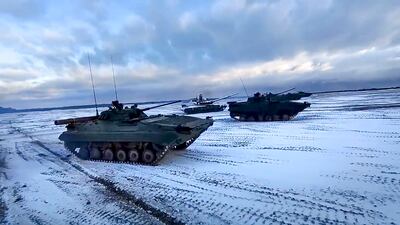
Russian and Belarus troops held joint combat training at firing ranges in Belarus as tensions remain high under the looming threat of war with Ukraine. AP Photo -
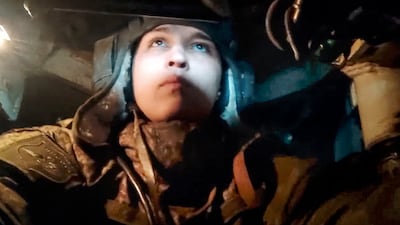
A soldier drives an armoured vehicle at Brestsky firing range, Belarus. AP Photo -
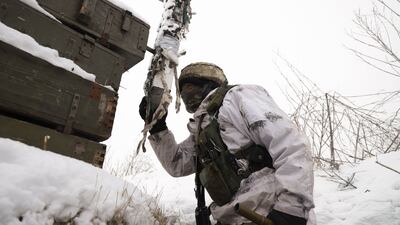
A Ukrainian serviceman carries out checks not far from the pro-Russian militant-controlled city of Donetsk, Ukraine. EPA -
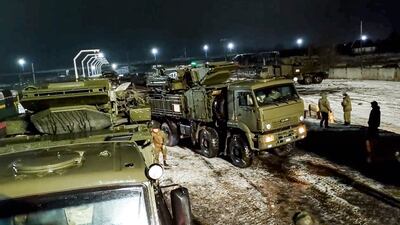
A Russian military vehicle drives off a railway platform after arriving in Belarus. AP Photo -
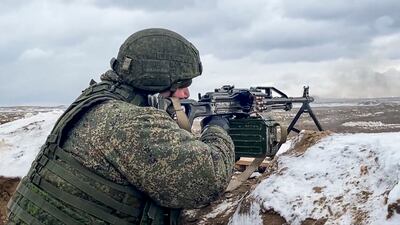
A soldier takes aim during a Russian and Belarusian military drill at Brestsky firing range. AP Photo -

A Ukrainian serviceman repairs a shelter near Donetsk, Ukraine. EPA -
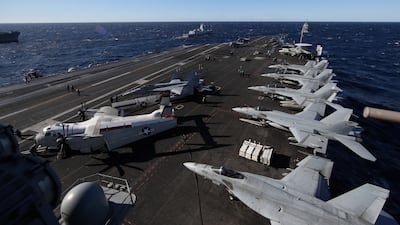
Aircraft are lined up on 'USS Harry S Truman' in the Adriatic Sea. The Truman strike group is operating under Nato command and control along with several other Nato allies for co-ordinated maritime manoeuvres, anti-submarine warfare training and long-range training. Reuters -
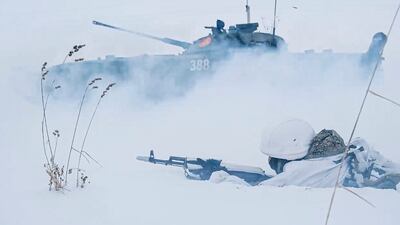
Russian soldiers attend the Yurginsky training ground in the Kemerovo region, Russia. AP Photo -
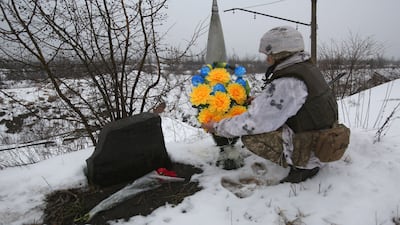
A Ukrainian serviceman lays flowers where one of his friends was killed in 2017 near Avdiivka. Anatolii Stepanov / AFP -

A Ukrainian serviceman stands guard in a dugout on the frontline with the Russia-backed separatists near Avdiivka. AFP -
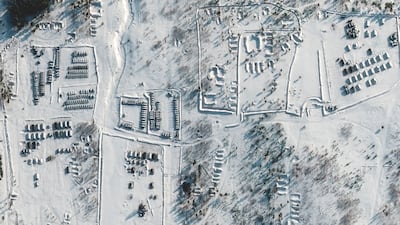
This satellite image shows troops gathered at a training ground in Pogonovo, Russia. AP Photo


German Chancellor Olaf Scholz said the West was ready to negotiate over Russia's security demands “without being naive".
“We will differentiate clearly between untenable demands and legitimate security interests,” he said.
Also speaking in Munich was European Commission President Ursula von der Leyen, who told Moscow that its thinking from “a dark past” could cost Russia a prosperous future.
“The world has been watching in disbelief as we face the largest build-up of troops on European soil since the darkest days of the Cold War, because the events of these days could reshape the entire international order,” she said.

