


Two journalists have won the Nobel Peace Prize for championing free expression under increasingly repressive conditions in the Philippines and Russia.
Maria Ressa and Dmitry Muratov were described by Nobel jurors as representing all journalists who stand up for press freedom around the world.
Ressa, this year's first female Nobel laureate, is the co-founder of investigative journalism site Rappler and has faced the threat of prison for reporting on the deadly drug war in the Philippines.
"I am in shock," she said in a Rappler broadcast after the Nobel award was announced.
Named a Time magazine person of the year in 2018, she is appealing against a libel conviction that could send her to prison for six years and was seen as a blow to media freedom in the country.
In addition to repeated legal battles, she has described receiving up to 90 hate messages an hour on Facebook because of her public profile.
Ressa, 58, uses her work to "expose abuse of power, use of violence and growing authoritarianism in her native country", said Berit Reiss-Andersen, the chairwoman of the Norwegian Nobel Committee.
The International Criminal Court approved a full investigation into possible crimes against humanity during the drugs crackdown led by Philippine President Rodrigo Duterte.
According to the Committee to Protect Journalists, 17 media workers were killed in the Philippines in the past decade and 23 in Russia.
"Ressa has shown herself to be a fearless defender of freedom of expression," Ms Reiss-Andersen said.
Muratov is the editor of Russian outlet Novaya Gazeta, described by the Nobel committee as the "most independent newspaper in Russia today".
The newspaper was set up with the help of Mikhail Gorbachev, the last leader of the Soviet Union, but has faced what activists describe as an increasingly repressive climate in Russia.
"This award raises the importance of the press in the modern world to great heights," Mr Gorbachev said in a statement. "This is good, very good news."
Antonio Guterres, the UN Secretary General, hailed the award at a time of growing violence against journalists. "I congratulate Maria Ressa and Dmitry Muratov on being awarded the 2021 Nobel Peace Prize," he said. "Throughout the world, a free press is essential for peace, justice, sustainable development and human rights — and the cornerstone for building fair and impartial institutions."
The newspaper has published articles criticising Russian authorities for alleged corruption, electoral fraud, police violence and secretive interventions abroad.
Six of the newspaper's journalists have been killed since 1993, Ms Reiss-Andersen said, and others have faced harassment, threats and violence.
"Despite the killings and threats, editor-in-chief Muratov has refused to abandon the newspaper’s independent policy," she said. "He has consistently defended the right of journalists to write anything they want about whatever they want."
Despite the criticism of Moscow, Kremlin spokesman Dmitry Peskov offered praise for Muratov after the Nobel award. "He has consistently worked in accordance with his ideals," Mr Peskov said.
-
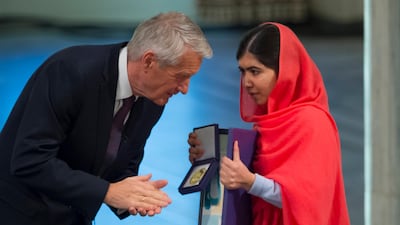
Malala Yousafzai became the youngest person to receive this prize in 2014. Getty Images -
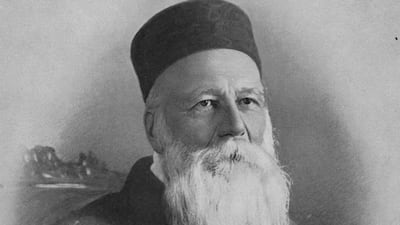
Swiss philanthropist Jean Henri Dunant was one of the first to receive the Nobel Peace Prize in 1901 for his role in the founding of the International Red Cross. Getty Images -
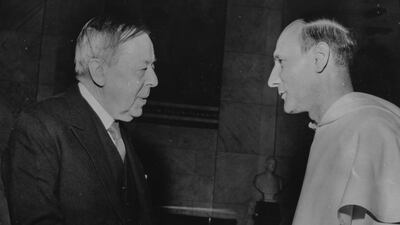
Belgian Dominican friar Dominique Pire's (right) work helping refugees in post-World War II Europe saw him receive the Nobel Peace Prize in 1958. Getty Images -
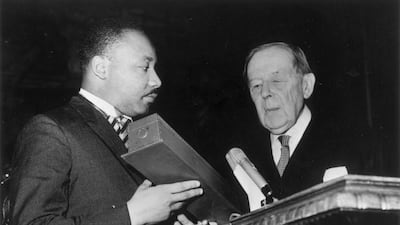
American civil rights leader Martin Luther King, Jr., left, announced that he would turn over the prize money to the furtherance of the civil rights movement. Getty Images -
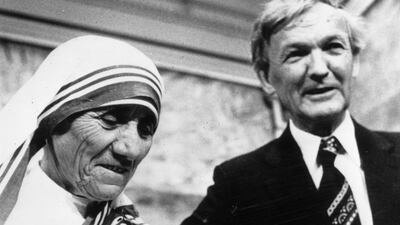
Mother Teresa was awarded the Nobel Peace Prize for her humanitarian work with the poor in 1979. Getty Images -
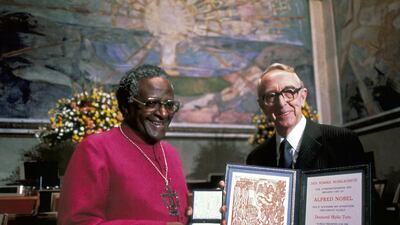
South African Archbishop Mgr Desmond Tutu, left, was honored with the Peace Prize for his opposition to apartheid. AFP -
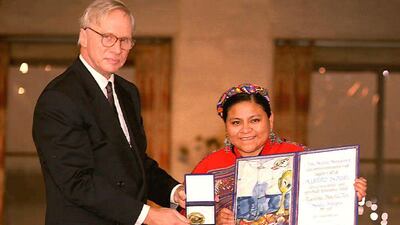
Guatemalan Indian activist Rigoberta Menchu, right, was the ninth woman to win the award. AFP -
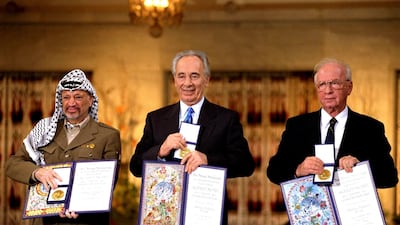
From left: Palestinian leader Yaser Arafat, Israeli Foreign Minister Shimon Peres and Israeli Prime Minister Yitzak Rabin are the joint Nobel Peace Prize winners for 1994 for their efforts to create peace in the Middle East. Getty Images -
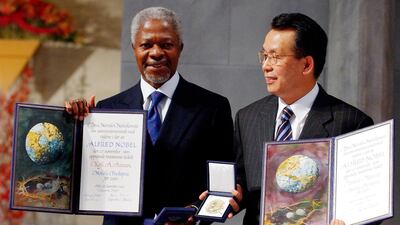
President of the UN General Assembly, South Korean Foreign Minister Han Seung-soo, right, looks at Secretary-General of the United Nations Kofi Annan at the Nobel Peace Awards in 2001. The prize was awarded to Annan for his work as secretary-general and the UN represented by Han Seung-soo. AFP -
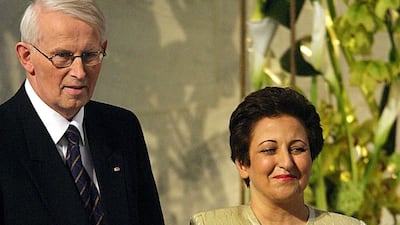
Iranian lawyer and human rights activist Shirin Ebadi, right, receives the 2003 Nobel Peace Prize for her democracy-building efforts and her work to improve human rights in Iran, making her the first Muslim woman to receive the award. AFP -

Mohamed ElBaradei, director general of the International Atomic Energy Agency, left, and Yukiya Amano, chairman of its board of governors, received the 2005 Nobel Peace Prize at a ceremony for their efforts to halt the spread of nuclear weapons. AFP -
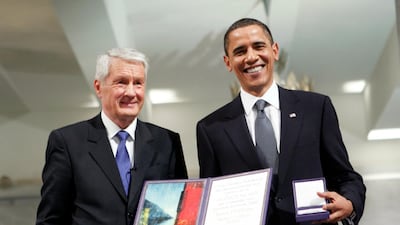
US President Barack Obama was awarded the 2009 Nobel Peace Prize "for his extraordinary efforts to strengthen international diplomacy and cooperation between peoples." AFP -

Dr. Denis Mukwege and Nadia Murad have been jointly awarded the 2018 Nobel peace prize in recognition for their efforts to end the use of sexual violence as a weapon in war. Getty Images


The peace prize is awarded to the person who has "done the most or best to advance fellowship among nations" or reduce the size of military forces, under the instructions left by Alfred Nobel.
Jurors said the Swedish benefactor's wishes for a peaceful world would not be possible without free expression and freedom of the press.
"This year’s award of the Nobel Peace Prize is therefore firmly anchored in the provisions of Alfred Nobel’s will," they said.
Christophe Deloire, the head of advocacy group Reporters Without Borders, said the Nobel award was a tribute to journalism himself.
"Journalism is in danger. Democracies are weakened by disinformation, by rumours, by hate speech," he said. "This is a time for mobilisation, for journalism, for democracy."
There were 329 nominations for this year's prize. Their names are kept secret for 50 years, meaning there was no official word on who else was in the running, although Russian activist Alexei Navalny and climate campaigner Greta Thunberg had been mentioned as contenders.
Previous winners of the prize include Pakistani education campaigner Malala Yousafzai, late South African leader Nelson Mandela and former US president Barack Obama.
The peace prize is the fifth in this year's Nobel awards season and the only one to be handed out in Norway rather than Sweden.
The medicine prize went to two biologists who shone a light on human senses. Climate change was a theme of the physics award, which was shared by three scientists.
The chemistry winners were two scientists who discovered a new way of creating molecules. Abdulrazak Gurnah, who wrote novels about the fate of refugees, won the literature prize on Thursday.

