


The terrorist attacks on Paris were “nothing personal”, the sole surviving member of the armed cell that launched the massacre said on Wednesday.
Salah Abdeslam told the court that France “knew the risks” of attacking targets in Syria and the Paris attacks in 2015 were a reaction.
Abdeslam and 19 others stand accused in the biggest trial in modern French legal history. Six of those charged will be tried in absentia over the attacks that killed at least 130 people.
“We fought France, we attacked France, we targeted the civilian population. It was nothing personal against them,” Abdeslam said.
“I know my statement may be shocking, but it is not to dig the knife deeper in the wound but to be sincere towards those who are suffering immeasurable grief.”
He insisted that he and his co-accused were not “terrorists, extremists” but “Muslims".
-
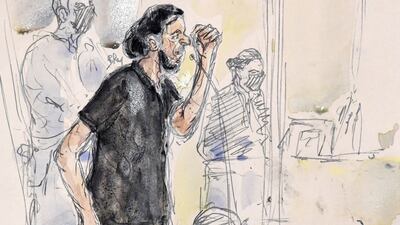
A court sketch of Salah Abdeslam during the first day of the trial of the November 2015 Paris terrorist attacks, taking place in a temporary courtroom at the Palais de Justice. AFP -

The sole survivor of the terrorist cell that carried out the November 2015 atrocity told the Paris courtroom he wanted to testify that he is being “treated like a dog” behind bars and that he would anyway be 'resuscitated' in death. Reuters -
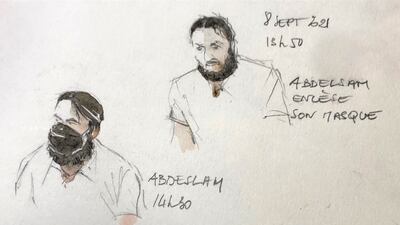
Sketches of defendant Salah Abdeslam with and without a mask in the special courtroom built for the 2015 Paris attacks trial. AP -

Abdeslam's lawyer Olivia Ronen (C) talks outside the courtroom in Paris. AP -

French police officers secure the courthouse before the arrival of the convoy transporting Abdeslam. EPA -
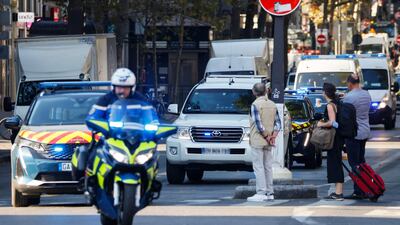
French Gendarmes escort a convoy understood to be transporting Abdeslam. AFP -

Victour Edou, the victims' lawyer, speaks to the press at the trial. EPA -
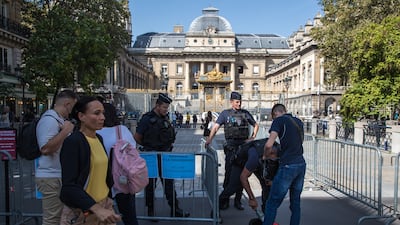
Policemen secure the access to the courthouse in Paris. EPA -

French Gendarmes stand guard outside the Palais de Justice in Paris. AFP -

Policemen arrive at the courthouse in Paris. EPA


“It's about authentic Islam,” he said.
“They say often that I'm being provocative, but it's not true, I want to be sincere. My goal is not to hurt anyone."
Abdeslam, who was arrested months after the attacks, said the assaults were a response to French air strikes in Syria and Iraq.
It was the first time in the trial that Abdeslam had addressed the court with the judges' permission.
Nine ISIS gunmen and suicide bombers struck within minutes at locations around Paris on November 13, 2015, targeting fans at the national football stadium and cafe-goers and ending at the Bataclan concert hall.
-

A person is being evacuated after a shooting, outside the Bataclan theater in Paris. A series of attacks targeting young concert-goers, soccer fans and Parisians enjoying a Friday night out at popular nightspots killed over 100 people in the deadliest violence to strike France since the Second World War. Thibault Camus/ AP Photo -

Spectators spill onto the pitch of the Stade de France stadium after three suicide bombers blew themselves up outside the stadium where France were playing Germany in an international football match. Michel Euler/AP Photo -

Spectators running onto the pitch of the Stade de France stadium amid the chaos and aftermath of suicide bombings outside the venue. Christophe Ena/AP Photo -

A victim under a blanket lays dead outside the Bataclan theatre in Paris on Nov 13, 2015, as more than 120 people were killed in a series of shooting and explosions across the French capital. Jerome Delay/AP Photo -
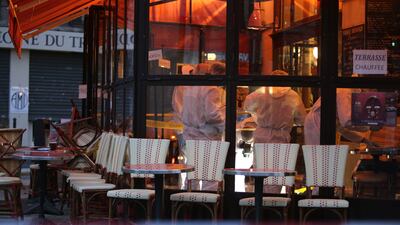
Forensic police searching for evidence inside the Comptoir Voltaire cafe at the site of an attack on November 14, 2015 in Paris, the morning after a series of gun attacks occurred across the city. Kenzo Tribouillard/AFP Photo -
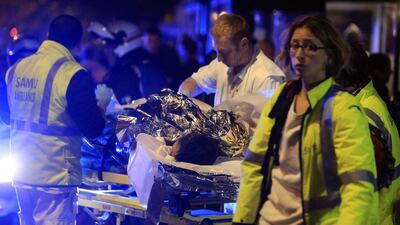
Emergency workers tending to the injured outside the Bataclan theatre. Thibault Camus/AP Photo -
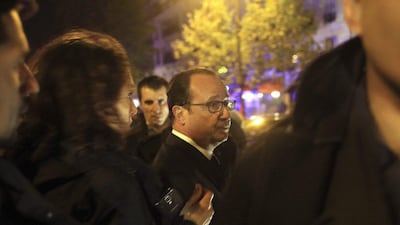
French president Francois Hollande, who declared a state of emergency and announced that he was closing the country's borders, arrives to visit the site of the the Bataclan theatre after the maasacre. Thibault Camus/AP Photo -

Investigators search for clues outside the Stade de France stadium after an explosion and after a friendly soccer match between France and Germany, in Saint Denis, outside Paris, early Saturday Nov 14, 2015. Michel Spingler/ AP Photo -
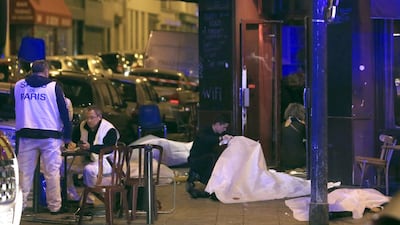
Victims lay on the pavement outside a Paris restaurant. Thibault Camus/AP Photo -
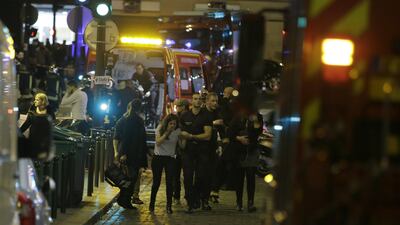
French security moving people in the area of Rue Bichat in the 10th arrondissement of the French capital Paris following a string of attacks on November 13, 2015. At least 18 people were killed as multiple shootings and explosions hit Paris, police said. Police also said there was an ongoing hostage crisis in the Bataclan a concert hall in the French capital.Kenzo Tribouillard/AFP Photo -
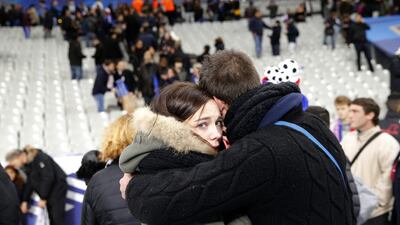
A man comforts a woman after spectators poured onto the pitch of the Stade de France stadium after multiple explosions outside. Christophe Ena/AP Photo


It was the deadliest violence to strike France since the Second World War.
Observers are hoping Abdeslam, who declined to remove his mask as he spoke in the custom-built courtroom, will offer new details of the attack.
A photo of the car he abandoned in northern Paris, after dropping off three suicide bombers at the Stade de France, was shown to the court.
Two people he called upon to drive through the night from Brussels to Paris to pick him up are among the 20 on trial.
The trial is expected to last until May 2022, with 145 days of scheduled hearings involving about 330 lawyers.
The same network struck the airport and subway system in Brussels in March 2016, killing 32 people.
Among those on trial in Paris is Mohammed Abrini, who left the city the night before the 2015 attack and took part in the Brussels assaults.
A French investigator told the court: “The sentiment we had that evening at the Bataclan was one of failure … I’m not sure we had the means to prevent everything. But when we went into the Bataclan that was the feeling."

