


After escaping Kabul, some of the Afghans airlifted to Germany have been sheltered in much-criticised asylum facilities fenced off by barbed wire.
The so-called “anchor centres” were introduced in 2018 to process asylum seekers and house them until they are admitted or deported.
Activists have described poor living conditions in the camps, with concerns about privacy and tensions between residents and police.
One of the camps is in Bamberg, southern Germany, on the site of a former US Army base. Nearly 100 Afghans have been housed there since the fall of Kabul.
“Our willingness to help seems to end at the barbed-wire fences of the anchor centres,” said the Bavarian Refugee Council, an advocacy group, which criticised the use of the camps.
It described them as places of limited medical facilities and “marginalisation through checks, fences and steel gates”.
“We unfortunately have to expect that this will not allow people to recover from the terrible events of recent weeks, but rather lead to further trauma,” the council said.
Another activist group called the Centre for Political Beauty mocked the state's efforts to welcome Afghans, saying: “Thanks for your help, welcome to Bavaria, here is your cage!”
Visiting the centre, Bavarian Interior Minister Joachim Herrmann said some Afghans at the camp had already had their asylum applications approved.
Others are waiting for a decision. Germany suspended deportations to Afghanistan shortly before the fall of Kabul.
Officials said the state government was doing its best to provide accommodation and would “do everything” to integrate the new arrivals.
“There cannot be any talk of us reaching the limits of our capacity to take people in,” Mr Herrmann said.
-
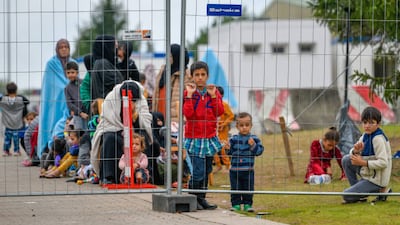
Recently-arrived refugees from Afghanistan are seen at a camp at the US Army's Rhine Ordnance Barracks, where they are being temporarily housed, in Kaiserslautern, Germany. Getty Images -
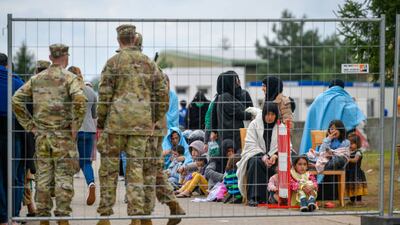
Refugees at the Rhine Ordnance Barracks. Several US military facilities with the capacity to house up to several thousand evacuees are participating in an operation called Operation Allied Refuge. Getty Images -
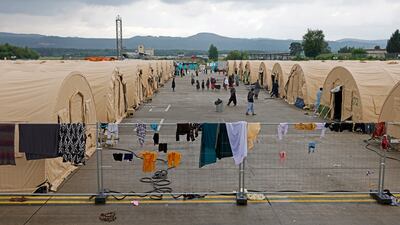
Evacuees from Afghanistan at the US Air Base in Ramstein, Germany. Ramstein Air Base is serving as major hub in the operation to evacuate people from Afghanistan. EPA -

Afghan refugees receive Covid-19 vaccine shots in an Italian Red Cross refugee camp, in Avezzano, Italy. AP -

Afghan refugees listen to instructions before getting Covid-19 vaccine shots at the camp in Avezzano. AP -
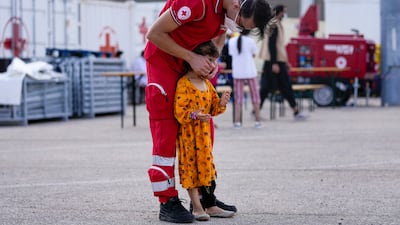
This quarantine camp in Abruzzo, central Italy, where 1,250 migrants are hosted, is expected to close in a week as the quarantine expires and they are moved to other structures to apply for asylum. AP -
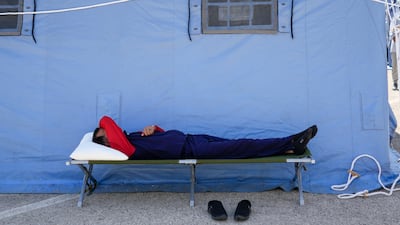
An Afghan refugee rests in the Italian Red Cross refugee camp, in Avezzano. AP -
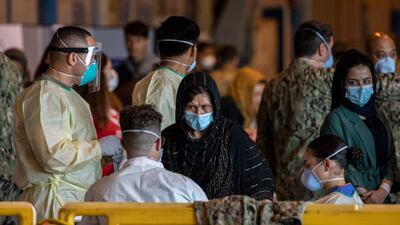
Health workers prepare to perform Covid-19 tests for Afghan evacuees after disembarking from a US Air Force plane at Rota Naval Base in Spain. Getty Images -
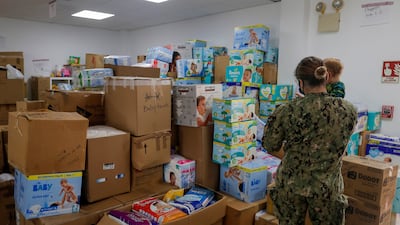
A US navy sailor stands next to boxes containing nappies and towels for Afghan children, who have been evacuated from Kabul, in Rota, southern Spain. Reuters -
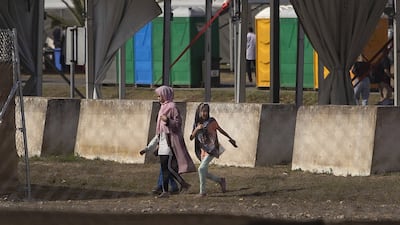
Afghans are seen at Rota naval base in Spain. A temporary camp has been set up to host evacuees from Afghanistan with 53 tents with capacity for almost 1,600 people, although it is expected to be enlarged to host up to 3,000 people. EPA -
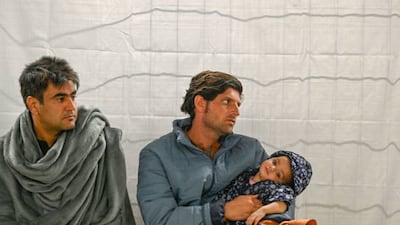
Recently-arrived refugees from Afghanistan wait for medical support at a temporary camp at the US Army's Rhine Ordnance Barracks, where they are being temporarily housed. Getty Images -
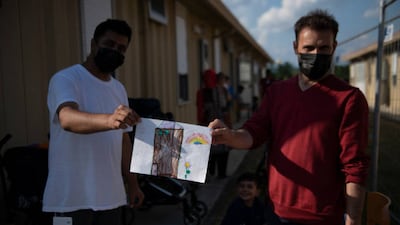
Afghan evacuees show a child's drawing at the Luigi Fenoglio Refugee Center in Settimo Torinese, managed by the Italian Red Cross. Getty Images -
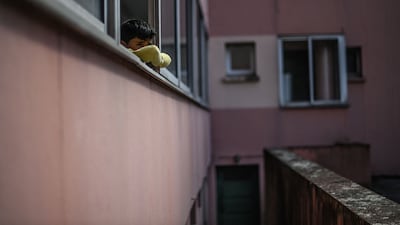
A boy looks out of a window near Lyon, France, as Afghan refugee families arrived after their evacuation from Kabul. AFP


Germany’s government has been criticised for failing to rescue more of its Afghan staff in the months before the fall of Kabul.
About 2,000 evacuees have been airlifted to Germany, but about 600 people who worked for Nato forces are still thought to be in Afghanistan.
“We are doing our utmost to bring them to safety,” Germany’s Defence Ministry said on Thursday.
Refugees will be given an initial three-year residency permit, which could be renewed if they are still thought to be in danger.
The permit allows them to work in Germany, get social security payments and send their children to schools and kindergartens.
The anchor centres were agreed in a coalition deal that followed the 2017 general election in Germany.
The election saw the far-right Alternative for Germany (AfD) party surge into parliament in a backlash against Chancellor Angela Merkel’s refugee policies.
A report by Germany’s Migration Ministry this year said the camps had helped to make the asylum process more efficient.
Asylum seekers with children are not meant to stay at the camps for more than six months, while adults can stay for up to two years.

