• The sprawling cemetery of Wadi Al Salam in the holy city of Najaf, where Ayatollah Mohammad Sadiq Al Sadr is burried.
    The sprawling cemetery of Wadi Al Salam in the holy city of Najaf, where Ayatollah Mohammad Sadiq Al Sadr is burried.
  • Graves at Wadi Al Salam in Najaf, May 25, 2020. AFP
    Graves at Wadi Al Salam in Najaf, May 25, 2020. AFP
  • A general view of the almost empty "Valley of Peace" cemetery after coronavirus lockdown measures to contain the coronavirus in the holy city of Najaf. REUTERS
    A general view of the almost empty "Valley of Peace" cemetery after coronavirus lockdown measures to contain the coronavirus in the holy city of Najaf. REUTERS
  • Former opposition leader Ayatollah Mohammad Baqir Al Hakim, assassinated in 2003, after the toppling of Saddam Hussein, and buried in Wadi Al Salam. Reuters
    Former opposition leader Ayatollah Mohammad Baqir Al Hakim, assassinated in 2003, after the toppling of Saddam Hussein, and buried in Wadi Al Salam. Reuters
  • Ayatollah Mohammed Baqer Al Sadr, executed by Saddam Hussein in 1980. Alamy
    Ayatollah Mohammed Baqer Al Sadr, executed by Saddam Hussein in 1980. Alamy
  • Mohammed Sadiq Al Sadr, killed by Saddam's agents in 1999. Mohammed Sadiq was the father of Moqtada Al Sadr, king maker in Iraqi politics. Alamy
    Mohammed Sadiq Al Sadr, killed by Saddam's agents in 1999. Mohammed Sadiq was the father of Moqtada Al Sadr, king maker in Iraqi politics. Alamy
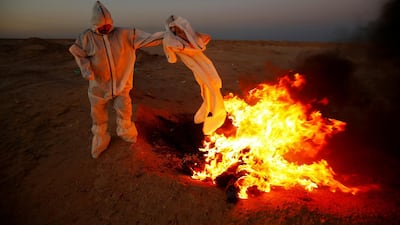
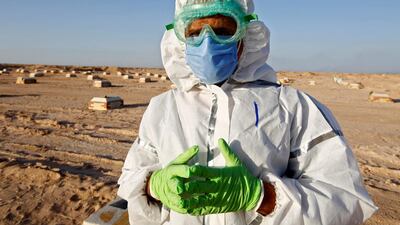
  • A member of the Popular Mobilization Forces (PMF), who volunteered to work in a cemetery wears a protective suit as he burns clothes used for burial of Covid-19 patients near the new Wadi Al-Salam cemetery, which is dedicated to those who died of the coronavirus disease. REUTERS
    A member of the Popular Mobilization Forces (PMF), who volunteered to work in a cemetery wears a protective suit as he burns clothes used for burial of Covid-19 patients near the new Wadi Al-Salam cemetery, which is dedicated to those who died of the coronavirus disease. REUTERS
  • A man mourns at the grave of Iraqi paramilitary commander Abu Mahdi Al Muhandis at the Wadi Al Salam cemetery in the Iraq. AFP
    A man mourns at the grave of Iraqi paramilitary commander Abu Mahdi Al Muhandis at the Wadi Al Salam cemetery in the Iraq. AFP
  • Shiite pilgrims walk outside the shrine of Imam Ali in Najaf, Iraq. AP
    Shiite pilgrims walk outside the shrine of Imam Ali in Najaf, Iraq. AP
  • Najaf, after the outbreak of the coronavirus pandemic, on March 31, 2020. Reuters
    Najaf, after the outbreak of the coronavirus pandemic, on March 31, 2020. Reuters
  • A Shiite Muslim man wears a protective face mask as he walks next to religious books during the holy month of Ramadan in Najaf. Reuters
    A Shiite Muslim man wears a protective face mask as he walks next to religious books during the holy month of Ramadan in Najaf. Reuters
  • Members of the civil defence spray disinfectant to sanitise surrounding of the Kufa mosque in Najaf. Reuters
    Members of the civil defence spray disinfectant to sanitise surrounding of the Kufa mosque in Najaf. Reuters
  • Iraqi medical workers disinfect a ward at the Hakim Hospital in Najaf. AFP
    Iraqi medical workers disinfect a ward at the Hakim Hospital in Najaf. AFP
  • A member of the Iraqi civil defence sprays disinfectant on and around a building where Islamic students are quarantined for having had contact with Iraq's first confirmed case of novel coronavirus infection in the central Najaf on February 26, 2020. AFP
    A member of the Iraqi civil defence sprays disinfectant on and around a building where Islamic students are quarantined for having had contact with Iraq's first confirmed case of novel coronavirus infection in the central Najaf on February 26, 2020. AFP
  • A woman sews a protective suit at a factory in Najaf, Iraq. Less than 15 per cent of women are part of the Iraqi workforce. Reuters
    A woman sews a protective suit at a factory in Najaf, Iraq. Less than 15 per cent of women are part of the Iraqi workforce. Reuters
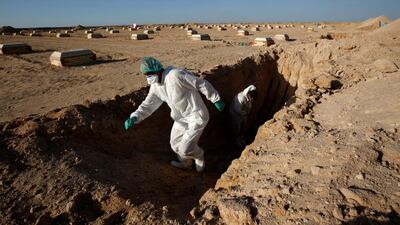
  • An Iraqi man in a hazmat suit mourns over a tombstone at a cemetery for COVID-19 victims, 20 km from the central Iraqi holy city of Najaf. AFP
    An Iraqi man in a hazmat suit mourns over a tombstone at a cemetery for COVID-19 victims, 20 km from the central Iraqi holy city of Najaf. AFP
  • An aerial picture taken with a drone shows graves of victims who died with coronavirus at a cemetery in the holy city of Najaf, southern Iraq. EPA
    An aerial picture taken with a drone shows graves of victims who died with coronavirus at a cemetery in the holy city of Najaf, southern Iraq. EPA
  • An aerial picture taken with a drone shows members of Iraqi Shiite group Imam Ali Brigades, which belongs to Shiite Popular Mobilization Forces, preparing to bury victims who died with coronavirus, at a cemetery in the holy city of Najaf, southern Iraq. EPA
    An aerial picture taken with a drone shows members of Iraqi Shiite group Imam Ali Brigades, which belongs to Shiite Popular Mobilization Forces, preparing to bury victims who died with coronavirus, at a cemetery in the holy city of Najaf, southern Iraq. EPA

Coronavirus: world’s largest cemetery thrust to centre of Iraq’s fight against pandemic


Khaled Yacoub Oweis
  • English
  • Arabic

A rift about Shiite burials while Iraq experiences a spike in coronavirus deaths has highlighted how religious disputes and politics are undermining efforts to contain the pandemic.

The split centres on the Wadi Al Salam (Valley of Peace), a sprawling cemetery in the holy city of Najaf. It is the most coveted resting place for Shiites from around the world and believed to be the biggest cemetery in the world, with millions of bodies within its perimeter.

On one side are doctrinaire adherents who are encouraging burials at the cemetery in the parched lands on the edge of Najaf, despite movement bans designed to contain the coronavirus.

On the other are their more pragmatically inclined fellow believers who are concerned about what they say is a pandemic that is becoming unmanageable, with corruption rampant in the public health system and the rest of the bureaucracy.

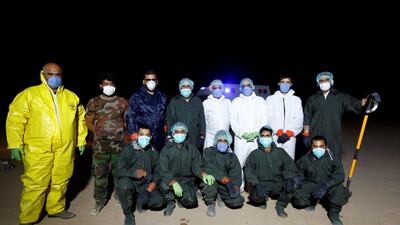
  • Members of the Popular Mobilization Forces, and Shiite students of Al Hawza Al Ilmiyya, who volunteered to work at the cemetery, wear protective suits as they pose for a group photo at the new Wadi Al Salam cemetery dedicated to those who died of coronavirus disease, on the outskirts of the holy city of Najaf. REUTERS
    Members of the Popular Mobilization Forces, and Shiite students of Al Hawza Al Ilmiyya, who volunteered to work at the cemetery, wear protective suits as they pose for a group photo at the new Wadi Al Salam cemetery dedicated to those who died of coronavirus disease, on the outskirts of the holy city of Najaf. REUTERS
  • Abdelhussan Kadhim, from the PMF, who volunteered to work in the cemetery, wearing a protective suit, reads a verse from the Koran near the coffin of a man who passed away due to coronavirus, during his burial at the new Wadi Al Salam cemetery, which is dedicated to those who died of COVID-19, on the outskirts of the holy city of Najaf. REUTERS
    Abdelhussan Kadhim, from the PMF, who volunteered to work in the cemetery, wearing a protective suit, reads a verse from the Koran near the coffin of a man who passed away due to coronavirus, during his burial at the new Wadi Al Salam cemetery, which is dedicated to those who died of COVID-19, on the outskirts of the holy city of Najaf. REUTERS
  • A member of the PMF, who volunteered to work in a cemetery, wears a protective suit, as he burns clothes they used for burial. REUTERS
    A member of the PMF, who volunteered to work in a cemetery, wears a protective suit, as he burns clothes they used for burial. REUTERS
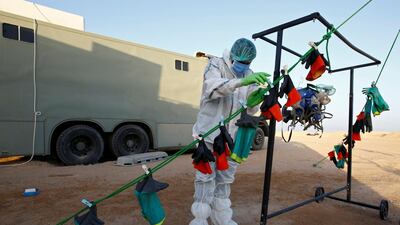
  • A member of the PMF, who volunteered to work in the cemetery, wears a protective suit as he hangs masks and gloves to dry them after sterilization at the new Wadi Al Salam cemetery for those who died of Covid-19). REUTERS
    A member of the PMF, who volunteered to work in the cemetery, wears a protective suit as he hangs masks and gloves to dry them after sterilization at the new Wadi Al Salam cemetery for those who died of Covid-19). REUTERS
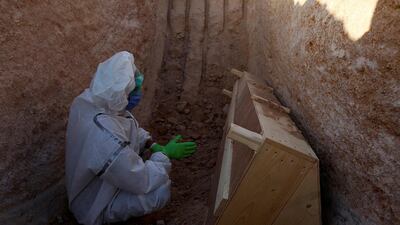
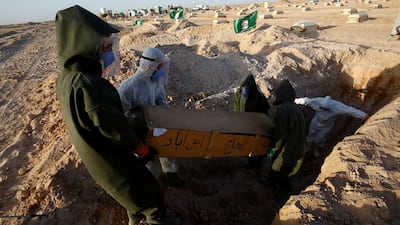
  • Members of the PMF, who volunteered to work at the cemetery, wear protective suits as they bury the coffin of a man who passed away due to coronavirus disease. REUTERS
    Members of the PMF, who volunteered to work at the cemetery, wear protective suits as they bury the coffin of a man who passed away due to coronavirus disease. REUTERS
  • Abdelhussan Kadhim, from the PMF, who volunteered to work in the cemetery, wearing a protective suit, takes a rest at the new Wadi Al Salam cemetery, which is dedicated to those who died of the coronavirus disease. REUTERS
    Abdelhussan Kadhim, from the PMF, who volunteered to work in the cemetery, wearing a protective suit, takes a rest at the new Wadi Al Salam cemetery, which is dedicated to those who died of the coronavirus disease. REUTERS
  • Abdelhussan Kadhim, from the PMF, who volunteered to work in the cemetery, wears his protective suit, at new Wadi Al Salam cemetery, which is dedicated to those who died of the coronavirus disease. REUTERS
    Abdelhussan Kadhim, from the PMF, who volunteered to work in the cemetery, wears his protective suit, at new Wadi Al Salam cemetery, which is dedicated to those who died of the coronavirus disease. REUTERS
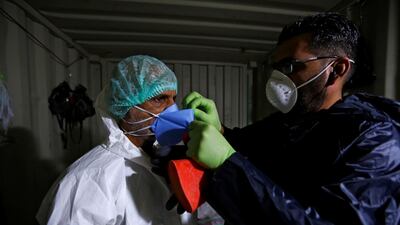
  • Abdelhussan Kadhim, from the PMF, who volunteered to work in the cemetery, gets help from his fellow to put on his protective mask. REUTERS
    Abdelhussan Kadhim, from the PMF, who volunteered to work in the cemetery, gets help from his fellow to put on his protective mask. REUTERS
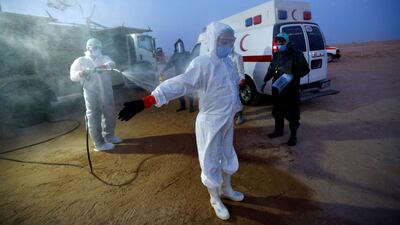
  • Abdelhussan Kadhim from the PMF, who volunteered to work at the cemetery, wears a protective suit as he is disinfected after the burial of a man who passed away due to coronavirus. REUTERS
    Abdelhussan Kadhim from the PMF, who volunteered to work at the cemetery, wears a protective suit as he is disinfected after the burial of a man who passed away due to coronavirus. REUTERS
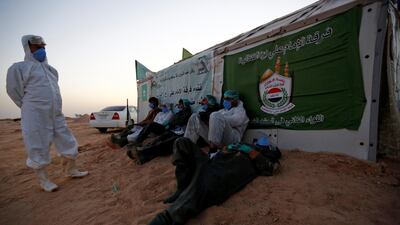
  • Abdelhussan Kadhim from the PMF, who volunteered to work at the cemetery, wears a protective suit as he stands next to fellow volunteers as they take a rest at the new Wadi Al Salam cemetery. REUTERS
    Abdelhussan Kadhim from the PMF, who volunteered to work at the cemetery, wears a protective suit as he stands next to fellow volunteers as they take a rest at the new Wadi Al Salam cemetery. REUTERS
  • Abdelhussan Kadhim, from the PMF, who volunteered to work in the cemetery, wearing a protective suit and poses for the camera at the new Wadi Al Salam cemetery for those who died of the coronavirus. Reuters
    Abdelhussan Kadhim, from the PMF, who volunteered to work in the cemetery, wearing a protective suit and poses for the camera at the new Wadi Al Salam cemetery for those who died of the coronavirus. Reuters
  • Members of the PMF, who volunteered to work in the cemetery, wearing a protective suit as he checks a grave before burial at new Wadi Al Salam cemetery. REUTERS
    Members of the PMF, who volunteered to work in the cemetery, wearing a protective suit as he checks a grave before burial at new Wadi Al Salam cemetery. REUTERS

Iraq has officially registered 1,839 deaths from the pandemic, mostly in the past several weeks, and 47,151 cases. But official figures are widely believed to represent only a fraction of the real number of infections and deaths.

A partial border shutdown since March sharply reduced outside traffic to the cemetery. The site contains the remains of Shiite theologians, politicians and businessmen from through the centuries, along with less-known people from all walks of life.

There remains significant demand for burial at Wadi Al Salam from inside Iraq.

A Shiite-dominated militia grouping announced on Sunday that its cadres transferred 49 bodies of people who died from the coronavirus in hospitals across Iraq to Najaf.

Data released by the Popular Mobilisation Forces, or the Hashed, as the militias are known, showed that 14 of the 49 came from slums in Baghdad.

A health ministry spokesman earlier this month singled out the same districts as being responsible for the worst breaches of a curfew in the capital.

Moqtada Al Sadr delivers a speech to his supporters. AFP

But Najaf governor Louay Al Yasiri told official media on Sunday that the dead should be laid to rest in their home regions, blaming burials at Wadi Al Salam for spreading infections in the city.

Mr Al Yasiri said that 160 out of 1,795 medical personnel in Najaf have been infected with the coronavirus.

“This is a dangerous proportion. A main reason behind the rise of cases is open provincial borders and allowing the bodies of the infected and those travelling with them to enter Najaf to bury them,” Mr Al Yasiri said, without mentioning the militias specifically.

The Hashed has sought to improve its image among impoverished Shiites, who constituted the core of the Iraqi uprising against the entire political class that broke out in October, 2019.

Militias in the Hashed and security forces partnered to mow down peaceful demonstrators and crush the uprising, citing earlier this year the coronavirus as a reason behind the crackdown.

One of the most prominent figures buried in Wadi Al Salam is ayatollah Mohammed Baqer Al Sadr, a Shiite theologian whose work focused on a synthesis between Islam and modern science as well as Islam and democracy.

Ayatollah Ruhollah Khomeini called Al Sadr “our university”. Saddam Hussein executed Al Sadr after Khomeini made public a letter from Al Sadr congratulating Khomeini on the 1979 revolution, although the two Shiite figures were not in sync ideologically.

A cousin of Al Sadr, assassinated by Saddam's agents in 1999, was ayatollah Mohammed Sadiq Al Sadr, father of Moqtada Al Sadr, the Shiite cleric who for the past decade has been kingmaker of Iraqi politics and who supported the crackdown on Iraq's protest movement. His father too is buried in Wadi Al Salam.

Moqtada, however, is known as a more political operator than his non-violent forbears.

His position on the coronavirus has alternated between urging his followers to ignore measures by the authorities to expressions of support for social distancing.

On the 21st anniversary of the assassination of his father last week, he called off marches to his grave in Wadi Al Salam to mark the occasion, drawing praise from Mr Al Yasiri, the Najaf governor.

His decision, the governor said, was “an initiative to preserve society from this dreaded pandemic”.