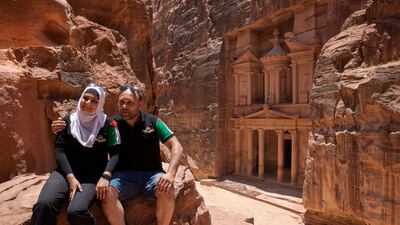
Jordan will reopen its airport next month to commercial flights from 10 countries deemed to have “low-risk” coronavirus levels, a government spokesman said.
Amjad Al Adayleh told the official news agency that a list of “green countries” from which flights will be allowed into Queen Alia International Airport, the kingdom’s main airport south of Amman, include Austria, Switzerland, Germany, Italy, Greece, Cyprus, Hong Kong and Thailand.
No date has been set for the reopening, he said.
Mr Al Adayleh said any resident or national of the 10 countries “with a low risk pandemic situation will be allowed entry into Jordan”.
Travellers from these destinations will not be subjected to quarantine so long as they have undergone a Covid-19 test 72 hours prior to arrival, he said.
Mr Al Adayleh said that Jordan is a “moderate risk” country, citing continued infections from within the kingdom.
He said a major indicator of whether the coronavirus risk in Jordan could decrease would be 10 days passing without recording a single case traced to local sources of infection.
“The danger is still there despite recording a limited number of local cases lately,” Mr Al Adayleh said.
Jordan lifted most coronavirus-related bans last month but an overnight curfew remains in place and gatherings of more than 20 people are not allowed. The government said this week that schools would be allowed to reopen in September.
Official data shows that 1,200 people have been infected with the coronavirus in Jordan and 10 deaths have been recorded.
-
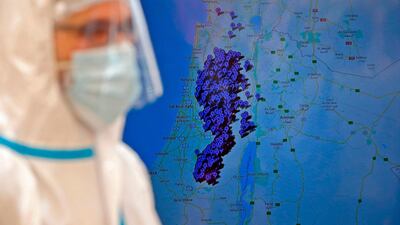
A doctor from the Palestinian ministry of health stands next to a map tracking the location of people infected with the coronavirus, in Hebron in the occupied West Bank. AFP -
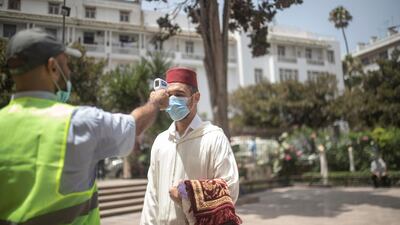
A worker checks the temperature of people who are going to pray at a mosque in Rabat, Morocco. With the exception of Friday prayer, mosques reopened for the first time since their closure in March following the coronavirus outbreak. AP Photo -

A Palestinian youth sells sweets by the beach in Gaza City as coronavirus restriction eases. AFP -
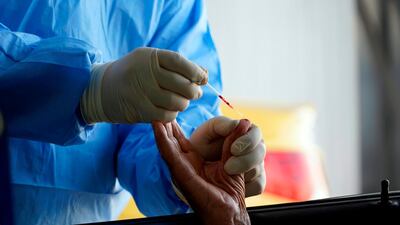
A health worker conducts a coronavirus test at a drive-through testing centre in the central Iraqi city of Najaf. AFP -
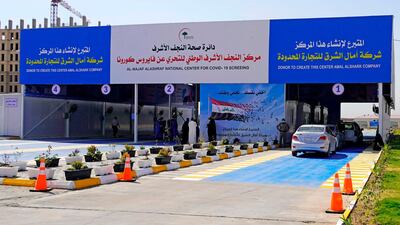
A drive-through testing facility for coronavirus in the central Iraqi city of Najaf. AFP -
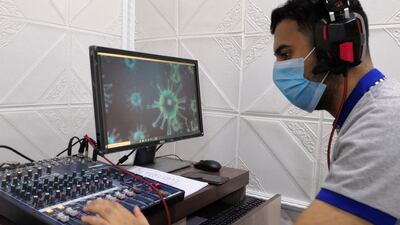
An employee from the ministry of health during a radio broadcast that offers advice about the coronavirus precautionary measures at a radio station in Basra, Iraq. Reuters -
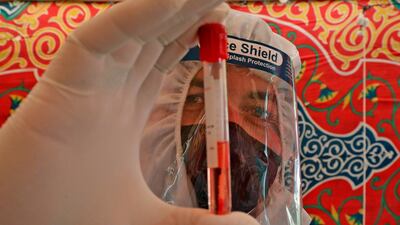
A doctor displays a blood sample taken from a person suspected of being infected with the coronavirus in Hebron in the occupied West Bank. AFP -
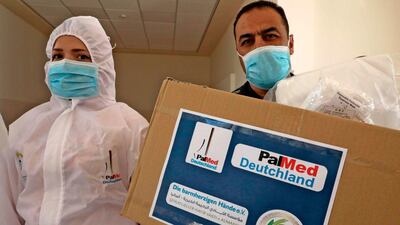
Dr Issam Mujahed, right, a member of the Pal-Med Europe, presents medical donations to doctors battling the coronavirus in Hebron in the occupied West Bank. AFP -

A Palestinian man rides a bicycle with his child in Gaza City as coronavirus lockdown eases. AFP -
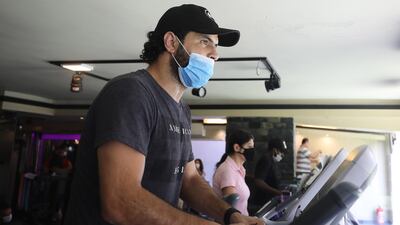
People training at a gym after its reopening in Cairo, Egypt. EPA -
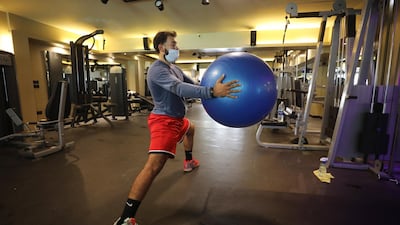
People train at a gym after its reopening in Cairo, Egypt. EPA -

A policeman wears a face mask as he reviews the passport of a traveller at Mohammed V International Airport in Casablanca, Morocco. AP Photo



