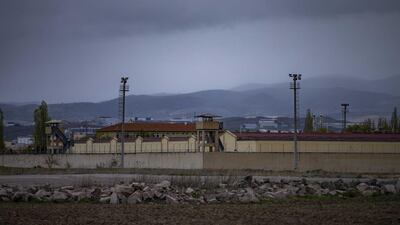
The Sincan prison complex in Ankara, Turkey, where hundreds of people are being tried for their alleged involvement in a 2016 coup attempt. Anadolu Agency via Getty Images

Core Turkish coup plotters handed life sentences in mass trial of military


  • English
  • Arabic

Hundreds of accused coup plotters were jailed on Thursday as the largest trial related to Turkey’s bloody failed 2016 putsch came to an end.

The trial of 475 defendants at Sincan prison complex on the outskirts of Ankara for their involvement in trying to overthrow President Recep Tayyip Erdogan began three years ago.

Prison sentences ranged from life without parole for those convicted of attempting to overthrow the constitutional order, murder and attempting to assassinate Mr Erdogan to six years for lesser charges. Seventy defendants were acquitted.

Known as the “Akinci base case” after the military airfield outside the Turkish capital that served as the headquarters for the coup on the night of July 15, the trial had been delayed due to the coronavirus outbreak.

From Akinci, F-16 jets and helicopters took off to bomb Turkey’s parliament, the presidential palace and police headquarters. Civilians were also gunned down in the street as they resisted the soldiers.

Although he is already in office, Mr Erdogan frequently holds mass rallies, such as this one in Kahramanmaras , for his supporters. AP Photo

Senior military figures who refused to go along with the plot, such as then chief of general staff Hulusi Akar, now Turkey’s defence minister, were also held at the base.

The case was just one of nearly 300 that have been held to prosecute those suspected of involvement in the coup through their accused ties to a religious sect that has spread across the world and which Ankara holds responsible for the failed putsch.

Led by Fethullah Gulen, a former imam who has lived in the US since 1999, the movement has been labelled the Fethullahist Terrorist Organisation, or Feto, by the Turkish authorities.

The group is said to have infiltrated state institutions, including the judiciary, police and military, over many years in a bid to seize power.

Critics of the government have said it has used the failed coup as an excuse to weed out dissent in Turkey. More than 91,000 people have been jailed and some 150,000 dismissed or suspended from their jobs over alleged Feto links.

Aykan Erdemir, a former Turkish MP and senior director of the Turkey programme at the Foundation for Defence of Democracies, said the case demonstrated “significant shortcomings in due process” and had been used to “settle partisan scores”.

“This was a missed opportunity for strengthening the rule of law and improving civil-military relations by ensuring greater transparency and accountability in the Turkish armed forces,” he added.

The defendants on Thursday consisted of 471 former military members as well as four civilians accused of acting as the handlers to Gulenists in the armed forces.

The plaintiffs in the case included Mr Erdogan, MPs, generals targeted by the conspiracy as well as the families of those killed during the coup.

The trial was split between two cavernous halls, with victims’ relatives and others observing proceedings in the second room via a video link.

More than 250 people were killed and some 2,200 wounded on the night of the coup as rogue military units were mobilised in Ankara and Istanbul. Some 30 coup plotters were killed.

A helicopter-borne group of commandos was also ordered to kill or capture Mr Erdogan as he holidayed on the Mediterranean coast but he left minutes before they arrived.

A 4,600-page indictment claimed plans for the coup began after elections the previous year. The four civilians – Kemal Batmaz, Hakan Cicek, Harun Bitis and Nurrettin Oruc – were said to be the core group of plotters, as well as a fifth, Adil Oksuz, who remains at large.

All were captured at or nearby Akinci the morning after the coup. Mr Oksuz escaped after he was released from custody by a judge.

Nineteen defendants, including the four “civilian imams”, generals and F-16 pilots received 79 aggravated life sentences each, according to state-run Anadolu news agency.

The pilots included those who bombed parliament, a TV facility, police bases and the presidential palace in Ankara. The 19 were responsible for the deaths of 77 people killed by ground fire or aerial attacks.

A total of 337 other defendants received life sentences while the remainder received jail terms between six and 16 years.

Mr Gulen, who was tried in absentia, is alleged to be the mastermind of the coup, with Mr Oksuz and Mr Batmaz his chief lieutenants in Turkey. Mr Gulen has denied any involvement and the US has refused to extradite him.

The trial heard from witnesses, listened to control tower recordings and saw video footage from the base that showed senior military officers deferring to the civilian defendants.

Former air force commander Akin Ozturk would have led a post-coup administration to run the country under the title Peace at Home Council. He had claimed he was visiting Akinci on the night of the coup to visit his grandchildren, whose father was an air force officer also involved in the plot.


UPI facts

More than 2.2 million Indian tourists arrived in UAE in 2023
More than 3.5 million Indians reside in UAE
Indian tourists can make purchases in UAE using rupee accounts in India through QR-code-based UPI real-time payment systems
Indian residents in UAE can use their non-resident NRO and NRE accounts held in Indian banks linked to a UAE mobile number for UPI transactions

Ten tax points to be aware of in 2026

1. Domestic VAT refund amendments: request your refund within five years

If a business does not apply for the refund on time, they lose their credit.

2. E-invoicing in the UAE

Businesses should continue preparing for the implementation of e-invoicing in the UAE, with 2026 a preparation and transition period ahead of phased mandatory adoption. 

3. More tax audits

Tax authorities are increasingly using data already available across multiple filings to identify audit risks. 

4. More beneficial VAT and excise tax penalty regime

Tax disputes are expected to become more frequent and more structured, with clearer administrative objection and appeal processes. The UAE has adopted a new penalty regime for VAT and excise disputes, which now mirrors the penalty regime for corporate tax.

5. Greater emphasis on statutory audit

There is a greater need for the accuracy of financial statements. The International Financial Reporting Standards standards need to be strictly adhered to and, as a result, the quality of the audits will need to increase.

6. Further transfer pricing enforcement

Transfer pricing enforcement, which refers to the practice of establishing prices for internal transactions between related entities, is expected to broaden in scope. The UAE will shortly open the possibility to negotiate advance pricing agreements, or essentially rulings for transfer pricing purposes. 

7. Limited time periods for audits

Recent amendments also introduce a default five-year limitation period for tax audits and assessments, subject to specific statutory exceptions. While the standard audit and assessment period is five years, this may be extended to up to 15 years in cases involving fraud or tax evasion. 

8. Pillar 2 implementation 

Many multinational groups will begin to feel the practical effect of the Domestic Minimum Top-Up Tax (DMTT), the UAE's implementation of the OECD’s global minimum tax under Pillar 2. While the rules apply for financial years starting on or after January 1, 2025, it is 2026 that marks the transition to an operational phase.

9. Reduced compliance obligations for imported goods and services

Businesses that apply the reverse-charge mechanism for VAT purposes in the UAE may benefit from reduced compliance obligations. 

10. Substance and CbC reporting focus

Tax authorities are expected to continue strengthening the enforcement of economic substance and Country-by-Country (CbC) reporting frameworks. In the UAE, these regimes are increasingly being used as risk-assessment tools, providing tax authorities with a comprehensive view of multinational groups’ global footprints and enabling them to assess whether profits are aligned with real economic activity. 

Contributed by Thomas Vanhee and Hend Rashwan, Aurifer

TRAP

Starring: Josh Hartnett, Saleka Shyamalan, Ariel Donaghue

Director: M Night Shyamalan

Rating: 3/5

TALE OF THE TAPE

Floyd Mayweather

  • Height 
  • Weight
  • Reach
  • Record

Conor McGregor

  • Height 
  • Weight
  • Reach
  • Record
Company profile

Company: Eighty6 

Date started: October 2021 

Founders: Abdul Kader Saadi and Anwar Nusseibeh 

Based: Dubai, UAE 

Sector: Hospitality 

Size: 25 employees 

Funding stage: Pre-series A 

Investment: $1 million 

Investors: Seed funding, angel investors  

GAC GS8 Specs

Engine: 2.0-litre 4cyl turbo

Power: 248hp at 5,200rpm

Torque: 400Nm at 1,750-4,000rpm

Transmission: 8-speed auto

Fuel consumption: 9.1L/100km

On sale: Now

Price: From Dh149,900

Mina Cup winners

Under 12 – Minerva Academy

Under 14 – Unam Pumas

Under 16 – Fursan Hispania

Under 18 – Madenat