
A giant asteroid measuring up to 4.1km will enter the Earth’s trajectory around the sun tomorrow, coming close to the earth later this month NASA said. According to asteroid trackers at the space agency, asteroid 1998 OR2 will miss the earth by 6.2 million kilometres when it passes by on April 29, posing no threat to the planet.
NASA scientists reiterated on Twitter that there is no imminent danger from the asteroid after a UK newspaper article falsely claimed an asteroid warning had been put out. “On April 29 asteroid 1998 OR2 will safely pass Earth by 3.9 million miles/6.2 million km,” the agency said in a tweet on March 4.
“The orbit is well understood and it will pass harmlessly at 16 times the distance to our moon. No one should have any concern about it,” NASA Asteroid Watch said in a second tweet the following day.
The newspaper has since issued a clarification.
-
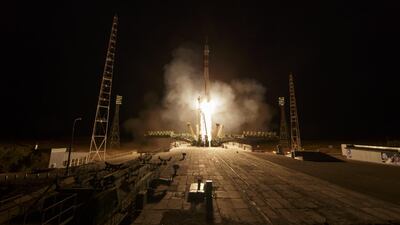
This incredible image by Nasa's official photographer Bill Ingalls captures up close the moment the Soyuz-FG rockets fire, lifting it and the MS-15 spacecraft its carrying into the stars. Bill Ingalls / Nasa -
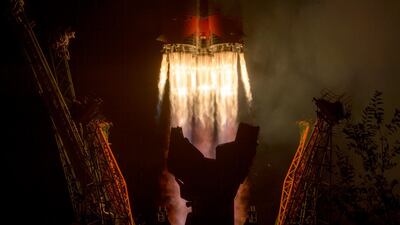
The rocket leaves the Gagarin's Start launch pad at 5.57pm UAE time (6.57pm Kazakhstan time) propelling the Soyuz into the sky. Bill Ingalls / Nasa -
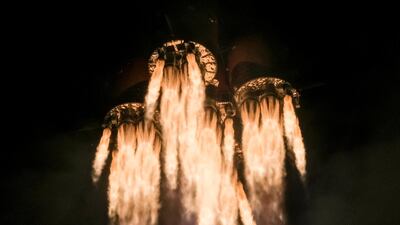
The rocket leaves the Gagarin's Start launch pad at 5.57pm UAE time (6.57pm Kazakhstan time) propelling the Soyuz into the sky. Shamil Zhumatov / Reuters -

The Soyuz is seen in this long exposure photograph as it launches with Expedition 61 crew members Jessica Meir, Oleg Skripochka and Hazza Al Mansouri from the Baikonur Cosmodrome in Kazakhstan. Bill Ingalls / Nasa -
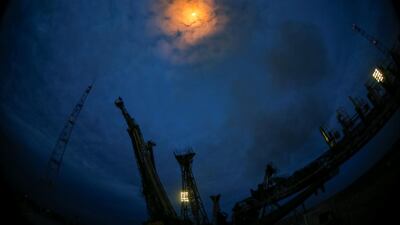
The rocket soars into the clouds moments after launch. Shamil Zhumatov / Reuters -
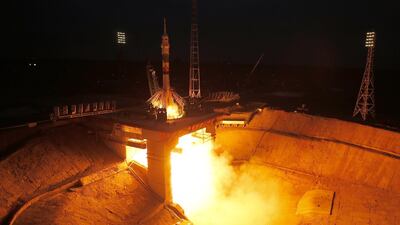
This image taken moments earlier shows how the launch pad functions, with the incredible heat from the boosters funnelled away from the rocket into a blast zone. Gagarin's Start has been used for Soyuz flights since 1961 but Wednesday's launch was its last, as it cannot accommodate Russia's new generation of 'Federation' space ships. Maxim Shipenkov / EPA -
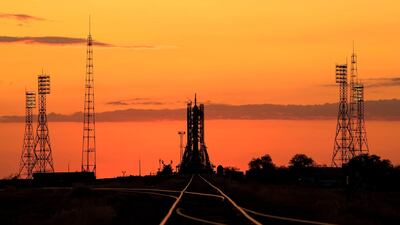
The Soyuz rocket is pictured in the early hours of Wednesday, before the launch. Soyuz MS-15 is the last space ship that will take-off from the Gagarin's Start launch pad at Baikonur. Bill Ingalls / Nasa -
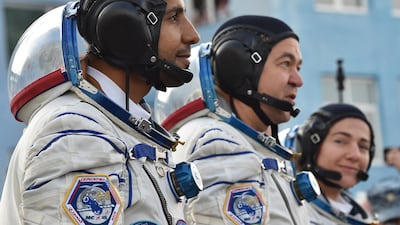
Hazza Al Mansouri appears calm and at ease as he walks to the rocket before take-off. Vyacheslav Oseledko / EPA


The asteroid, which is the largest to fly by earth this year, is still classified it as “potentially hazardous” because of its potential to make a threatening close approach to the Earth in the future. If it were to hit the earth at any point, the damage would be considerable.

An asteroid is a small rocky object that orbits the sun while a meteor occurs when a small piece of asteroid or comet – which contains more ice – burns up on entering the Earth’s atmosphere, leaving a streak of light in the sky.
NASA’s Jet Propulsion Laboratory lists 24 Near Earth Objects due within the next 60 days.
The closest approach in the 1998 OR2 flyby will take place at about 5.56am EDT on April 29. At present, it’s only visible via professional telescopes but amateur astronomers will be able to view 1998 OR2 when it draws nearer to Earth this month.
Otherwise, stargazers can still watch its path via a free live webcast from The Virtual Telescope Project in Rome, beginning April 28. The organisation says it is expected to be "quite bright around the time of the fly-by" with a visual magnitude of around 10 or 11, according to EarthSky.com.
The next two flybys for 1998 OR2 will be in 2031 and 2048 with the closest approach to earth marked for April 16 2079, when it will be 1.8 million km away.

