


When Satyaki Mitra's father developed a mild fever in mid-March, the graduate student in Philadelphia wasn't especially worried. He told his father, 57, who lived in the eastern Indian city of Kolkata, to get tested for coronavirus.
The initial test came back negative, but Samir Kumar Mitra's condition steadily worsened.
On Monday, two days after testing positive for the virus, Samir died, plunging his family into grief and triggering a public backlash that has left his son, 27, stunned.
On a Kolkata street, crowds battled with police for hours to stop Samir's cremation, fearing it would spread the virus and endanger lives.
On Facebook, users left abusive messages on Samir's account, accusing him of meeting Satyaki and his American wife and bringing the virus to Kolkata, a sprawling city of 4.5 million people.
The case underscores how vitriol and disinformation can fan paranoia and even violence in a country already reeling from the worst communal riots in years between Hindus and Muslims, partly whipped up by fake news.
That risks complicate the government's efforts to manage the unfolding crisis in the nation of 1.3 billion people.
The entire population is under a 21-day lockdown and so far the number of cases and deaths related to coronavirus have been small compared with many other large countries.
But experts and some officials are concerned they could increase quickly.
Satyaki said he and his wife have been targeted on social media and his mother and grandmothers took shelter at a hospital because they were too scared to return to their home.
"I can't understand how people can be so hateful," Satyaki said.
He was unable to return to India from the US for his father's last rites due to travel restrictions put in place to combat the pandemic.
Lists circulate online
-

Labourers wear protective face masks as they wait in line to get temperature checked before entering construction worksite, following the outbreak of the coronavirus disease (COVID-19), in Ahmadi, Kuwait. Reuters -

A street cat sits on a table sealed off from customers at Istanbul's famous Pierre Loti cafe in Istanbul, Turkey. Getty Images -

An Afghan man sells Masala dishes as he waits for customers despite a lockdown in Kabul, Afghanistan. EPA -

A man works on the construction site of a new 100-bed hospital in Herat province, Afghanistan. Reuters -

Trees are pictured along an empty road, during a countrywide lockdown in Beirut, Lebanon. Reuters -

A pharmacist, wearing a face mask and gloves as a preventive measure against Covid-19, talks to a customer from behind a nylon curtain put up at the front of the pharmacy in Damascus, Syria. EPA -

Palestinian security forces arrest a Palestinian man who has not adhered to the house quarantine for 14 days, and takes him to a detention centre in the city of Hebron in the West Bank. EPA -

A Palestinian girl sits on the window of a multi-storey building in the West Bank city of Nablus. EPA -
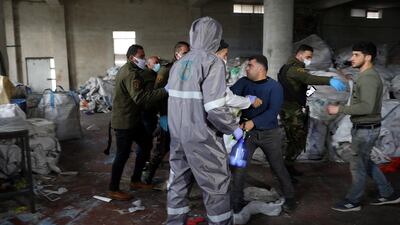
Palestinian security forces arrest a shop owner who did not abide by the lockdown, and take him to a prison in the West Bank city of Hebron. EPA -

Turkish police officers set up a control point at an exit of Istanbul, Turkey. EPA -

A Turkish police officer checks the temperature of passengers in a bus which was not following the rules at an exit in Istanbul, Turkey. EPA -

View of a nearly-empty street in the northern Gaza Strip. EPA -

A young Egyptian woman is jogging near the compound of the military academy in Cairo, Egypt. EPA -

A life-sized dummy dressed in a safety gear and a protective mask is seen on a construction worksite, following the outbreak of the coronavirus disease (COVID-19), in Ahmadi, Kuwait. Reuters


On March 20, India's federal government issued an advisory to social media companies to clamp down on the circulation of false information and unverified data on the outbreak and told its own officials to debunk fake news.
Two independent Indian fact-checkers reported a harp increase in misinformation and fake news about coronavirus across social media platforms since the outbreak was first detected in India.
Rajneil Kamath, publisher of Newschecker, said the increase mirrored misinformation typically seen during major political events, including a flood of queries in regional Indian languages.
"Everybody is just forwarding things and asking: is this true?" he said.
People are also using online platforms to identify those who have recently returned from places considered high-risk, or who may have come into contact with people with the virus.
Authorities in the southern state of Karnataka posted lists of quarantined people across several districts online, which were shared on local WhatsApp groups.
The lists, complete with addresses, have been used to create at least one website where users can put in their zip code to check if anyone is quarantined nearby.
WhatsApp and Facebook said they were working to connect people directly with public health officials.
As of Saturday evening, India had more than 900 confirmed cases of coronavirus. Samir was the first patient to die after contracting the virus in the state of West Bengal. He is among about 20 deaths due to the outbreak in India.
Health authorities in the country said the virus remained largely restricted to those who travelled to affected areas and others who came into direct contact with them, but experts warned the spread may be wider.
According to one projection, more than 100,000 Indians could be infected by mid-May, putting India's creaking healthcare system under severe strain.
Italian connection?
While Facebook and WhatsApp messages alleged Samir travelled to Italy, Europe's coronavirus hot spot, or members of his family visited from there, Satyaki and a colleague of his father's denied the man had been abroad.
Both men said Samir travelled to Central India to attend a wedding in early March and returned to Kolkata by train before falling ill.
"He didn't come into contact with anyone that I know who had travelled abroad," Satyaki said.
He always kept in touch with his parents, he said.
Ajoy Chakraborty, director of West Bengal's health services, said it was still unclear how Samir contracted the virus.
"The case is under intense investigation," Mr Chakraborty said.
Samir, a lifelong employee of Indian Railways, did not suffer from any serious ailments, his son said.
Less than a week after his birthday on March 8, Samir came down with a fever and cough and visited a local doctor.
Within days, he was sent to hospital and put on a ventilator, Satyaki said. His father was treated for a bacterial pneumonia.
"On the 21st, my mother called and informed me he had Covid-19. The tests had come back positive," he said. "I was absolutely shattered."
Chaos at the cremation
After Samir's death on March 23, West Bengal Chief Minister Mamata Banerjee instructed officials to ensure Samir was safely and quickly cremated.
"The virus should not escape," she said in a video uploaded by a local Bengali news channel.
By the time paperwork was completed and the body was taken to a riverside crematorium on Monday night, local residents had surrounded the hearse, two police officers said.
A crowd of about 100 people demanded the body was taken elsewhere, fearing Samir's cremation would contaminate the area, one of the officers said.
"The mob grew in numbers and turned aggressive," the officer said.
Police called in reinforcements and charged the crowd with batons, before cremating Samir's remains at about midnight.
The backlash in Kolkata may not be an anomaly. News reports across India suggest mobs have harassed people suspected of carrying the virus, including doctors and cabin crew.
Some healthcare workers in rented accommodation have been evicted by their landlords due to infection fears, a doctor's association said.
A day after India went into lockdown, Prime Minister Narendra Modi appealed to citizens to stop harassing essential service workers.
"This is not done," Mr Modi said. "We should help those who are serving us."
'They should be shot dead'
Even as his father lay on his death bed on Monday, rumours were circulating on social media, Satyaki said.
In a forwarded WhatsApp message received by several Kolkata residents, a message posted below a picture of Samir, his wife, son and daughter-in-law, read: "The son and Italian daughter-in-law had come to India recently. What a gift they got for the father."
The only child of middle-class Indian parents, Satyaki said he hadn't been back home since July last year.
"I was going to lose my father and on top of that people were just trying to vilify me and my wife," Satyaki said.
He felt helpless knowing there was no way he could go back home, he said.
On Samir's Facebook profile, a message posted below an image of him and his family said: "It's because of people like him that the coronavirus has come to us. They should be shot dead."

