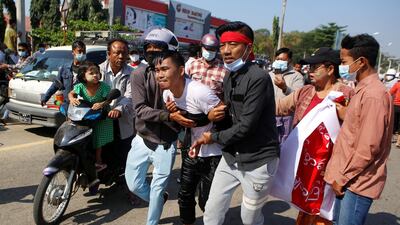
Anti-coup protesters run when police try to disperse them with tear gas in Mandalay, Myanmar. AP Photo

Two protestors shot dead in Myanmar as more countries cut ties with military junta


  • English
  • Arabic

At least two people were killed in police firing in Myanmar overnight, domestic media reported, as activists called for more anti-coup protests on the death anniversary of a student whose killing in 1988 sparked an uprising against the government.

Saturday's calls for protests came as the leaders of the United States, India, Australia and Japan vowed to work together to restore democracy in Myanmar where violence has escalated as authorities crack down on protests and civil disobedience.

Domestic media reported two protesters were killed in police firing in the Tharketa district of Myanmar's commercial capital Yangon overnight. DVB News said police opened fire on a crowd that gathered outside the Tharketa police station demanding the release of people arrested.

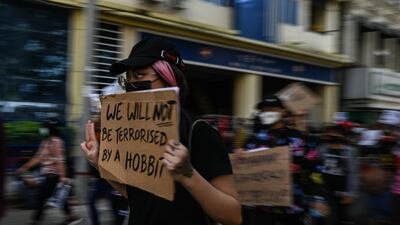
  • Protesters hold signs demanding the release of detained Myanmar leader Aung San Suu Kyi during a demonstration against the military coup in Yangon. AFP
    Protesters hold signs demanding the release of detained Myanmar leader Aung San Suu Kyi during a demonstration against the military coup in Yangon. AFP
  • Protesters take part in demonstration against the military coup in front of police station in Yangon. AFP
    Protesters take part in demonstration against the military coup in front of police station in Yangon. AFP
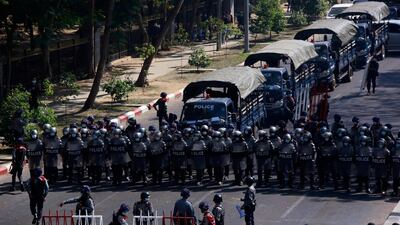
  • Riot police stand guard on a road during a demonstration against the military coup in in Yangon. AFP
    Riot police stand guard on a road during a demonstration against the military coup in in Yangon. AFP
  • Schoolteachers hold up posters during a sit-down demonstration against the February 1 military coup in Yangon. AFP
    Schoolteachers hold up posters during a sit-down demonstration against the February 1 military coup in Yangon. AFP
  • A protester sits in front a graffiti during a demonstration against the military coup in Yangon. AFP
    A protester sits in front a graffiti during a demonstration against the military coup in Yangon. AFP
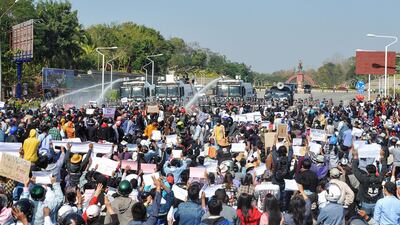
  • Myanmar police fire water cannon at protesters as they continue to demonstrate against the February 1 military coup in the capital Naypyidaw. AFP
    Myanmar police fire water cannon at protesters as they continue to demonstrate against the February 1 military coup in the capital Naypyidaw. AFP
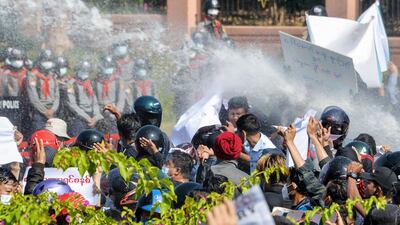
  • Myanmar police fire water cannon at protesters as they continue to demonstrate against the February 1 military coup in the capital Naypyidaw. AFP
    Myanmar police fire water cannon at protesters as they continue to demonstrate against the February 1 military coup in the capital Naypyidaw. AFP
  • Myanmar police fire water cannon at protesters as they continue to demonstrate against the February 1 military coup in the capital Naypyidaw. AFP
    Myanmar police fire water cannon at protesters as they continue to demonstrate against the February 1 military coup in the capital Naypyidaw. AFP
  • An injured protester is helped by his fellow protesters, at a rally against the military coup and to demand the release of elected leader Aung San Suu Kyi, in Naypyitaw, Myanmar. Reuters
    An injured protester is helped by his fellow protesters, at a rally against the military coup and to demand the release of elected leader Aung San Suu Kyi, in Naypyitaw, Myanmar. Reuters
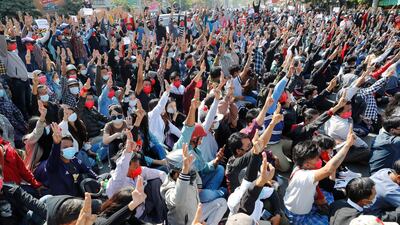
  • Protesters flash the three-fingered salute, a symbol of resistance, during a protest in Mandalay, Myanmar. AP
    Protesters flash the three-fingered salute, a symbol of resistance, during a protest in Mandalay, Myanmar. AP

Posters spread on social media calling on people to come out on the streets to protest against the junta and to mark the death anniversary of Phone Maw, who was shot and killed by security forces in 1988 inside what was then known as the Rangoon Institute of Technology campus.

His shooting and that of another student who died a few weeks later sparked widespread protests against the military government known as the 8-8-88 campaign, because they peaked in August that year. An estimated 3,000 people were killed when the army crushed the uprising.

Aung San Suu Kyi emerged as a democracy icon during the movement and was kept under house arrest for nearly two decades. She was released in 2008 as the military began democratic reforms and her National League for Democracy won elections in 2015 and again in November last year.

On February 1 this year, the generals overthrew her government and detained Suu Kyi and many of her cabinet colleagues, claiming fraud in the November elections.

More than 70 people have been killed in the Southeast Asian nation in widespread protests since then, the Assistance Association for Political Prisoners (AAPP) advocacy group said.

The coup in Myanmar, where the military has close ties to China, is a major early test for new US President Joe Biden.

His administration flagged a virtual meeting with the Indian, Japanese and Australian leaders on Friday, the first official summit of a group known as the Quad, as part of a push to demonstrate a renewed US commitment to regional security.

"As long-standing supporters of Myanmar and its people, we emphasise the urgent need to restore democracy and the priority of strengthening democratic resilience," the four leaders said in a statement released by the White House.

A spokesman for the junta did not answer phone calls from Reuters seeking comment.

South Korea suspends defence ties

UN human rights investigator Thomas Andrews on Friday dismissed as "absurd" comments by a senior Myanmar official that authorities were exercising "utmost restraint".

Addressing the UN Human Rights Council in Geneva, he called for a united approach to "strip away the junta's sense of impunity".

Former colonial power Britain warned its citizens in Myanmar to leave on Friday, saying "political tension and unrest are widespread since the military takeover and levels of violence are rising".

South Korea said it would suspend defence exchanges and reconsider development aid to Myanmar because of the violence.

The Kremlin said Russia, which has close ties to Myanmar’s military, was concerned over the mounting violence and was "analysing" whether to suspend military-technical cooperation.

"We evaluate the situation as alarming, and we are concerned about the information about the growing number of civilian casualties coming from there," Kremlin Spokesman Dmitry Peskov was quoted by the TASS news agency as saying.

Earlier this week, the UN Security Council dropped language from a statement that condemned the army takeover as a coup due to opposition by China, Russia, India and Vietnam.

Poland's foreign ministry said a Polish journalist was arrested this week in Myanmar, the second foreign reporter to be detained. A Japanese journalist was briefly held while covering a protest.

Riot police and armed soldiers entered the general hospital in Hakha, in the western Chin state, forcing all 30 patients to leave and evicting staff from on-site housing, said local activist Salai Lian.

Soldiers have been occupying hospitals and universities across Myanmar as they try to quash a civil disobedience movement that started with government employees such as doctors and teachers but has expanded into a general strike that has paralysed many sectors of the economy.

On Friday evening, large crowds gathered for evening vigils. In Yangon, the commercial capital, they lit candles in the shape of a three-finger salute, the symbol of the movement, while saffron-robed monks gathered outside a pagoda in the northern Sagaing region.


Ten tax points to be aware of in 2026

1. Domestic VAT refund amendments: request your refund within five years

If a business does not apply for the refund on time, they lose their credit.

2. E-invoicing in the UAE

Businesses should continue preparing for the implementation of e-invoicing in the UAE, with 2026 a preparation and transition period ahead of phased mandatory adoption. 

3. More tax audits

Tax authorities are increasingly using data already available across multiple filings to identify audit risks. 

4. More beneficial VAT and excise tax penalty regime

Tax disputes are expected to become more frequent and more structured, with clearer administrative objection and appeal processes. The UAE has adopted a new penalty regime for VAT and excise disputes, which now mirrors the penalty regime for corporate tax.

5. Greater emphasis on statutory audit

There is a greater need for the accuracy of financial statements. The International Financial Reporting Standards standards need to be strictly adhered to and, as a result, the quality of the audits will need to increase.

6. Further transfer pricing enforcement

Transfer pricing enforcement, which refers to the practice of establishing prices for internal transactions between related entities, is expected to broaden in scope. The UAE will shortly open the possibility to negotiate advance pricing agreements, or essentially rulings for transfer pricing purposes. 

7. Limited time periods for audits

Recent amendments also introduce a default five-year limitation period for tax audits and assessments, subject to specific statutory exceptions. While the standard audit and assessment period is five years, this may be extended to up to 15 years in cases involving fraud or tax evasion. 

8. Pillar 2 implementation 

Many multinational groups will begin to feel the practical effect of the Domestic Minimum Top-Up Tax (DMTT), the UAE's implementation of the OECD’s global minimum tax under Pillar 2. While the rules apply for financial years starting on or after January 1, 2025, it is 2026 that marks the transition to an operational phase.

9. Reduced compliance obligations for imported goods and services

Businesses that apply the reverse-charge mechanism for VAT purposes in the UAE may benefit from reduced compliance obligations. 

10. Substance and CbC reporting focus

Tax authorities are expected to continue strengthening the enforcement of economic substance and Country-by-Country (CbC) reporting frameworks. In the UAE, these regimes are increasingly being used as risk-assessment tools, providing tax authorities with a comprehensive view of multinational groups’ global footprints and enabling them to assess whether profits are aligned with real economic activity. 

Contributed by Thomas Vanhee and Hend Rashwan, Aurifer

%E2%80%98White%20Elephant%E2%80%99
%3Cp%3E%3Cstrong%3EDirector%3A%3C%2Fstrong%3E%20Jesse%20V%20Johnson%3Cbr%3E%3Cstrong%3EStars%3A%3C%2Fstrong%3E%20Michael%20Rooker%2C%20Bruce%20Willis%2C%20John%20Malkovich%2C%20Olga%20Kurylenko%3Cbr%3E%3Cstrong%3ERating%3A%3C%2Fstrong%3E%203%2F5%3C%2Fp%3E%0A
CHINESE GRAND PRIX STARTING GRID

1st row 
Sebastian Vettel (Ferrari)
Kimi Raikkonen (Ferrari)

2nd row 
Valtteri Bottas (Mercedes-GP)
Lewis Hamilton (Mercedes-GP)

3rd row 
Max Verstappen (Red Bull Racing)
Daniel Ricciardo (Red Bull Racing)

4th row 
Nico Hulkenberg (Renault)
Sergio Perez (Force India)

5th row 
Carlos Sainz Jr (Renault)
Romain Grosjean (Haas)

6th row 
Kevin Magnussen (Haas)
Esteban Ocon (Force India)

7th row 
Fernando Alonso (McLaren)
Stoffel Vandoorne (McLaren)

8th row 
Brendon Hartley (Toro Rosso)
Sergey Sirotkin (Williams)

9th row 
Pierre Gasly (Toro Rosso)
Lance Stroll (Williams)

10th row 
Charles Leclerc (Sauber)
arcus Ericsson (Sauber)

Fund-raising tips for start-ups

Develop an innovative business concept

Have the ability to differentiate yourself from competitors

Put in place a business continuity plan after Covid-19

Prepare for the worst-case scenario (further lockdowns, long wait for a vaccine, etc.) 

Have enough cash to stay afloat for the next 12 to 18 months

Be creative and innovative to reduce expenses

Be prepared to use Covid-19 as an opportunity for your business

* Tips from Jassim Al Marzooqi and Walid Hanna

The biog

Born: High Wycombe, England

Favourite vehicle: One with solid axels

Favourite camping spot: Anywhere I can get to.

Favourite road trip: My first trip to Kazakhstan-Kyrgyzstan. The desert they have over there is different and the language made it a bit more challenging.

Favourite spot in the UAE: Al Dhafra. It’s unique, natural, inaccessible, unspoilt.

%20Ramez%20Gab%20Min%20El%20Akher
%3Cp%3E%3Cstrong%3ECreator%3A%3C%2Fstrong%3E%20Ramez%20Galal%3C%2Fp%3E%0A%3Cp%3E%3Cstrong%3EStarring%3A%3C%2Fstrong%3E%20Ramez%20Galal%3C%2Fp%3E%0A%3Cp%3E%3Cstrong%3EStreaming%20on%3A%20%3C%2Fstrong%3EMBC%20Shahid%3C%2Fp%3E%0A%3Cp%3E%3Cstrong%3ERating%3A%20%3C%2Fstrong%3E2.5%2F5%3C%2Fp%3E%0A
The biog

Favourite car: Ferrari

Likes the colour: Black

Best movie: Avatar

Academic qualifications: Bachelor’s degree in media production from the Higher Colleges of Technology and diploma in production from the New York Film Academy

UAE currency: the story behind the money in your pockets
The specs: 2018 Mercedes-AMG C63 S Cabriolet

Price, base: Dh429,090

Engine 4.0-litre twin-turbo V8

Transmission Seven-speed automatic

Power 510hp @ 5,500rpm

Torque 700Nm @ 1,750rpm

Fuel economy, combined 9.2L / 100km