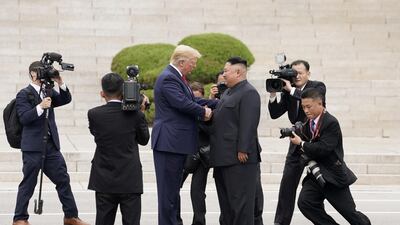
US President Donald Trump meeting North Korean leader Kim Jong Un at the demilitarised zone separating the two Koreas, in Panmunjom, South Korea, June 30, 2019. Reuters

South Korea's Moon calls for US-North Korea summit before US election


  • English
  • Arabic

South Korean President Moon Jae-in has said US President Donald Trump and North Korean leader Kim Jong Un should meet again before the US presidential election in November, a Seoul official told reporters on Wednesday.

Mr Moon's remarks were made during a video conference with European Council President Charles Michel on Tuesday, during which he said another summit between Mr Trump and Mr Kim would help resume stalled nuclear negotiations.

"I believe there's a need for North Korea and the United States to try dialogue one more time before the US presidential election," a presidential official quoted Mr Moon as saying.

"The issues of nuclear programmes and sanctions will ultimately have to be resolved through North Korea-US talks."

Mr Moon's office had conveyed such views to Washington and the officials there are making efforts to resume the talks, the South Korean official said.

Mr Trump and Mr Kim met for the first time in 2018 in Singapore, raising hopes of an agreement to get Pyongyang to give up its nuclear weapons programme. But their second summit, in early 2019 in Vietnam, fell apart.

Mr Trump and Mr Kim met again at the demilitarized zone separating the two Koreas in June 2019 and agreed to restart negotiations, but working-level talks between the two sides in Sweden in October were broken off.

Inter-Korean tensions flared last month after the North blew up a joint liaison office, severed hotlines and threatened military action over plans by defector groups in the South to send anti-Kim leaflets across the border. Following weeks of heated exchanges, Mr Kim suspended the military plans, without specifying why.

The moves from Pyongyang were seen aimed at recapturing the attention of Mr Trump and making a renewed push for sanctions relief before the November election, experts said.

On Monday, US Deputy Secretary of State Stephen Biegun, who led working-level negotiations with North Koreans, said there is still time for both sides to re-engage and "make substantial progress".

Mr Biegun, however, said an in-person summit would be difficult before the November election, citing the coronavirus pandemic which has all but wiped the world's diplomatic calendar clean.


COMPANY%20PROFILE
%3Cp%3E%3Cstrong%3EDate%20started%3A%3C%2Fstrong%3E%202020%3Cbr%3E%3Cstrong%3EFounders%3A%3C%2Fstrong%3E%20Khaldoon%20Bushnaq%20and%20Tariq%20Seksek%3Cbr%3E%3Cstrong%3EBased%3A%3C%2Fstrong%3E%20Abu%20Dhabi%20Global%20Market%3Cbr%3E%3Cstrong%3ESector%3A%3C%2Fstrong%3E%20HealthTech%3Cbr%3E%3Cstrong%3ENumber%20of%20staff%3A%3C%2Fstrong%3E%20100%3Cbr%3E%3Cstrong%3EFunding%20to%20date%3A%3C%2Fstrong%3E%20%2415%20million%3C%2Fp%3E%0A
Tips to stay safe during hot weather
  • Stay hydrated: Drink plenty of fluids, especially water. Avoid alcohol and caffeine, which can increase dehydration.
  • Seek cool environments: Use air conditioning, fans, or visit community spaces with climate control.
  • Limit outdoor activities: Avoid strenuous activity during peak heat. If outside, seek shade and wear a wide-brimmed hat.
  • Dress appropriately: Wear lightweight, loose and light-coloured clothing to facilitate heat loss.
  • Check on vulnerable people: Regularly check in on elderly neighbours, young children and those with health conditions.
  • Home adaptations: Use blinds or curtains to block sunlight, avoid using ovens or stoves, and ventilate living spaces during cooler hours.
  • Recognise heat illness: Learn the signs of heat exhaustion and heat stroke (dizziness, confusion, rapid pulse, nausea), and seek medical attention if symptoms occur.
COMPANY%20PROFILE%20
%3Cp%3E%3Cstrong%3ECompany%20name%3A%20%3C%2Fstrong%3ENomad%20Homes%3Cbr%3E%3Cstrong%3EStarted%3A%20%3C%2Fstrong%3E2020%3Cbr%3E%3Cstrong%3EFounders%3A%20%3C%2Fstrong%3EHelen%20Chen%2C%20Damien%20Drap%2C%20and%20Dan%20Piehler%3Cbr%3E%3Cstrong%3EBased%3A%3C%2Fstrong%3E%20UAE%20and%20Europe%3Cbr%3E%3Cstrong%3EIndustry%3C%2Fstrong%3E%3A%20PropTech%3Cbr%3E%3Cstrong%3EFunds%20raised%20so%20far%3A%3C%2Fstrong%3E%20%2444m%3Cbr%3E%3Cstrong%3EInvestors%3A%3C%2Fstrong%3E%20Acrew%20Capital%2C%2001%20Advisors%2C%20HighSage%20Ventures%2C%20Abstract%20Ventures%2C%20Partech%2C%20Precursor%20Ventures%2C%20Potluck%20Ventures%2C%20Knollwood%20and%20several%20undisclosed%20hedge%20funds%3C%2Fp%3E%0A

Mercer, the investment consulting arm of US services company Marsh & McLennan, expects its wealth division to at least double its assets under management (AUM) in the Middle East as wealth in the region continues to grow despite economic headwinds, a company official said.

Mercer Wealth, which globally has $160 billion in AUM, plans to boost its AUM in the region to $2-$3bn in the next 2-3 years from the present $1bn, said Yasir AbuShaban, a Dubai-based principal with Mercer Wealth.

Within the next two to three years, we are looking at reaching $2 to $3 billion as a conservative estimate and we do see an opportunity to do so,” said Mr AbuShaban.

Mercer does not directly make investments, but allocates clients’ money they have discretion to, to professional asset managers. They also provide advice to clients.

“We have buying power. We can negotiate on their (client’s) behalf with asset managers to provide them lower fees than they otherwise would have to get on their own,” he added.

Mercer Wealth’s clients include sovereign wealth funds, family offices, and insurance companies among others.

From its office in Dubai, Mercer also looks after Africa, India and Turkey, where they also see opportunity for growth.

Wealth creation in Middle East and Africa (MEA) grew 8.5 per cent to $8.1 trillion last year from $7.5tn in 2015, higher than last year’s global average of 6 per cent and the second-highest growth in a region after Asia-Pacific which grew 9.9 per cent, according to consultancy Boston Consulting Group (BCG). In the region, where wealth grew just 1.9 per cent in 2015 compared with 2014, a pickup in oil prices has helped in wealth generation.

BCG is forecasting MEA wealth will rise to $12tn by 2021, growing at an annual average of 8 per cent.

Drivers of wealth generation in the region will be split evenly between new wealth creation and growth of performance of existing assets, according to BCG.

Another general trend in the region is clients’ looking for a comprehensive approach to investing, according to Mr AbuShaban.

“Institutional investors or some of the families are seeing a slowdown in the available capital they have to invest and in that sense they are looking at optimizing the way they manage their portfolios and making sure they are not investing haphazardly and different parts of their investment are working together,” said Mr AbuShaban.

Some clients also have a higher appetite for risk, given the low interest-rate environment that does not provide enough yield for some institutional investors. These clients are keen to invest in illiquid assets, such as private equity and infrastructure.

“What we have seen is a desire for higher returns in what has been a low-return environment specifically in various fixed income or bonds,” he said.

“In this environment, we have seen a de facto increase in the risk that clients are taking in things like illiquid investments, private equity investments, infrastructure and private debt, those kind of investments were higher illiquidity results in incrementally higher returns.”

The Abu Dhabi Investment Authority, one of the largest sovereign wealth funds, said in its 2016 report that has gradually increased its exposure in direct private equity and private credit transactions, mainly in Asian markets and especially in China and India. The authority’s private equity department focused on structured equities owing to “their defensive characteristics.”

Jetour T1 specs

Engine: 2-litre turbocharged

Power: 254hp

Torque: 390Nm

Price: From Dh126,000

Available: Now