
Gayatri Khutale has been surveying community coronavirus outbreaks without a break for 132 days – speaking to more than 13,200 households and counting. An error in her work could throw off efforts to trace people who have been in contact with infected individuals and put an entire community at risk.
After more than four months, Ms Khutale, 40, continues her work, phoning around sources for updates in a role that requires detective-like vigilance.
“I’ve got to be extra careful,” she says, as stigma, economic necessity and misinformation are making people hide or not report symptoms.
She is one of the government's 970,000 Accredited Social Health Activists (Asha) – the women front-line community health workers and the backbone of rural India’s health care system – working to contain the community transmission of Covid-19 across about 600,000 villages.
Asha workers are implementing a key part of the health ministry's plan to contain the coronavirus, tracking down confirmed and suspected coronavirus patients as well as those that they have been in contact with. Workers keep careful records and raise awareness by word of mouth and pamphlet.
Ms Khutale began surveying villages on March 22, covering at least 100 households a day. But she says people often conceal symptoms for fear of being ostracised by the community or losing their livelihood.
To get around it, Asha workers often seek information from neighbours instead.
One man in her village in the Kolhapur district of western India’s Maharashtra state, travelled 15 miles for a swab test, instead of heading to the nearest centre less than a mile away.
"None of us knew he got a swab test and was asked to quarantine. Secretly, he found a room on the outskirts and after 10 days, his father contacted me asking if he could return," she told The National.
“How do we contact trace when people hide the details?” she asks. “People only contact us when things become extremely severe.”
Asha employees are required to maintain meticulous records – if surveys are not updated daily, their salary could be cut from around 3000 to 5000 rupees (Dh146-Dh244).
Even when people do admit to having symptoms, “no one wants to get a swab test done,” Ms Khutale says, “Because contracting Covid is considered a taboo.”
-
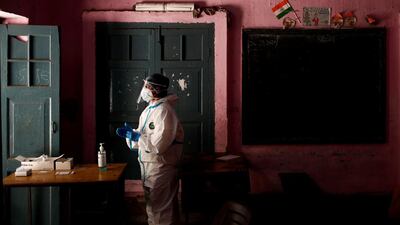
A medical worker waits for the next person to get tested at a school turned into a centre to conduct tests for coronavirus in New Delhi, India. Reuters -
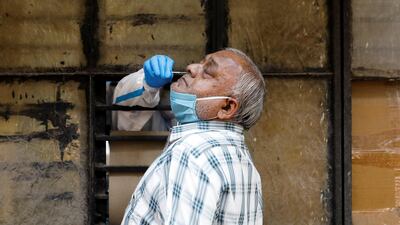
A medical worker collects a sample from a man at a school turned into a centre in New Delhi. Reuters -
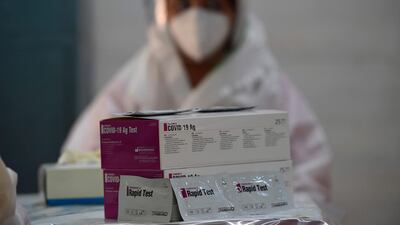
A medical worker waits for people to be tested with rapid antigen test (RAT) for the Covid-19 coronavirus in New Delhi. AFP -
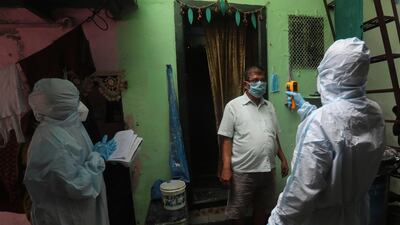
A doctor checks the temperature of a man during a free medical camp in Dharavi, one of Asia's largest slums, in Mumbai. AP -
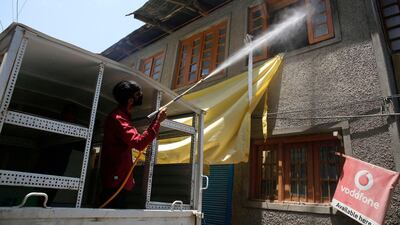
A government municipal worker sprays disinfectant in area during a funeral in Srinagar. EPA -
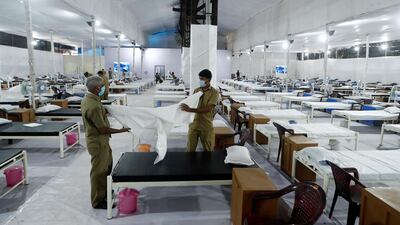
Workers prepare a bed at a recently constructed quarantine facility for patients diagnosed with the Covid-19 in Mumbai. Reuters -

A Hindu devotee performs rituals in Mumbai. AP -
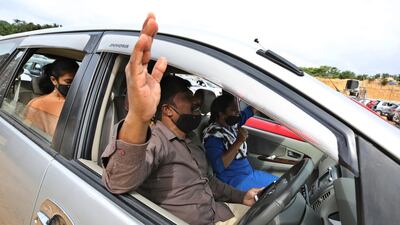
Faithful attend a drive-in mass in an open area of Bethel AG Church as part of maintaining social distancing to prevent the spread of coronavirus in Bengaluru. AP -
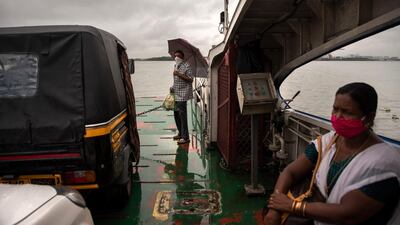
Commuters travel in a ferry during rain in Kochi, Kerala state. AP -
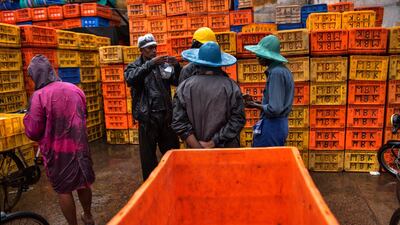
A man prepares to wear his mask as fish vendors chat on a rainy day in Kochi, Kerala state. AP -

A boy exercises at a park after a few restrictions were relaxed during a lockdown in Mumbai. Reuters -
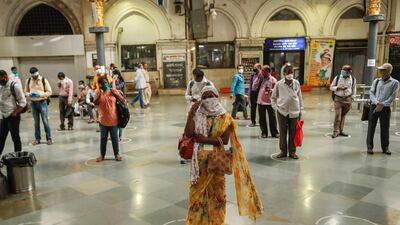
Commuters stand inside circles to maintain social distancing as they wait to board a train at a railway station after some restrictions were lifted in Mumbai. Reuters -
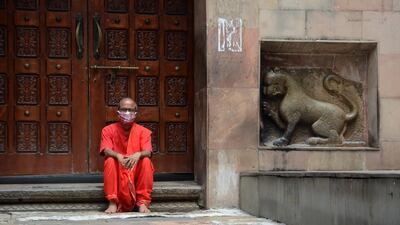
The President of Kamakhya Temple Committee in front of the main entrance gate of Kamakhya temple. AFP


The stigma around the virus, fears of the economic impact of quarantine and rampant disinformation make life difficult for Asha workers, who sometimes face verbal and physical abuse as they make their rounds.
Misinformation that eating chicken causes coronavirus has cost the Indian economy millions of dollars a day, according to the Ministry of Fisheries, Animal Husbandry and Dairying.
Another piece of widely held misinformation is that gaumutra, or cow urine, is a cure for coronavirus. This culminated in a gaumutra party in India’s capital of New Delhi by a far-right group.
Netradipa Patil, an activist and an Asha worker, said another woman was recently dragged by her hair and manhandled by a politician from the community who took exception to her survey questions.
“What was her fault? She was doing her duty,” says Ms Patil, who added that little action is taken to protect the Asha workers.
In the Shirol block of Kolhapur, where she carries out surveys, a local politician’s relative hid their travel history, putting the entire community at risk.
When Ms Patil enquired further, she was shouted at and insulted. “We are used to abuse and foul language,” she says.
As of July 30, India recorded more than 1.5 million confirmed cases of Covid-19.
Prime Minister Narendra Modi declared a 10-week lockdown on March 24, halting the movement of 1.3 billion people and shutting down economic activity across the country.
In that time, 122 million people lost their jobs and millions were pushed into poverty, putting further pressure on the country’s health workers.
Alongside the extra Covid-19 workload, Asha employees continue their regular duties, which include advising on pregnancy and family planning, providing contraceptives, medicines and vaccinations and keeping track of newborns.
“All the trust and goodwill we earned with our service in now converted into this humiliation,” Ms Patil says.
Many carry out the additional work at considerable risk to themselves. According to Ms Patil, several Asha workers conducted Covid-19 surveys for at least for three months without any personal protective equipment.
“We were given 20 cloth masks in May. As the patients increased, we demanded at least four N95 masks – we got only 1-2.”
Relying on such minimal gear can be dangerous. Nine Asha workers recently tested positive in the Kolhapur district.
Manisha Chavan, 41, another Asha worker from rural Kolhapur, who has carried out surveys for four months with only a cloth mask for protection says they were only given PPE one when the first case was recorded in the area. Within a day, her village recorded five more cases, risking the entire community.
Physical distancing can be extremely difficult in some of India’s more crowded villages.
Many of these communities rely on agriculture that has since collapsed as farmers are unable to sell their harvest during lockdown. Falling demand for milk and dairy products has affected the livelihood of millions. Milk consumption in India fell by 25-30 per cent between April and May.
For some, a 14-day quarantine could lead to starvation, forcing people to hide symptoms so they can work and survive.
Now, the Asha staff talk of little but the virus.
“For us, now the good night message has changed to the news of people quarantined and good morning message is how many of them tested positive,” Ms Khutale says.

