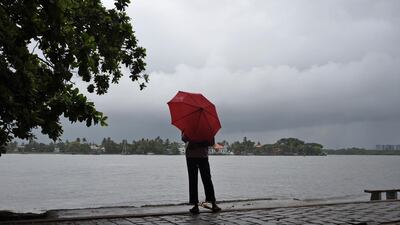
A man stands by the Arabian Sea coast as it drizzles in Kochi in the southern state of Kerala where India's monsoon begins. AP Photo

India forecast to experience normal monsoon this year


  • English
  • Arabic

India's monsoon, which irrigates more than half the country's farmland and is critical for economic growth, is expected to be normal for a third year as external weather patterns such as El Nino are likely to be absent.

Total rainfall during the June-September rainy period is likely to be 98 per cent of a long-term average, Madhavan Nair Rajeevan, secretary of the Ministry of Earth Sciences, said on Friday. The forecast has a 5 per cent margin of error.

Most parts of the country, except some areas in the east and the north, are likely to receive normal to above-normal rain during the four-month period, according to the India Meteorological Department.

The chances of a normal monsoon are 40 per cent, while there is a 16 per cent chance of above-normal rains, the department said. The likelihood of below-normal showers is 25 per cent.

The monsoon is crucial for India because about 60 per cent of more than 1.3 billion people depend directly or indirectly on agriculture, which accounts for about 18 per cent of its economy. Normal rains would help to support an economic recovery, which is facing new risks from a resurgence in coronavirus cases.

“Amidst the heightened uncertainty related to the second wave of Covid-19 in India, the India Meteorological Department’s forecast of a likely normal monsoon for the third year in a row couldn’t have come at a better time,” said Kaushik Das, chief India economist at Deutsche Bank in Mumbai.

"A probable normal monsoon will help the farm sector to grow by at least 3 per cent this year, as per our current forecast, and will also reduce potential risks on the inflation front, that is generally associated with [an] erratic monsoon," Mr Das said.

Rains during the four-month period not only water some fields directly, but also fill reservoirs that help to irrigate winter-sown crops. A good monsoon boosts crop output, while deficient rains lead to drinking water shortages, lower crop output and higher imports of some commodities.

The nation is the world’s top grower of cotton, the second-biggest producer of wheat, rice and sugar, and the largest buyer of palm oil.

About 60 per cent to 90 per cent of total annual rainfall occurs during the season over different states. A monsoon is considered normal when rains recorded are between 96 per cent and 104 per cent of the 50-year average.

A combine harvester at work in a wheat field in Panipat district of Haryana, India, on April 11, 2021. Bloomberg

Kerala first

The monsoon typically reaches the southern state of Kerala in the first week of June, before moving north to cover most of the nation. Any delay or rain deficit in the early part of the season could hamper sowing and hurt crops such as rice, cotton and soybeans, even if the rainfall gathers pace later.

Last year’s monsoon rain was 9 per cent higher than normal, while it was 10 per cent more than the long-term average in 2019. Bountiful rains helped crops and boosted India’s food grain output to a record in 2020-2021.

Agriculture was the only bright spot as the economy posted a record slump last year as manufacturing and services were badly hit by the nationwide lockdown caused by the rapid spread of the coronavirus.

The meteorological department said that neutral Enso conditions – the absence of El Nino or La Nina weather patterns – are prevailing over the Pacific Ocean, supporting its forecast of a normal monsoon this year.

“There is very much less chance of El Nino development during the monsoon season.”

Mercer, the investment consulting arm of US services company Marsh & McLennan, expects its wealth division to at least double its assets under management (AUM) in the Middle East as wealth in the region continues to grow despite economic headwinds, a company official said.

Mercer Wealth, which globally has $160 billion in AUM, plans to boost its AUM in the region to $2-$3bn in the next 2-3 years from the present $1bn, said Yasir AbuShaban, a Dubai-based principal with Mercer Wealth.

Within the next two to three years, we are looking at reaching $2 to $3 billion as a conservative estimate and we do see an opportunity to do so,” said Mr AbuShaban.

Mercer does not directly make investments, but allocates clients’ money they have discretion to, to professional asset managers. They also provide advice to clients.

“We have buying power. We can negotiate on their (client’s) behalf with asset managers to provide them lower fees than they otherwise would have to get on their own,” he added.

Mercer Wealth’s clients include sovereign wealth funds, family offices, and insurance companies among others.

From its office in Dubai, Mercer also looks after Africa, India and Turkey, where they also see opportunity for growth.

Wealth creation in Middle East and Africa (MEA) grew 8.5 per cent to $8.1 trillion last year from $7.5tn in 2015, higher than last year’s global average of 6 per cent and the second-highest growth in a region after Asia-Pacific which grew 9.9 per cent, according to consultancy Boston Consulting Group (BCG). In the region, where wealth grew just 1.9 per cent in 2015 compared with 2014, a pickup in oil prices has helped in wealth generation.

BCG is forecasting MEA wealth will rise to $12tn by 2021, growing at an annual average of 8 per cent.

Drivers of wealth generation in the region will be split evenly between new wealth creation and growth of performance of existing assets, according to BCG.

Another general trend in the region is clients’ looking for a comprehensive approach to investing, according to Mr AbuShaban.

“Institutional investors or some of the families are seeing a slowdown in the available capital they have to invest and in that sense they are looking at optimizing the way they manage their portfolios and making sure they are not investing haphazardly and different parts of their investment are working together,” said Mr AbuShaban.

Some clients also have a higher appetite for risk, given the low interest-rate environment that does not provide enough yield for some institutional investors. These clients are keen to invest in illiquid assets, such as private equity and infrastructure.

“What we have seen is a desire for higher returns in what has been a low-return environment specifically in various fixed income or bonds,” he said.

“In this environment, we have seen a de facto increase in the risk that clients are taking in things like illiquid investments, private equity investments, infrastructure and private debt, those kind of investments were higher illiquidity results in incrementally higher returns.”

The Abu Dhabi Investment Authority, one of the largest sovereign wealth funds, said in its 2016 report that has gradually increased its exposure in direct private equity and private credit transactions, mainly in Asian markets and especially in China and India. The authority’s private equity department focused on structured equities owing to “their defensive characteristics.”

Men’s singles 
Group A:
Son Wan-ho (Kor), Lee Chong Wei (Mas), Ng Long Angus (HK), Chen Long (Chn)
Group B: Kidambi Srikanth (Ind), Shi Yugi (Chn), Chou Tien Chen (Tpe), Viktor Axelsen (Den)

Women’s Singles 
Group A:
Akane Yamaguchi (Jpn), Pusarla Sindhu (Ind), Sayaka Sato (Jpn), He Bingjiao (Chn)
Group B: Tai Tzu Ying (Tpe), Sung Hi-hyun (Kor), Ratchanok Intanon (Tha), Chen Yufei (Chn)

Teri%20Baaton%20Mein%20Aisa%20Uljha%20Jiya
%3Cp%3E%3Cstrong%3EDirectors%3A%3C%2Fstrong%3E%20Amit%20Joshi%20and%20Aradhana%20Sah%3C%2Fp%3E%0A%3Cp%3E%3Cstrong%3ECast%3A%3C%2Fstrong%3E%20Shahid%20Kapoor%2C%20Kriti%20Sanon%2C%20Dharmendra%2C%20Dimple%20Kapadia%2C%20Rakesh%20Bedi%3C%2Fp%3E%0A%3Cp%3E%3Cstrong%3ERating%3A%3C%2Fstrong%3E%204%2F5%3C%2Fp%3E%0A
Results:

6.30pm: Handicap (Turf) | US$175,000 2,410m | Winner: Bin Battuta, Christophe Soumillon (jockey), Saeed bin Suroor (trainer)

7.05pm: UAE 1000 Guineas Trial Conditions (Dirt) | $100,000 1,400m | Winner: Al Hayette, Fabrice Veron, Ismail Mohammed

7.40pm: Handicap (T) $145,000 1,000m | Winner: Faatinah, Jim Crowley, David Hayes

8.15pm: Dubawi Stakes Group 3 (D) $200,000 1,200m | Winner: Raven’s Corner, Richard Mullen, Satish Seemar

8.50pm: Singspiel Stakes Group 3 (T) $200,000 1,800m | Winner: Dream Castle, Christophe Soumillon, Saeed bin Suroor

9.25pm: Handicap (T) $175,000 1,400m​​​ | Winner: Another Batt, Connor Beasley, George Scott

Ferrari 12Cilindri specs

Engine: naturally aspirated 6.5-liter V12

Power: 819hp

Torque: 678Nm at 7,250rpm

Price: From Dh1,700,000

Available: Now
