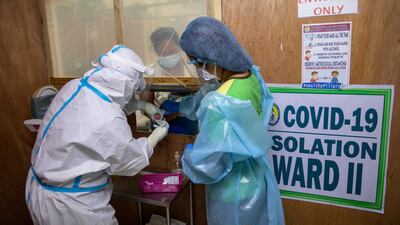
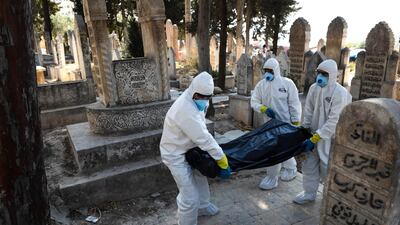
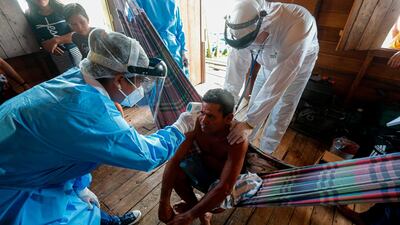
Coronavirus patients in India are dying because of a lack of beds in intensive care units and a shortage of oxygen cylinders as the healthcare system struggles to cope with a surge in cases.
India's tally of confirmed cases passed 5.2 million this week, second only to the United States, after several weeks with an average of 90,000 new infections a day. More than 4 million patients have recovered, leaving the country with slightly more than 1 million active cases, while the death toll from Covid-19 has passed 84,000.
“The situation is critical," said Dr Devender Singh Rana, chairman of Sir Ganga Ram Hospital in the Indian capital New Delhi. "We are witnessing an unbelievable rise in the number of cases that we had not even seen in June when coronavirus was at its peak [in Delhi] … there are no beds; we are all full.” The healthcare infrastructure in the country of 1.3 billion was already less than ideal before the pandemic, with one doctor for 1,457 people instead of the World Health Organisation norm of 1,000, and one hospital bed for every 1,844 people, according to World Bank data.
The government says it has provided 230,000 oxygen-supported isolation beds and 62,717 critical care beds with ventilators since India recorded its first case on January 30. Doctors say this is not enough to deal with the pandemic's onslaught.
New Delhi, a metropolis of 22 million people, has just 37 Covid-19 designated hospitals and 2,558 ICU beds to treat more than 30,000 active cases. In Mumbai, the financial capital, there was not a single ventilator bed available in any of the top hospitals in the first week of September.
_______________
Coronavirus around the world
______________
A record-breaking surge of one million cases in just 11 days has also triggered a sharp rise in the demand for oxygen cylinders. Nearly 6 per cent of Covid-19 cases experience moderate to severe symptoms and require oxygen support.
The demand for oxygen has triggered hoarding as well as theft of cylinders – a vehicle loaded with oxygen supplies for hospitals was robbed in the city of Pune last week.
“It is a very stressful situation, there is shortage of beds, shortage of oxygen, patients are dying while looking for ICUs. There has been a 10 per cent rise in the demand for oxygen since mid-August as cases have gone up," said Dr Vidyadhar Gaikwad, in-charge of Pune Cantonment Hospital.
"Every day, 4,000-5,000 people are positive in the city and 3 per cent are going to be critical and they need ICU and oxygen beds and we do not have enough," Dr Gaikwad told The National.
According to the All India Industrial Gases Manufacturers Association, hospitals and healthcare centres are using up to 2,700 tonnes of medical oxygen a day, compared to 750 tonnes a day at the beginning of the pandemic.
Meanwhile the country's medical personnel are struggling with the lack of equipment, long working hours, public anger and personal risk from exposure to the virus. At least 380 doctors have lost their lives in the last six months while treating coronavirus patients, according to the Indian Medical Association (IMA), which has nearly 350,000 doctors as members.
In some states, nurses and doctors at government-run hospitals are threatening to strike over non-payment of wages since March, when the country went into lockdown to prevent the virus from spreading.
In Maharashtra, the worst-affected state, officials reduced the one-week break given to doctors after treating Covid-19 patients for weeks at a stretch to just one day. Some doctors have faced discrimination and violence from the general public over fears that they might transmit the virus, including eviction by their landlords.
Dr Rajan Sharma, national president of the IMA, called the situation a “double-whammy” for medical professionals.
"They are attacked … we are facing a shortage of oxygen but patients blame doctors," he told The National.
"Doctors are overburdened. They are forced to sleep on the floor and on stretchers, work 18 hours a day, but there is no alternative as there are not enough doctors.”
Dr Sharma blamed poor government policies and India's historically low spending on the healthcare. In 2018, India spent just 1.3 per cent of its GDP on public healthcare infrastructure, almost half the amount of its defence budget that year.
“Indian governments have never invested in the country’s healthcare," he said.
"The healthcare infrastructure already had cracks and it has now come into focus because of coronavirus."

GOLF’S RAHMBO
- 5 wins in 22 months as pro
- Three wins in past 10 starts
- 45 pro starts worldwide: 5 wins, 17 top 5s
- Ranked 551th in world on debut, now No 4 (was No 2 earlier this year)
- 5th player in last 30 years to win 3 European Tour and 2 PGA Tour titles before age 24 (Woods, Garcia, McIlroy, Spieth)
england euro squad
Goalkeepers: Dean Henderson (Man Utd), Sam Johnstone (West Brom), Jordan Pickford (Everton)
Defenders: John Stones (Man City), Luke Shaw (Man Utd), Harry Maguire (Man Utd), Trent Alexander-Arnold (Liverpool), Kyle Walker (Man City), Tyrone Mings (Aston Villa), Reece James (Chelsea), Conor Coady (Wolves), Ben Chilwell (Chelsea), Kieran Trippier (Atletico Madrid)
Midfielders: Mason Mount (Chelsea), Declan Rice (West Ham), Jordan Henderson (Liverpool), Jude Bellingham (Borussia Dortmund), Kalvin Phillips (Leeds)
Forwards: Harry Kane (Tottenham), Marcus Rashford (Man Utd), Raheem Sterling (Man City), Dominic Calvert-Lewin (Everton), Phil Foden (Man City), Jack Grealish (Aston Villa), Jadon Sancho (Borussia Dortmund), Bukayo Saka (Arsenal)
GAC GS8 Specs
Engine: 2.0-litre 4cyl turbo
Power: 248hp at 5,200rpm
Torque: 400Nm at 1,750-4,000rpm
Transmission: 8-speed auto
Fuel consumption: 9.1L/100km
On sale: Now
Price: From Dh149,900
FINAL RESULT
Sharjah Wanderers 20 Dubai Tigers 25 (After extra-time)
Wanderers
Tries: Gormley, Penalty
cons: Flaherty
Pens: Flaherty 2
Tigers
Tries: O’Donnell, Gibbons, Kelly
Cons: Caldwell 2
Pens: Caldwell, Cross
UAE v Gibraltar
What: International friendly
When: 7pm kick off
Where: Rugby Park, Dubai Sports City
Admission: Free
Online: The match will be broadcast live on Dubai Exiles’ Facebook page
UAE squad: Lucas Waddington (Dubai Exiles), Gio Fourie (Exiles), Craig Nutt (Abu Dhabi Harlequins), Phil Brady (Harlequins), Daniel Perry (Dubai Hurricanes), Esekaia Dranibota (Harlequins), Matt Mills (Exiles), Jaen Botes (Exiles), Kristian Stinson (Exiles), Murray Reason (Abu Dhabi Saracens), Dave Knight (Hurricanes), Ross Samson (Jebel Ali Dragons), DuRandt Gerber (Exiles), Saki Naisau (Dragons), Andrew Powell (Hurricanes), Emosi Vacanau (Harlequins), Niko Volavola (Dragons), Matt Richards (Dragons), Luke Stevenson (Harlequins), Josh Ives (Dubai Sports City Eagles), Sean Stevens (Saracens), Thinus Steyn (Exiles)
How to protect yourself when air quality drops
Install an air filter in your home.
Close your windows and turn on the AC.
Shower or bath after being outside.
Wear a face mask.
Stay indoors when conditions are particularly poor.
If driving, turn your engine off when stationary.
Abu Dhabi Card
5pm: Maiden (PA) Dh 80,000 1,400m
National selection: AF Mohanak
5.30pm: Handicap (PA) Dh 90,000 1,400m
National selection: Jayide Al Boraq
6pm: Handicap (TB) Dh 100,000 1,400m
National selection: Rocket Power
6.30pm: Abu Dhabi Championship Listed (PA) Dh 180,000 1,600m
National selection: Ihtesham
7pm: Wathba Stallions Cup Handicap (PA) Dh 70,000 1,600m
National selection: Noof KB
7.30pm: Maiden (PA) Dh 80,000 2.200m
National selection: EL Faust
Match info
Wolves 0
Arsenal 2 (Saka 43', Lacazette 85')
Man of the match: Shkodran Mustafi (Arsenal)
Mercer, the investment consulting arm of US services company Marsh & McLennan, expects its wealth division to at least double its assets under management (AUM) in the Middle East as wealth in the region continues to grow despite economic headwinds, a company official said.
Mercer Wealth, which globally has $160 billion in AUM, plans to boost its AUM in the region to $2-$3bn in the next 2-3 years from the present $1bn, said Yasir AbuShaban, a Dubai-based principal with Mercer Wealth.
“Within the next two to three years, we are looking at reaching $2 to $3 billion as a conservative estimate and we do see an opportunity to do so,” said Mr AbuShaban.
Mercer does not directly make investments, but allocates clients’ money they have discretion to, to professional asset managers. They also provide advice to clients.
“We have buying power. We can negotiate on their (client’s) behalf with asset managers to provide them lower fees than they otherwise would have to get on their own,” he added.
Mercer Wealth’s clients include sovereign wealth funds, family offices, and insurance companies among others.
From its office in Dubai, Mercer also looks after Africa, India and Turkey, where they also see opportunity for growth.
Wealth creation in Middle East and Africa (MEA) grew 8.5 per cent to $8.1 trillion last year from $7.5tn in 2015, higher than last year’s global average of 6 per cent and the second-highest growth in a region after Asia-Pacific which grew 9.9 per cent, according to consultancy Boston Consulting Group (BCG). In the region, where wealth grew just 1.9 per cent in 2015 compared with 2014, a pickup in oil prices has helped in wealth generation.
BCG is forecasting MEA wealth will rise to $12tn by 2021, growing at an annual average of 8 per cent.
Drivers of wealth generation in the region will be split evenly between new wealth creation and growth of performance of existing assets, according to BCG.
Another general trend in the region is clients’ looking for a comprehensive approach to investing, according to Mr AbuShaban.
“Institutional investors or some of the families are seeing a slowdown in the available capital they have to invest and in that sense they are looking at optimizing the way they manage their portfolios and making sure they are not investing haphazardly and different parts of their investment are working together,” said Mr AbuShaban.
Some clients also have a higher appetite for risk, given the low interest-rate environment that does not provide enough yield for some institutional investors. These clients are keen to invest in illiquid assets, such as private equity and infrastructure.
“What we have seen is a desire for higher returns in what has been a low-return environment specifically in various fixed income or bonds,” he said.
“In this environment, we have seen a de facto increase in the risk that clients are taking in things like illiquid investments, private equity investments, infrastructure and private debt, those kind of investments were higher illiquidity results in incrementally higher returns.”
The Abu Dhabi Investment Authority, one of the largest sovereign wealth funds, said in its 2016 report that has gradually increased its exposure in direct private equity and private credit transactions, mainly in Asian markets and especially in China and India. The authority’s private equity department focused on structured equities owing to “their defensive characteristics.”
How to apply for a drone permit
- Individuals must register on UAE Drone app or website using their UAE Pass
- Add all their personal details, including name, nationality, passport number, Emiratis ID, email and phone number
- Upload the training certificate from a centre accredited by the GCAA
- Submit their request
What are the regulations?
- Fly it within visual line of sight
- Never over populated areas
- Ensure maximum flying height of 400 feet (122 metres) above ground level is not crossed
- Users must avoid flying over restricted areas listed on the UAE Drone app
- Only fly the drone during the day, and never at night
- Should have a live feed of the drone flight
- Drones must weigh 5 kg or less
More from Neighbourhood Watch:
The years Ramadan fell in May
Emergency
Director: Kangana Ranaut
Stars: Kangana Ranaut, Anupam Kher, Shreyas Talpade, Milind Soman, Mahima Chaudhry
Rating: 2/5