


India’s Supreme Court on Thursday scrapped the electoral bonds system that allowed political parties to receive funding, saying it was unconstitutional.
The system, which was heavily criticised, was introduced by Prime Minister Narendra Modi’s government in 2017.
It allowed donors, including corporations, to buy electoral bonds from state-controlled banks to fund political parties without their names being made public.
It was challenged by opposition members and a civil society group on grounds that it hindered the public's right to know who had given money to which political parties.
The verdict of the Supreme Court comes ahead of the general elections in which Mr Modi is seeking to win a third term.
A five-judge bench, led by Chief Justice of India DY Chandrachud, scrapped the system, after court hearings initiated after a petition filed by the Association for Democratic Reforms, an independent election watchdog, and the Communist Party of India (Marxist).
Both argued the system facilitated corruption and money laundering.
“We welcome the judgment wholeheartedly,” Trilochan Sastry, co-founder of ADR, told The National. “It is a big boost for Indian democracy. Money in elections is one of the biggest factors. Now it will be transparent.”
The petition was filed to the Supreme Court in 2018.
After a five-year gap, the top court heard the matter in October last year and reserved its verdict.
“Political contributions give a seat at the table to contributors, it enhances access to legislators ,” Justice Chandrachud said. "This access also translates to influence over policymaking.
"There is a also a legitimate possibility that financial contributions to a political party would lead to quid pro quo arrangements because of the close nexus between money and politics."
The court said that the anonymous electoral bonds are a breach of the right to information under the constitution.
The court also ordered the issuing bank, the State Bank of India, to stop sales of electoral bonds and to submit to the Election Commission of India the details of donations and the names of the political parties that received the contributions to date.
-
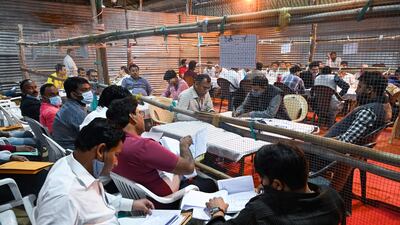
Electoral officials and polling agents wait for electronic voting machines (EVMs) to arrive at a counting centre for the Uttar Pradesh state assembly election votes in Ghaziabad. AFP -

An electoral official shows an open EVM during counting in Ghaziabad. AFP -
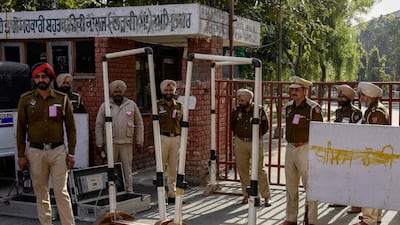
Police stand guard outside a counting centre in Amritsar, Punjab state. AFP -
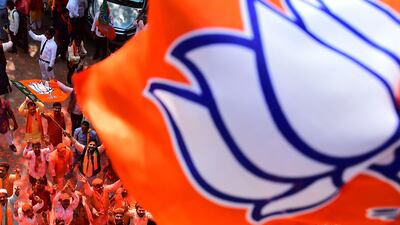
Supporters of India's Bharatiya Janata Party (BJP) celebrate outside the party office in Lucknow. AFP -
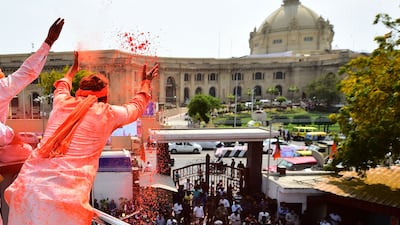
The BJP faithful celebrate in colourful style. AFP -
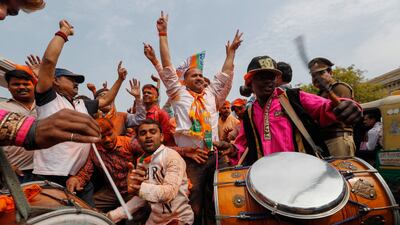
India's election authority started counting votes on Thursday in five states' elections that are a crucial test for Prime Minister Narendra Modi’s Hindu nationalist BJP. AP Photo -
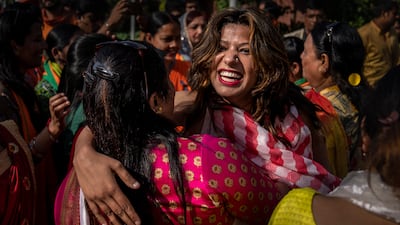
The BJP has a commanding lead in crucial state polls, despite soaring unemployment and farmer protests in India. AP Photo -
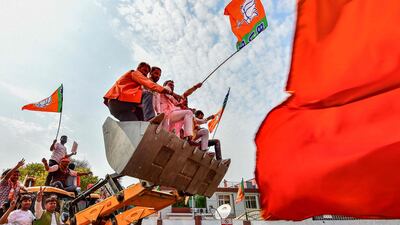
National elections take place in 2024. AFP -

A brass band member plays as BJP supporters celebrate election results at the party headquarters in New Delhi. AP Photo -
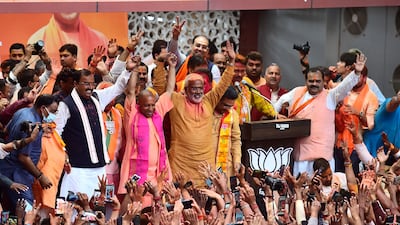
Chief Minister of India's Uttar Pradesh state Yogi Adityanath (wearing pink scarf) gestures to his supporters after BJP's win, in Lucknow. AFP -
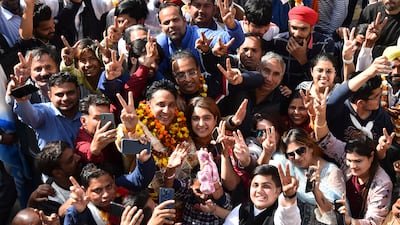
Ajay Gupta, from the Aam Aadmi Party, celebrates with supporters in Amritsar. AP Photo -
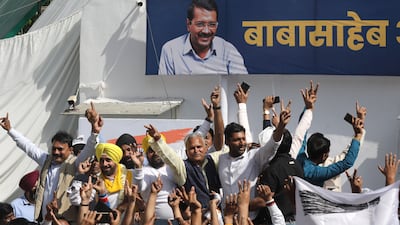
AAP workers celebrate at their party office after the party took the lead during vote counting for the Punjab Assembly election in New Delhi. EPA -
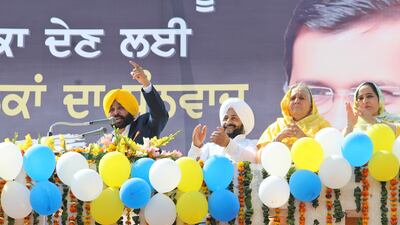
The AAP, which was formed in 2013 to eliminate corruption and has since ruled the national territory of Delhi for two consecutive terms, was fighting to oust the opposition Congress party. AP Photo -
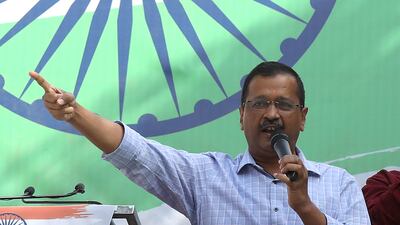
AAP, already ruling in Delhi state, is emerging as a national party after the Manipur, Goa, Uttar Pradesh, Uttarakhand and Punjab state elections results. EPA


Prashant Bhushan, the lawyer who represented the petitioners, said the judgment was “salutary” and will enhance the democratic process.
Mr Modi’s government had argued that the legislation was introduced to “cleanse the system of political funding in the country” and that it ensures transparency and promotes adherence to tax obligations.
The ruling comes at a critical time when political parties are gearing up for the national election due to take place in May.
Mr Modi's Bhartiya Janata Party has been the biggest beneficiary of the scheme, raking up billions of rupees since the law was introduced.
It had received 52.7 billion rupees from a total of 92 billion rupees ($1.1 billion), or 57 per cent of the value of electoral bonds sold from 2018 to 2022, according to Election Commission data.
The main opposition, the Congress Party, received 9.6 billion rupees, or 10 per cent, in the same period.
The BJP had received 13 billion rupees in electoral bonds last year, about seven times more than Congress which received 1.7 billion rupees.
Opposition leader Rahul Gandhi of the Congress Party said the verdict was proof of the "corrupt policies" of Mr Modi's government.
"BJP had made electoral bonds a medium for taking bribes and commission," he said.
What were electoral bonds?
Electoral bonds were a financial instrument that allowed donors to fund political parties. An individual was not required to publicly declare the amount donated.
The scheme was introduced through amendments to the Finance Acts of 2016 and 2017.
The new system removed capping that had restricted funding to 7.5 per cent of the corporate organisation's average net profit over the previous three-year period.
Cash donations from individual people was restricted to 2,000 rupees ($24).
The Finance Bill 2017 that legalised electoral bonds also courted controversy, because the government had introduced the proposed legislation in parliament as a "Money Bill", marking it as draft legislation that would not require a vote in the upper house, where Mr Modi’s administration was in the minority.
How did it work?
A person or corporation could buy bonds of any value between 1,000 and 10 million rupees ($12 to $120,000) from the State Bank of India, but donate numerous bonds to an eligible political party registered with the Election Commission, having at least 1 per cent of the votes polled in the last general and assembly election.
The parties could then cash the donated bonds within two weeks.
The bonds did not carry the name of the donor and even the political parties did not know their identity, although banks kept the information for auditing purposes and to ensure that such funding was legitimate.
Critics said the government could easily access donor details from the state-controlled bank and target individuals and corporations that funded its political opponents.
Why the criticism?
Those opposed to the scheme said the anonymity of donors could lead to corruption and quid pro quo in forming government policies.
The petitioners argued that the “government had legalised kickbacks" through the bond scheme.
Mr Bhushan had previously said that the scheme was fashioned in a way that the money could secretly pass through several hands to reach the ultimate beneficiary political party, creating further layers of opaqueness and potential for money laundering.
The government argued that it was not a fundamental right of citizens to know the source of donated funds.
Why are parties funded?
Indian elections are on an enormous scale and are the world’s costliest.
There are 28 states in the country and at least one state election takes place every year.
An election typically features extravagant public rallies, events, social media campaigns and widespread advertisements, for which political parties need money and are thus becoming increasingly dependent on donations.

