

About one third of the victims in the suicide bombing in Pakistan's Bajaur district were children, raising questions from their families about why they were at a political rally instead of at the religious schools where many of them were enrolled.
Officials said at least 63 people were killed and more than 120 injured when a suicide bomber detonated an explosive at a meeting of the Jamiat Ulema-e-Islam-Fazl, or JUI-F, party on July 30. The dead included 23 people under the age of 18, including eight-year-old Musa Khan.
Musa's older brother, Anwar Khan, said the boy left their home in Shindai Morh village to attend lessons at the local religious school, or madrassa.
Mr Khan said he and his father were at work and did not learn about Musa's fate until someone showed him a post about the bombing on social media.
“When I decided to stop working, someone showed me a Facebook post that contained the photo of my younger brother Musa,” he said.
When he called the number mentioned in the post, he was told that Musa was in Timergara Hospital in Lower Dir, a district adjacent to Bajaur.
“Later when I started travelling [there], I was informed that the child had breathed his last,” Mr Khan said.
-
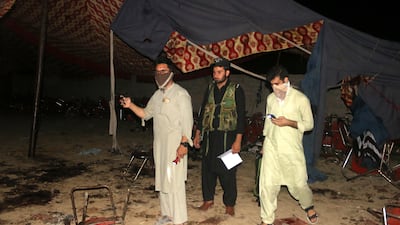
People survey the site of a blast targeting a gathering of hardline political party Jamiat Ulma-e-Islam-Fazl in Bajaur, Pakistan on Sunday. EPA -
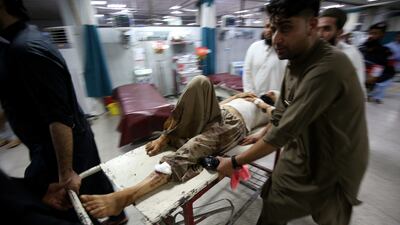
A wounded man is taken for treatment at a hospital in Peshawar following a blast in Bajaur, Pakistan. EPA -
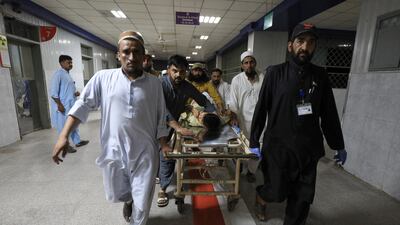
A wounded man is transported for treatment to the Lady Reading Hospital in Peshawar following a blast that killed at least 44 people in Bajaur, Pakistan. Reuters -
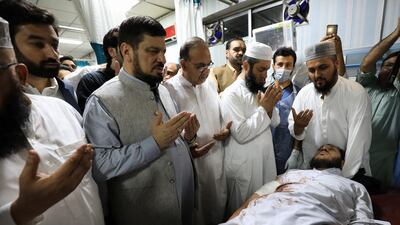
Governor of Khyber Pakhtunkhwa province, Haji Ghulam Ali, prays while visiting an injured man in hospital in Peshawar, Pakistan. Reuters -
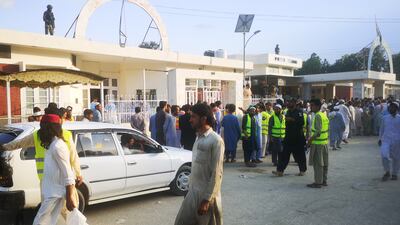
Rescue workers outside a hospital after a blast aimed at a gathering of political party Jamiat Ulma-e-Islam-Fazl in Bajaur, Pakistan, on July 30. At least 44 people were killed. EPA -
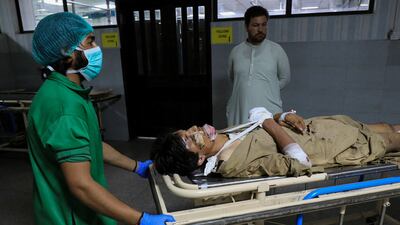
A paramedical staff wheels a man who was injured in the blast in the Bajaur district of Khyber Pakhtunkhwa, at the Lady Reading Hospital in Peshawar, Pakistan. Reuters -
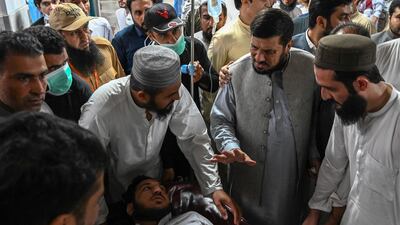
Haji Ghulam Ali, second from right, Governor of Khyber Pakhtunkhwa province, greets an injured man in a hospital in Peshawar. AFP -

A man injured in the blast is taken into a hospital in Peshawar. AFP -
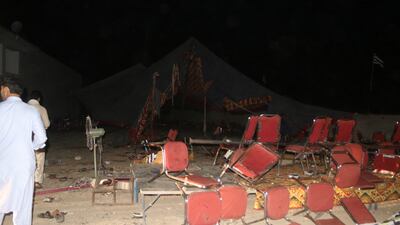
The site of a blast, which was a gathering of political party Jamiat Ulma-e-Islam-Fazl in Bajaur. EPA -
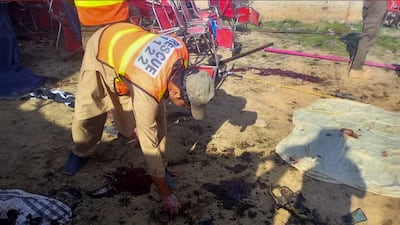
A rescue worker inspects the site after the bomb blast. AFP -

People take coffins to collect bodies of the victims outside a hospital after the blast. EPA -

Locals gather outside a hospital after the blast in Bajaur. EPA


His other brother, aged 12, also went to the rally and was injured, but recovered after treatment at the local hospital.
Maulvi Sultan, administrator of the madrassa where Musa studied, said the pupils had been allowed to go home early that day.
“We did not ask the students to go to the rally – it was their own decision,” he told The National.
Imadud Din, administrator of another madrassa, also denied that pupils had been told to go to the rally. One pupil from Mr Din's madrassa died and three others were injured in the blast.
“Maybe they had no classes and were free, that’s why they may have gone to the rally of their own will,” he said.
Momin Khan, the uncle of a child who was injured in the blast, told The National that the family did not know that the boy had gone to the political meeting.
“Our child has been staying at the madrassa and visits home from time to time,” he said. “When we learnt that he had been wounded in the rally, we asked his madrassa teacher whether we had sent him for lessons or to take part in the rally. The teacher could not answer the question.”
Rahmanullah, a resident of Bajaur whose young nephew was injured, said parents often did not keep track of their children's whereabouts after they left home for lessons at the madrasas.
“From now onwards, people should communicate with the madrassa teachers and ensure that the children remain in the school and do not go anywhere else,” he said.
Not all the children who died were madrassa pupils.
Abu Zar, 12, a Grade 7 pupil a government school, had gone to the rally to sell snacks, his father, Javed, said.
He said Abu Zar, the only boy among his eight children, used to sell food to help support the family.
A security official told The National it was a risky decision to hold a political meeting in a volatile area like Bajaur, part of the Khyber Pakhtunkhwa province that has seen a rise in militant attacks in recent years, mostly by the Tehreek-e-Taliban Pakistan.
The TTP denied carrying out the attack, which was later claimed by the regional branch of ISIS.
Investigators said they had obtained a photograph of the bomber showing him with one hand on the explosives he was carrying on his back.
They said he crossed the border from Afghanistan, which is about 20 kilometres away from Khar, the main town in Bajaur.
“The bomber’s get-up resembled that of the JUI-F activists. Under such circumstances, it was difficult to identify him amid the crowd of people arriving at the venue, which the party's own volunteer force were guarding armed with batons,” the security official said.

