

Students, businessmen and delivery workers are among millions of people affected by four days of internet shutdown imposed in Pakistan because of political violence.
Internet services were cut off after the arrest of former prime minister Imran Khan on Tuesday, which sparked violent protests and arson attacks across the country. Mr Khan was granted two weeks' bail on Friday as his supporters planned further demonstrations.
Interior Minister Rana Sanaullah said the internet ban would continue until all the instigators and perpetrators of the violence had been arrested.
Speaking to the Geo News channel, Mr Sanaullah said he would seek the prime minister’s advice if the situation regarding Mr Khan persisted beyond May 17.
The decision to suspend mobile broadband to the country’s 125 million subscribers and block access to social media apps has caused widespread frustration and inconvenience.
""I can't get orders because mobile data isn't working," said Sultan Niaz, 25, a food delivery rider who estimated that the shutdown cost him 9,000 rupees ($30) in lost earnings over three days.
Mr Niaz relies on the WhatsApp messaging service to receive food orders and to track down customers through the main roads, narrow streets and densely populated neighbourhoods of Peshawar. Finding a location in Pakistan's oldest city can be difficult because not every street and structure is properly named or numbered.
Apart from the loss of GPS-based tracking, security forces have blocked roads and intersections in Peshawar and other major cities to deter protesters, meaning Mr Niaz has to use longer alternative routes that consume more fuel for his motorcycle.
"Roadblocks and data outages have ruined my days," he said.
Muhammad Imran, 24, said he was unable to submit his application for a post-graduate course in the UK online and had to travel 136km from Dir to Peshawar to make sure it was received on time.
"Normally, it takes three hours to reach Peshawar, but due to protests and the closure of the main routes, it took me five hours to get there. It was quite disturbing and worrying," he said.
For Asim Khan, who lives in a village in the Upper Dir area of Pakistan's north-western Khyber Pakhtunkhwa province, the internet restrictions have left him feeling cut off from the rest of the country during a significant time.
"We rely on social media for news, but with most social media apps being restricted since Tuesday, we feel disconnected from the events taking place in Islamabad or Peshawar and other provinces," Mr Khan said.
-
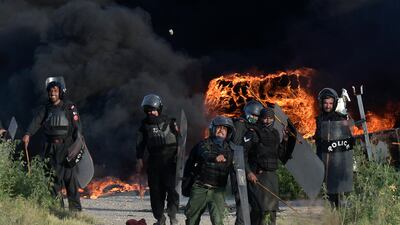
Pakistani police officers throw stones towards supporters of former prime minister Imran Khan during clashes in Islamabad. AP -
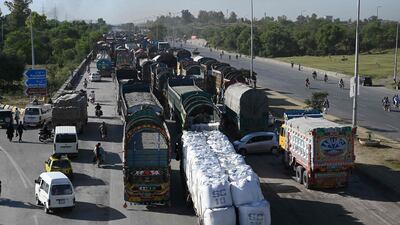
A motorway leading into Islamabad is blocked by supporters of Mr Khan as they protest against his arrest. AFP -

Mr Khan's supporters protest outside Avenfield House, the home of former Pakistani prime minister Nawaz Sharif, in London. Bloomberg -
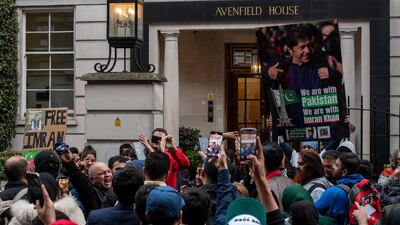
Nawaz Sharif is the brother of current Pakistani Prime Minister Shehbaz Sharif. Bloomberg -

Policewomen detain a supporter of Mr Khan in Karachi during a protest against his arrest. AFP -
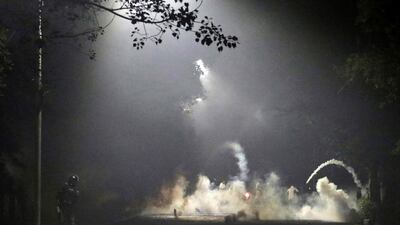
A security officer stands near tear gas fired during clashes with supporters of Mr Khan in Lahore. EPA -
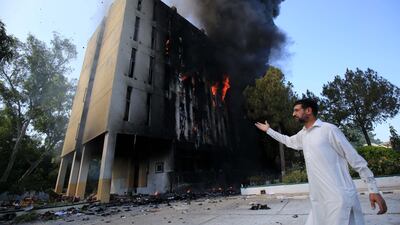
The Radio Pakistan building in Peshawar was set on fire during the protests. EPA -
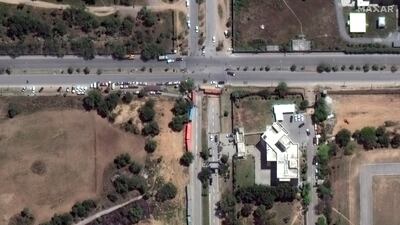
A satellite image shows heavy security around police headquarters in Islamabad after Mr Khan's arrest. Reuters -
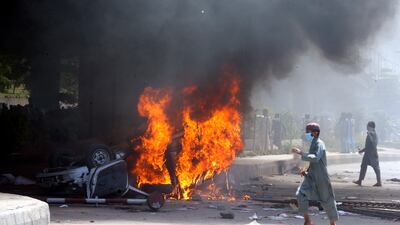
A car set on fire in Peshawar by supporters of Mr Khan during a protest. AP -
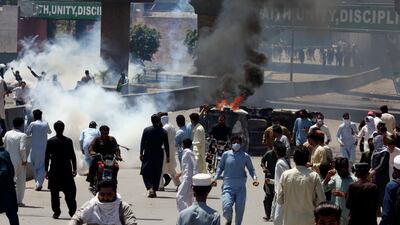
Mr Khan, 71, was expected to attend a hearing. AP -
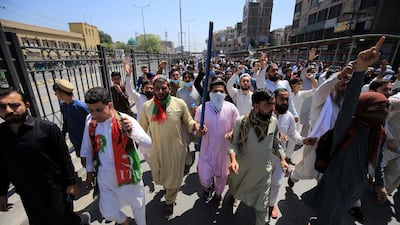
The government shut down Twitter, Facebook and YouTube across much of the country after the arrest. EPA -
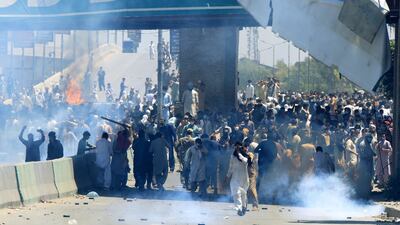
Authorities suspended the right of assembly in capital Islamabad and throughout Mr Khan's native province of Punjab. EPA -
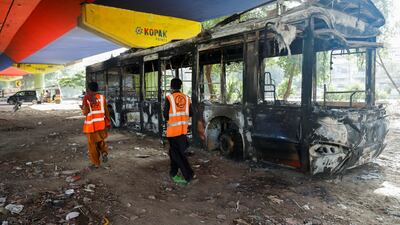
The shell of a bus set on fire during protests in Karachi. Reuters -

The debris of a check point set on fire by Mr Khan's supporters in Karachi. Reuters -
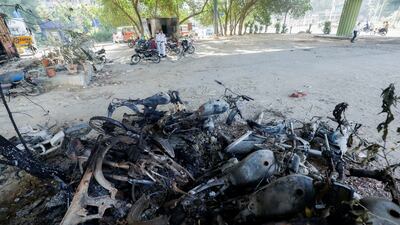
Motorcycles were also set on fire by Khan supporters. Reuters -
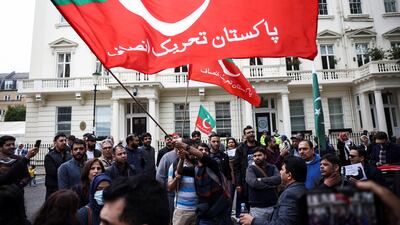
A protest against Mr Khan's arrest outside the High Commission for Pakistan in London. Reuters -

Pakistan Tehreek-e-Insaf (PTI) party activists protest against the arrest of their leader in Islamabad. AFP -
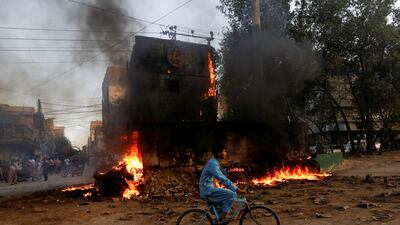
A paramilitary checkpoint burnt down during a protest in Karachi. Reuters -
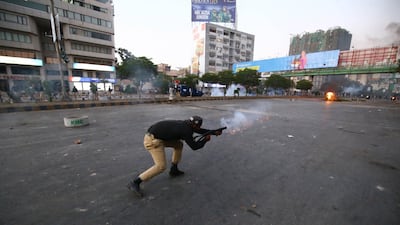
An officer fires a tear gas shell at Mr Khan's supporters in Karachi. EPA -
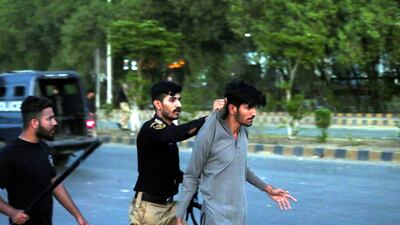
A supporter of Mr Khan is arrested in Karachi. EPA -
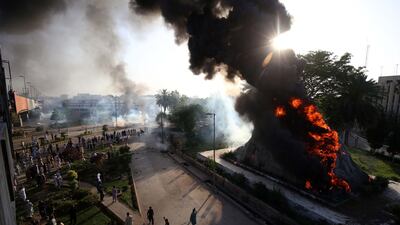
The Radio Pakistan premises after it was set on fire during clashes between police and Khan supporters in Peshawar. EPA -
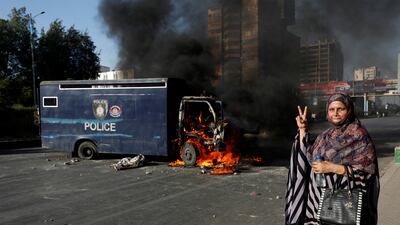
A burning police vehicle during a protest. Reuters -

Plain-clothes police officers beat a Khan supporter during a protest in Peshawar. AP -
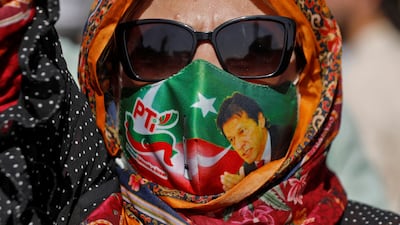
A supporter of Mr Khan participates in a protest against his arrest in Peshawar. Reuters -

Policemen retreat after firing tear gas shells towards supporters of Mr Khan protesting against his arrest in Karachi. AFP -
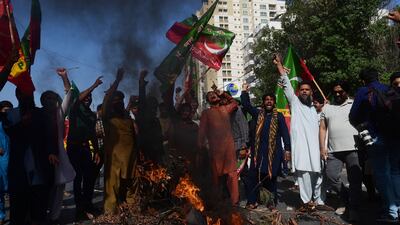
Supporters of Mr Khan block a road during a protest against his arrest. AFP -

Mr Khan sits in Islamabad's High Court moments before paramilitary troops entered and arrested him. Reuters -

Mr Khan is taken into a vehicle by police as they arrest him. Reuters -

Pakistani paramilitary troops walk to the court where Mr Khan is appearing in Islamabad. AP -

Mr Khan's lawyer receives medical attention after he was injured during his client's arrest. Reuters -
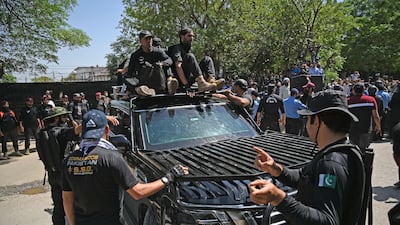
Security personnel escort a car carrying Mr Khan as he arrives at the court. AFP -
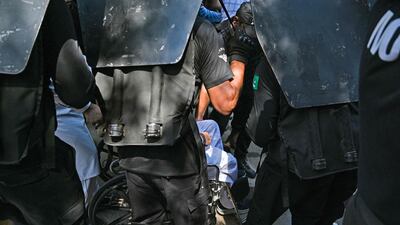
The guards apparently protected Mr Khan, seen sitting in a wheelchair, from protesters. He was later arrested. AFP -
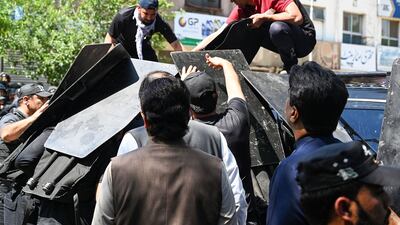
Mr Khan is protected with bullet proof shields. AFP -
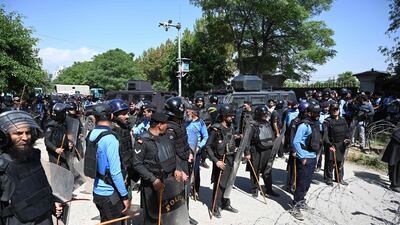
Mr Khan's party said he was arrested on what they claim are politically-motivated charges. AFP


Siraj Udin has a full-time job but also has a side business selling goods through Amazon. Usually he is able to keep an eye on his Amazon business account even while at work, but not since mobile internet services were blocked.
"Normally, I check my Amazon account every two to three hours to see if there are any orders, messages, or comments. However, due to the internet shutdown, I wasn't able to check my account for nine to 10 hours of work," he said.
Human rights organisations criticised the shutdown and called on the government to lift the restrictions immediately.
Human Rights Watch said that besides the adverse effect on businesses, the economy and education, the sweeping measure denied ordinary people access to lifesaving information, interfered with access to health care, and restricted the ability of journalists to upload photos and videos documenting government overreach and abuse.
"The most difficult thing for us was staying in touch with our organisation and collecting data," said Wasim Sajjad, a journalist working with an international news organisation.
Sending images of the protests was also challenging, he told The National.
"After staying for a while and shooting in the protest, I would return and somehow try to connect to a broadband connection which was luckily working to send visuals," he said.
"Going back to the field was also a challenge because the main routes were closed. It was hard to manage, but we did our best to keep updating the office."
He said keeping in touch with his family to assure them he was safe while covering the protests was also difficult.
Aside from causing an information blackout and impeding communication, the shutdown is taking a toll on the struggling economy as the country awaits a $1 billion bail-out from the International Monetary Fund.
According to reports in the Pakistani media, the telecommunication sector has suffered a loss of $2.85 million since Tuesday, while the government has lost nearly $1 million in tax revenue.
As soon as the shutdown was announced on Tuesday, Twitter users began to share ways to bypass the ban and to discuss the most effective VPN services.
According to a post by one user, Zubair Ud Din, Mr Khan and hashtags expressing support for him were among the top trends on Twitter despite the platform being officially blocked in Pakistan.

