

China’s near total reversal of border controls to stem the spread of Covid-19 came into effect on Sunday.
It ends almost three years of strict entry requirements that have slowed economic growth in a country that accounts for nearly 20 per cent of global gross domestic product.
-
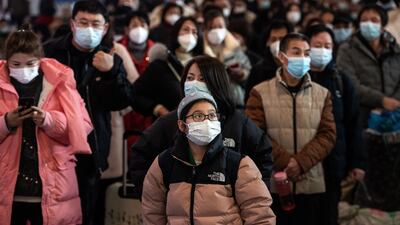
Passengers arrive at Hankou railway station on the first day of peak travel ahead of the Lunar New Year holiday in Wuhan, Hubei province. AFP -
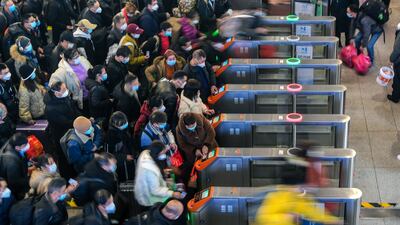
People wearing masks rush to catch their trains in Suzhou, a city in eastern China's Jiangsu province. This Lunar New Year public holiday, which officially begins on January 21, will be the first since 2020 without coronavirus travel restrictions. Xinhua via AP -

Passengers at Hankou railway station in Wuhan. China is bracing itself for an increase in the spread of coronavirus infections amid the large amount of travelling. AFP -
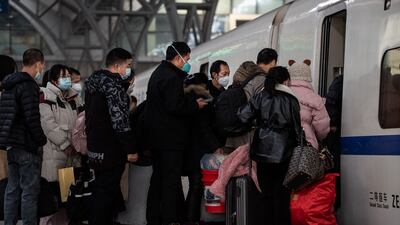
Passengers board their train at Hankou railway station in Wuhan. AFP -
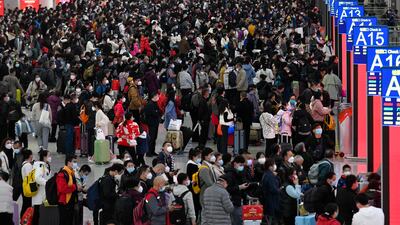
People wearing masks prepare to catch their trains at the North Railway Station in Shenzhen, a city in southern China's Guangdong province. Xinhua via AP -
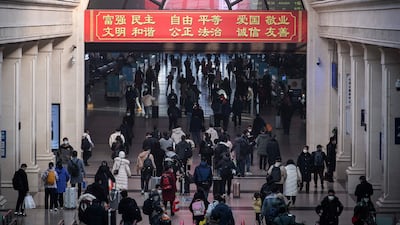
Passengers arrive at Hankou railway station in Wuhan. AFP -
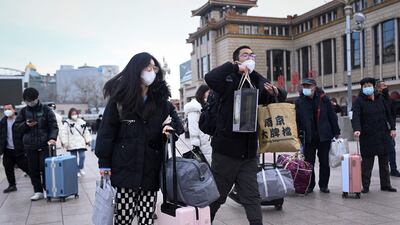
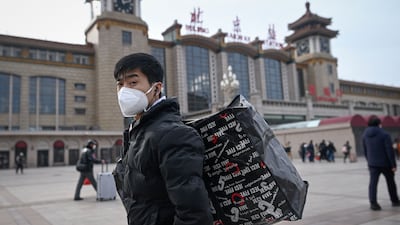
Passengers make their way to a Beijing railway station as people go back to their hometowns for Lunar New Year celebrations. AFP -
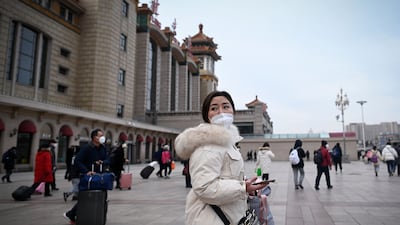
This Lunar New Year public holiday, which officially begins on January 21, will be the first since 2020 without coronavirus travel restrictions. AFP -

China's Ministry of Transport said on Friday that it expects more than two billion passengers trips over the next 40 days. AFP -
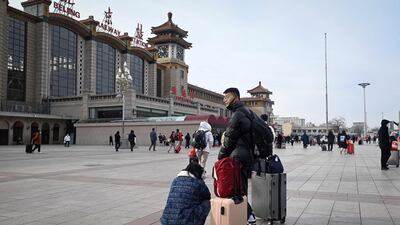
China on Saturday marked the first day of chunyun, the 40-day period of Lunar New Year travel, and braced itself for an increase in the spread of coronavirus infections. AFP -
China has dismantled its zero-Covid policy over the past month following protests against frequent testing, restricted movement and mass lockdowns. AFP


Many Chinese entering the country have been apart from their loved ones for years. They are coming more than a month after Beijing decided to end its zero-Covid policy, during which entire districts of major cities were regularly locked down for weeks and sometimes months on end.
Long queues formed at Hong Kong's international airport for flights to mainland cities, including Beijing, Tianjin and Xiamen. Some Hong Kong media outlets estimated that thousands of people were travelling.
Investors, economists and ordinary Chinese citizens have praised the end of the zero-Covid policy, which was blamed for a surge in youth unemployment.
But the end of travel and lockdown restrictions has also been accompanied by concerns over sub-variants of the globally dominant Omicron strain, such as BA.5.2 and BF.7, which experts say have driven a surge in cases in China.
Some experts worry that a wave of cases in China owing to the sudden end of Covid control policies could lead to dangerous new variants. The health authorities in Beijing are on alert to detect new strains of the disease.
Other countries have also reported new variants in recent weeks, with XBB.1.5, a variant dubbed “the kraken,” gaining traction in the US.
“I'm so happy, so happy, so excited. I haven't seen my parents for many years," said Hong Kong resident Teresa Chow as she and dozens of other travellers prepared to cross over to mainland China from Hong Kong's Lok Ma Chau checkpoint early on Sunday.
"My parents are not in good health, and I couldn't go back to see them even when they had colon cancer, so I'm really happy to go back and see them now," she said, adding that she plans to travel to her hometown in eastern China's Ningbo city.
Investors hope the reopening will eventually reinvigorate a $17-trillion economy suffering its lowest growth in nearly half a century. But the abrupt policy reversal has triggered a wave of infections that is overwhelming some hospitals and causing business disruptions.
The border opening follows Saturday's start of chun yun, the first 40-day period of Lunar New Year travel. Before the pandemic this was the world's largest annual migration of people, as millions returned to their hometowns or went on holiday with family.
About two billion trips are expected to be made this season, nearly double last year's movement and recovering to 70 per cent of 2019 levels, the government says.
Many Chinese are also expected to start travelling abroad, a long-awaited shift for tourist spots in countries such as Thailand and Indonesia. However, several governments — worried about a surge in Covid — are imposing curbs on travellers from the country.
Travel will not quickly return to pre-pandemic levels due to such factors as a lack of international flights, analysts say.
China on Sunday also resumed issuing passports and travel visas for mainland residents, and ordinary visas and residence permits for foreigners. Beijing has quotas on the number of people who can travel between Hong Kong and China each day.

