


Afghanistan’s diaspora has a role in rebuilding their country but stability and prosperity rely on respecting women’s rights, US Afghanistan Envoy Thomas West told a delegation of senior Taliban officials in a rare meeting in the UAE this week.
Mr West held talks with top Taliban officials, including acting defence minister Mullah Mohammed Yaqoub Mujahid, while both were in the UAE. He raised issues of security, stability and respect for human rights.
A US State Department official told The National that the meeting came about as "West’s visit to the UAE overlapped with a Taliban delegation".
"As a part of our policy of pragmatic engagement to advance our interests, West took advantage of the opportunity to meet with the Taliban representatives to engage on issues of great importance to the United States and the international community, including the deteriorating human rights situation and the restrictions that the Taliban are placing on women and girls," the official said.
The meeting came as the Taliban on Wednesday carried out the first public execution since their return to power in 2021. The man, they said, was convicted of murder.
The Taliban’s treatment of women is also in the spotlight after an international backlash at footage of women being publically flogged for “moral crimes”.
“[Afghanistan’s] economic and social stability, and the Taliban’s domestic and international legitimacy, depend enormously on their treatment of Afghanistan’s mothers and daughters,” Mr West said on Twitter shortly after the Abu Dhabi meeting.
The US and other western states have repeatedly said that their willingness to engage officially and continue to support Afghanistan depends on respect for rights and freedoms.
In recent weeks, the Taliban leadership has issued edicts heavily curtailing the rights of women, limiting their employment and barring their entry into public parks. Afghan girls above grade six have been prohibited from attending school in most provinces for more than 440 days.
Taliban fighters celebrate a year in power - in pictures
-
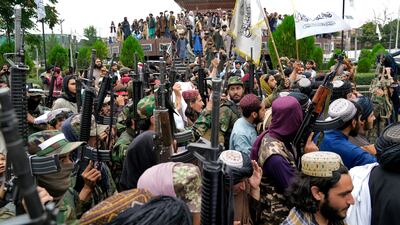
Taliban fighters celebrate the first anniversary of their return to power in Afghanistan, in front of the former US embassy in Kabul. AP -
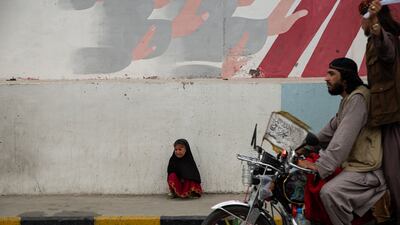
A girl cries on the pavement as men ride by on a motorbike, during celebrations in Kabul marking the first anniversary of Taliban's return to power. Getty -
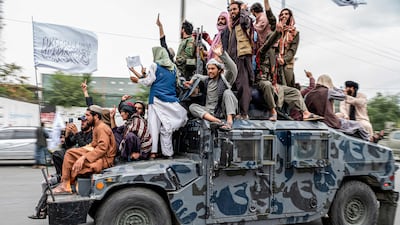
Taliban fighters hold weapons as they ride on a humvee in Kabul as during celebrations marking a year since their return to power in Afghanistan. AFP -
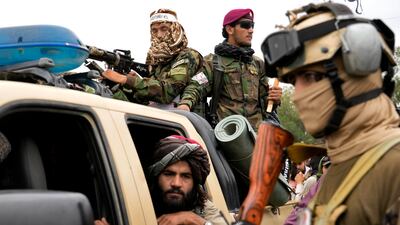
On August 15, 2021, the Taliban took control of Kabul after an 11-day blitz through Afghanistan. AP -
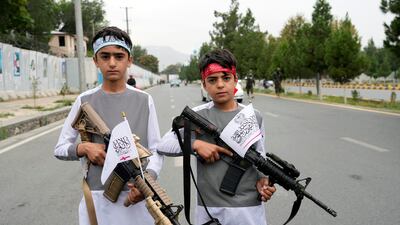
Afghan boys hold weapons as they join the celebrations. AP -
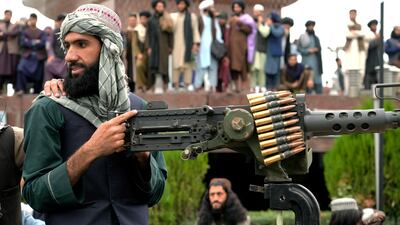
A Taliban fighter mans his weapon during the mass gathering in Kabul. AP -
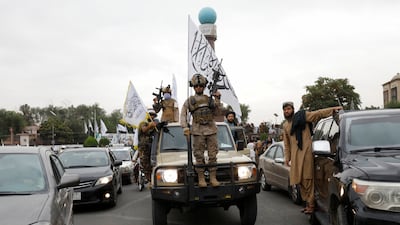
Taliban fighters drive in procession through the streets of the Afghan capital. Reuters -
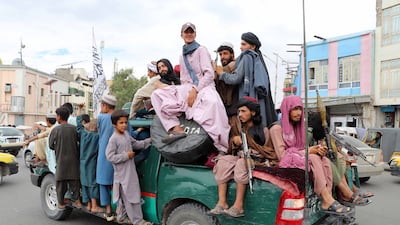
There were also celebrations in Kandahar, the extremists' seat of power. EPA -
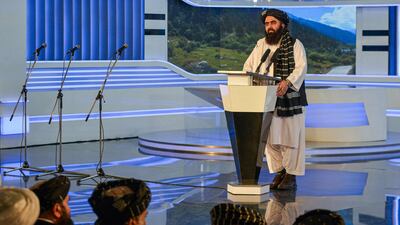
Foreign Minister Amir Khan Muttaqi gives a speech at an event in Kabul marking the first anniversary of the Taliban's return to power in Afghanistan. AFP -
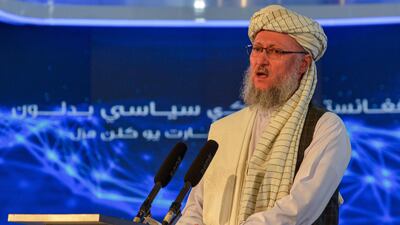
Deputy Prime Minister Abdul Salam Hanafi at the podium at an event in Kabul marking the first anniversary of the Taliban's return to power. AFP -
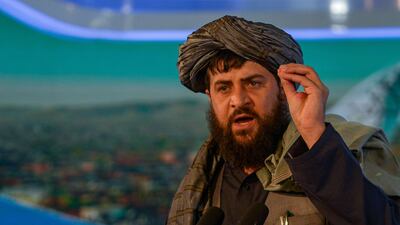
Acting Defence Minister Mohammad Yaqoob speaks at a gathering in Kabul to mark the first anniversary of the Taliban's return to power. AFP -
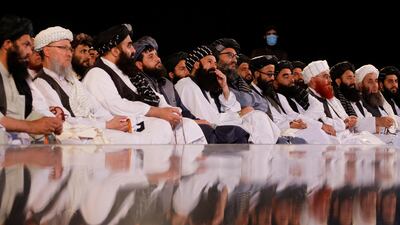
Taliban leaders attended an anniversary ceremony in Kabul. Reuters -
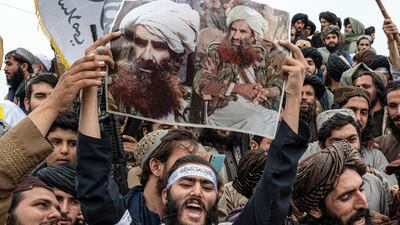
Outside the US embassy, fighters chanted victory slogans. AFP -
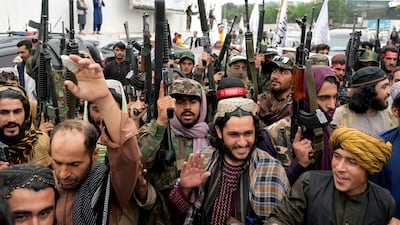
The fighters' show of force. AP -
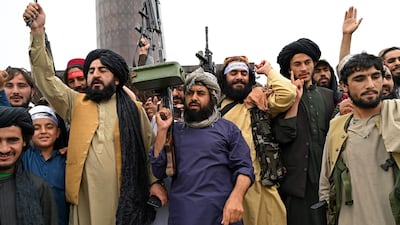
Taliban fighters hold rifles while chanting victory slogans at Ahmad Shah Massoud Square near the US embassy. AFP -
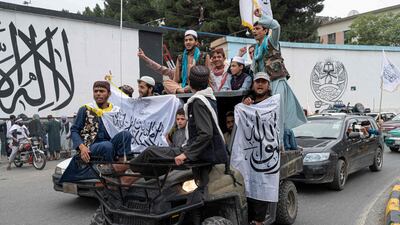
Taliban fighters ride in a convoy near the US embassy in Kabul. AFP -
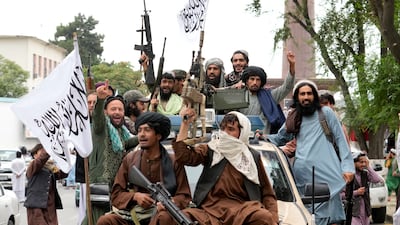
A year ago, the country's western-backed government fled and the Afghan military crumbled in the face of the Taliban advance. AP -
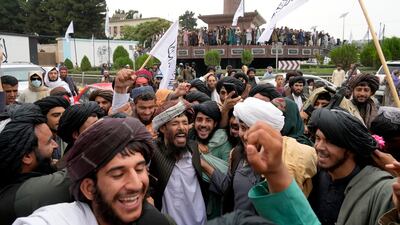
The chaotic withdrawal of foreign forces continued until August 31, as tens of thousands of Afghans and foreigners clamoured to board flights out of the country. AP -
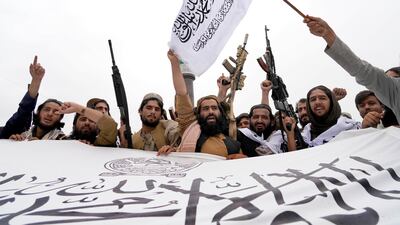
The Taliban authorities have so far not announced any official celebrations to mark the anniversary, but state television said it would air special programmes. AP -
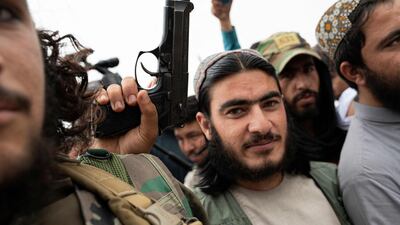
For ordinary Afghans, especially women, the return of the Taliban has increased hardships. Aid agencies say that half the country's 38 million people face extreme poverty. AFP -
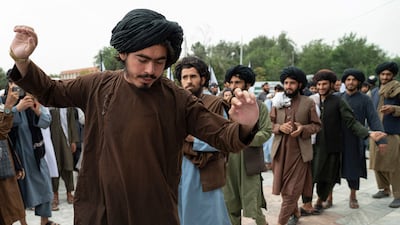
Initially, the Taliban promised a softer version of their harsh interpretation of Islamist rule that characterised their first stint in power from 1996 to 2001. But many restrictions have been imposed on women. AFP -
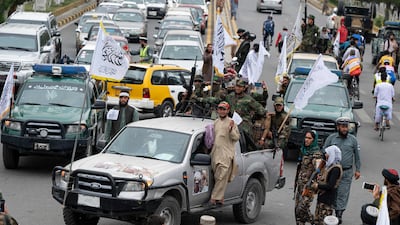
Tens of thousands of girls have been shut out of secondary schools, while women have been barred from returning to many government jobs. AFP


Mr West also discussed security matters with the Taliban delegation, including counter-terrorism efforts against ISIS.
Despite a huge reduction in bloodshed since the Taliban overran the government as the US withdrew in 2021, the country has still been rocked by attacks carried out by extremist groups.
Even after the US exit, however, Washington has said it will continue to take action against extremists that threaten its interests and security.
This was underscored on July 31 when a US precision drone strike in a heavily populated neighbourhood in central Kabul allegedly killed Ayman Al Zawahiri, the head of Al Qaeda and one of the world’s most wanted terrorists.
Mr Al Zawahiri’s apparent presence in the Afghan capital, where he is thought to have been living for months, cast into doubt Taliban assurances to the US that the group was now in the business of fighting terrorists rather than sheltering them.
Meanwhile, the Taliban has called on the West to drop international sanctions on the group to prevent the collapse of the economy and allow the country to rebuild after years of violence.
These sanctions largely target individual Taliban members rather than Afghan government institutions, but their vague parameters leave many banks, companies and even NGOs outside Afghanistan unwilling to deal with the country.
The US also continues to hold billions of dollars of Afghanistan’s national reserves, leaving the Taliban government short of cash with which to pay public-sector workers, including teachers.
The Taliban, meanwhile, have sought out Afghanistan’s large diaspora community, particularly in nearby countries, to attract investment and remittances to help boost the failing economy.
Mr Yaqoub was accompanied on his visit to the UAE by Anas Haqqani, a senior Taliban adviser and brother of acting interior minister Sirajuddin Haqqani.
Mr Haqqani addressed a large gathering of Afghan expatriates at a Dubai hotel on Tuesday, where he urged them to invest in Afghanistan and blamed years of foreign occupation and propaganda for sowing division among Afghans.
While Mr Haqqani’s speech was hostile towards the US, on Twitter Mr West suggested Washington was supportive of the message that Afghans in the UAE and elsewhere should play a greater role in revitalising their country’s economy.
“The UAE is … a long-time hub for Afghan businesses looking to grow [the Afghan] economy,” Mr West said.
Washington and the UAE shared the desire to “encourage policies that attract investment” in Afghanistan, Mr West said.
During their visit to the UAE, Mr Yaqoub and Mr Haqqani also met President Sheikh Mohamed, as well as Sheikh Mohammed bin Rashid, Vice President and Ruler of Dubai.
The UAE has played a significant role not only as a host to the US-Taliban meeting but also as a facilitator of humanitarian aid and diplomatic progress in Afghanistan.

