
North Korea fired an intercontinental ballistic missile (ICBM) above Japan's eastern waters on Thursday — part of a record-breaking series of launches over the past 24 hours.
Alarms blared from radios and public loudspeakers as fishermen hurried back to shore in northern Japan on Thursday, AP reported.
North Korea has now fired more missiles in 24 hours than it did during the whole of 2017.
Seoul's military had earlier said North Korea fired an intercontinental ballistic missile on Thursday, although it said that the launch appeared to have failed.
“North Korea's ICBM launch presumed to have ended in failure,” South Korea's military said.
It said the launch was “assessed to have failed in second stage separation”.
Seoul's Joint Chiefs of Staff said they detected the launch of a long-range ICBM, followed by two short-range ballistic missiles.
“The range of the long-range ballistic missile is around 760 kilometres, altitude of 1,920km at speed of Mach 15,” they said.
“The short-range ballistic missiles flew around 330km at an altitude of around 70km at speed of Mach 5.
“North Korea's successive launch of ballistic missiles is a serious provocation that harms the peace and stability of not only the Korean Peninsula but also the international community.
-
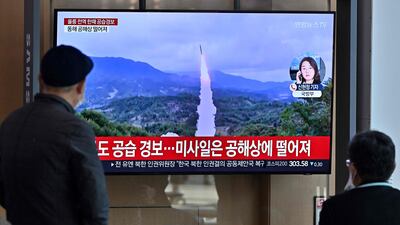
Air raid sirens sounded across South Korea as North Korea tested its missile systems on Wednesday, including one that fell close to South Korean waters. Here, travellers at a railway station in Seoul watch a news broadcast. AFP -
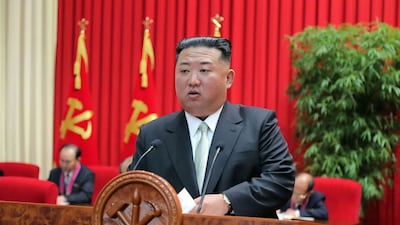
North Korean leader Kim Jong Un delivers a speech at the Central Academy of the Workers' Party of Korea in Pyongyang on October 18. AFP -
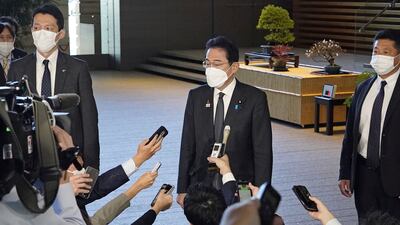
In Tokyo, Japanese Prime Minister Fumio Kishida speaks to reporters about North Korea's ballistic missile test on Wednesday. Reuters -

South Korea's President Yoon Suk-yeol, centre, attends a meeting of the National Security Council in Seoul, South Korea, on Wednesday. AP -
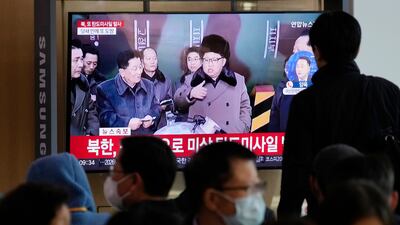
Travellers at Seoul Railway Station watch a TV news report on North Korea's missile tests. AP -
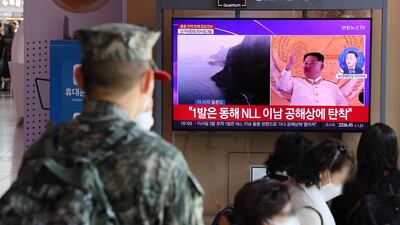
A soldier at Seoul Railway Station watches a TV news report about North Korea's missile tests. EPA -
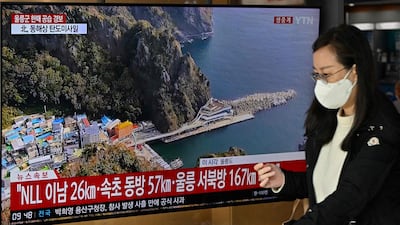
Television news in South Korea reports news of North Korea's missile tests. On Wednesday, Seoul told residents on the island of Ulleungdo off its east coast to evacuate to bunkers after North Korea fired three short range ballistic missiles. AFP -
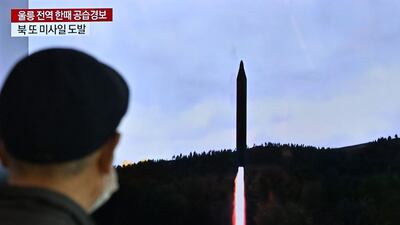
At a railway station in Seoul on Wednesday, a man watches a television broadcast showing a news broadcast with file footage of a North Korean missile test. AFP


“The South Korean military will maintain a firm readiness posture to overwhelmingly respond to any provocation from North Korea.”
Japan’s military said it lost track of one of the North Korean weapons, apparently the ICBM, after it disappeared from the skies over water between the Korean Peninsula and Japan.
The launches come during South Korea and the US's largest joint air drills yet, known as Vigilant Storm, involving hundreds of war aircraft. They will end on Friday.
Such exercises infuriate Pyongyang, which sees them as a rehearsal for invasion and said on Wednesday that South Korea and the US would “pay the most horrible price in history” if they did not halt them.
North Korea fired more than 20 missiles on Wednesday, including one that landed near South Korea's territorial waters, which Seoul said was “effectively a territorial invasion”.
In March, North Korea is believed to have failed in an apparent attempt to test its largest and most powerful ICBM, the Hwasong-17.
Seoul and Washington said at the time that the missile exploded shortly after launch, with the explosion visible in the sky above Pyongyang.
Another ICBM test is also believed to have failed in May, Seoul's military said.

