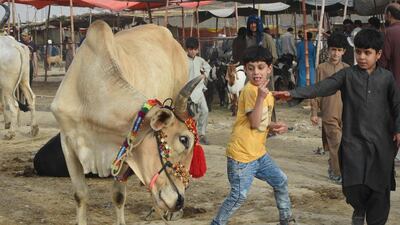
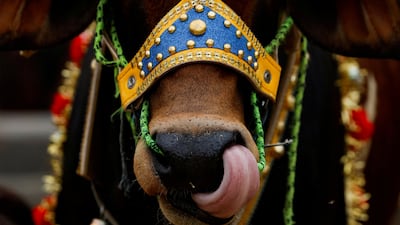
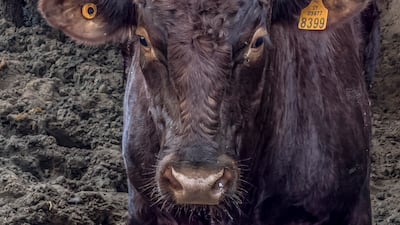
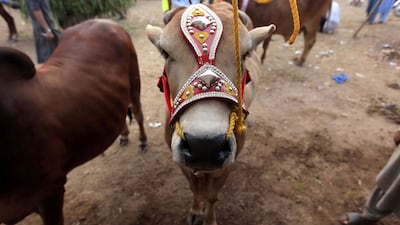
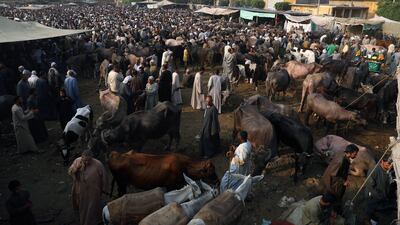
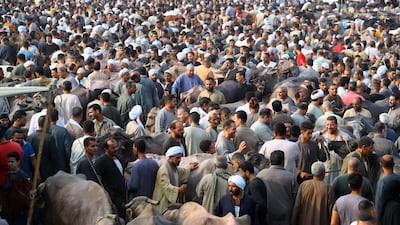
A buyer inspects a cow at an Eid livestock market in Islamabad. Bloomberg

Lumpy skin disease hits Eid Al Adha cattle sales in Pakistan


  • English
  • Arabic

In the crowded livestock markets set up ahead of Pakistan's Eid Al Adha festivities, shoppers this week scrutinised cows more closely than normal, looking for the ugly tell-tale signs of a devastating infection.

An outbreak of the pox-like lumpy skin disease is sweeping the nation's herds, killing or emaciating cattle and threatening ruin to farmers.

Hundreds of cattle have been killed and thousands infected, as livestock owners race to vaccinate animals before the virus spreads further.

The disease cannot spread to humans, and doctors say the meat of infected animals can still be eaten if properly cooked, but its emergence has spread alarm among buyers and sellers.

Prices of animals with proof of vaccination have risen, but many worried shoppers have switched to buying goats or sheep to celebrate the feast of sacrifice. The prices of these smaller animals have also increased.

Muslims prepare for Eid Al Adha — in pictures

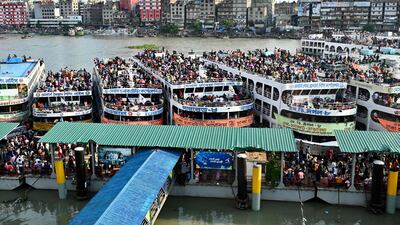
  • People aboard ferries wait for the departure as they travel back home ahead of Eid Al Adha in Dhaka. AFP
    People aboard ferries wait for the departure as they travel back home ahead of Eid Al Adha in Dhaka. AFP
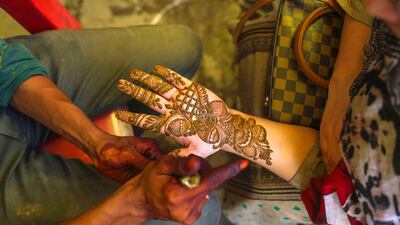
  • A Kashmiri Muslim girl decorates her hands with henna at a market in Srinagar. EPA
    A Kashmiri Muslim girl decorates her hands with henna at a market in Srinagar. EPA
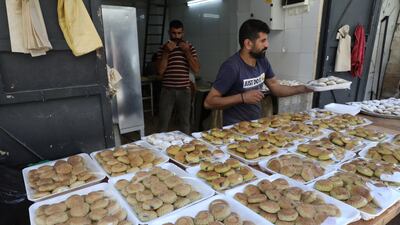
  • Palestinians prepare ma'moul and kahk in the West Bank city of Nablus. EPA
    Palestinians prepare ma'moul and kahk in the West Bank city of Nablus. EPA
  • A Muslim cloth seller arranges his wares on a pedestrian pavement in Bengaluru, India. Getty Images
    A Muslim cloth seller arranges his wares on a pedestrian pavement in Bengaluru, India. Getty Images
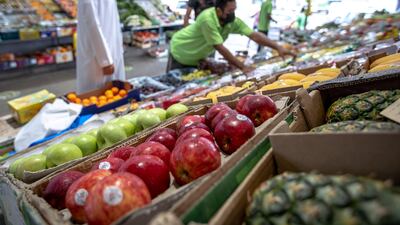
  • Shopper stock up at Abu Dhabi Fruit and Vegetable Market at Zayed Port, ahead of Eid Al Adha. Victor Besa / The National
    Shopper stock up at Abu Dhabi Fruit and Vegetable Market at Zayed Port, ahead of Eid Al Adha. Victor Besa / The National
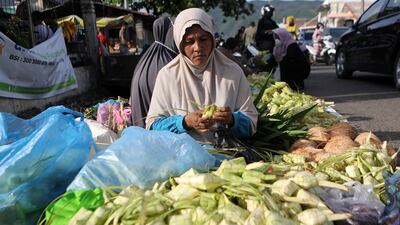
  • A woman sells traditional plaited coconut leaf pouches for ketupat rice cakes, ahead of Eid Al Adha in Banda Aceh, Indonesia. EPA
    A woman sells traditional plaited coconut leaf pouches for ketupat rice cakes, ahead of Eid Al Adha in Banda Aceh, Indonesia. EPA
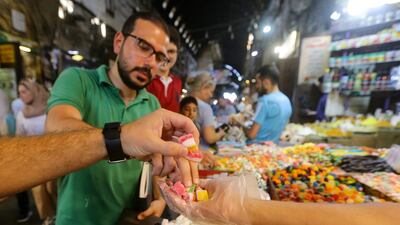
  • A vendor offers sweets to shoppers at his stall at Al Hamidiyah Souq in Damascus, Syria. AFP
    A vendor offers sweets to shoppers at his stall at Al Hamidiyah Souq in Damascus, Syria. AFP
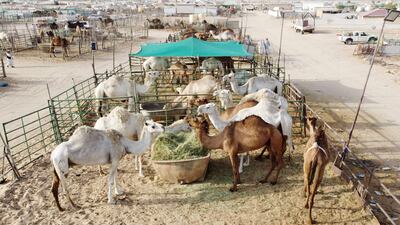
  • Camels in enclosures at the market in the Erhaiya desert area of Kuwait. AFP
    Camels in enclosures at the market in the Erhaiya desert area of Kuwait. AFP
  • People crowd on to a train to return home for Eid Al Adha, at a railway station in Lahore, Pakistan. AFP
    People crowd on to a train to return home for Eid Al Adha, at a railway station in Lahore, Pakistan. AFP
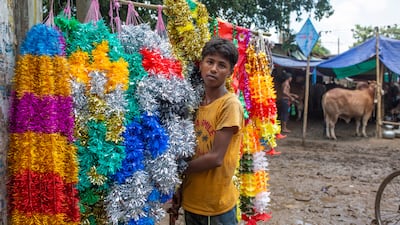
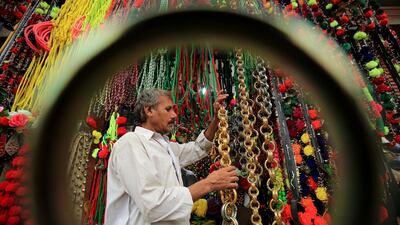
  • A vendor sells garlands for sacrificial animals near a livestock market in Dhaka, Bangladesh. EPA
    A vendor sells garlands for sacrificial animals near a livestock market in Dhaka, Bangladesh. EPA
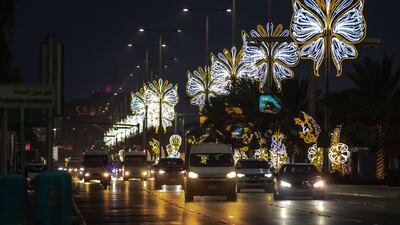
  • Eid Al Adha decorations illuminate the Corniche in central Abu Dhabi. Victor Besa / The National
    Eid Al Adha decorations illuminate the Corniche in central Abu Dhabi. Victor Besa / The National
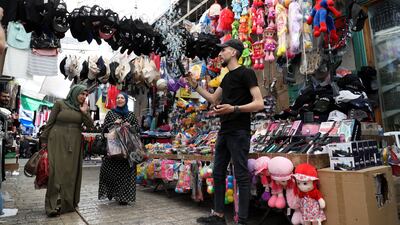
  • A stallholder sells soft toys ahead of Eid Al Adha, at a market in the West Bank city of Hebron. EPA
    A stallholder sells soft toys ahead of Eid Al Adha, at a market in the West Bank city of Hebron. EPA
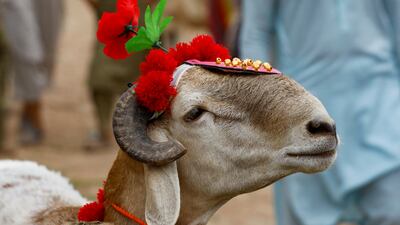
  • Ornaments for sacrificial animals on sale at a roadside stall in Peshawar, Pakistan, before the Muslim festival of Eid Al Adha. EPA
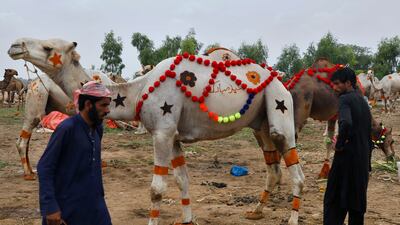
    Ornaments for sacrificial animals on sale at a roadside stall in Peshawar, Pakistan, before the Muslim festival of Eid Al Adha. EPA
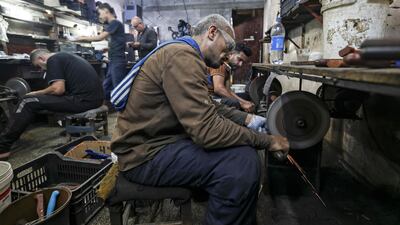
  • Knifesmiths in Gaza City sharpen blades to be used to slaughter animals for Eid Al Adha. AFP
    Knifesmiths in Gaza City sharpen blades to be used to slaughter animals for Eid Al Adha. AFP
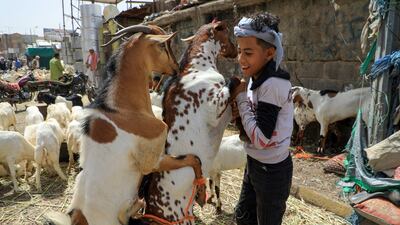
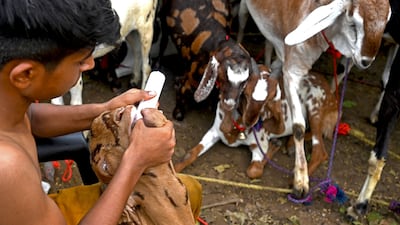
  • A boy plays with goats at a livestock market in Sanaa, the capital of Yemen. AFP
    A boy plays with goats at a livestock market in Sanaa, the capital of Yemen. AFP
  • A Palestinian stall-holder arranges sweets in the old city in Hebron in the Israeli-occupied West Bank. Reuters
    A Palestinian stall-holder arranges sweets in the old city in Hebron in the Israeli-occupied West Bank. Reuters
  • Goats being fed at a livestock market before Eid Al Adha in New Delhi, India. AP
    Goats being fed at a livestock market before Eid Al Adha in New Delhi, India. AP
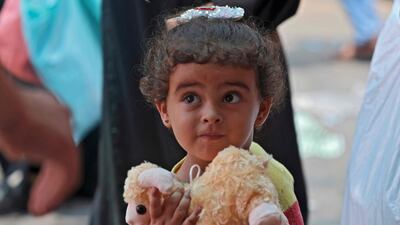
  • A Palestinian girl selects a stuffed toy from a shop at a market in Khan Yunis, in the southern Gaza Strip. AFP
    A Palestinian girl selects a stuffed toy from a shop at a market in Khan Yunis, in the southern Gaza Strip. AFP
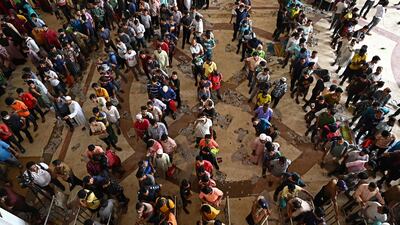
  • People queue to buy train tickets at a railway station in Dhaka, Bangladesh, before the start of Eid Al Adha. AFP
    People queue to buy train tickets at a railway station in Dhaka, Bangladesh, before the start of Eid Al Adha. AFP
  • A livestock vendor feeds a goat by the roadside while waiting for customers in New Delhi. AFP
    A livestock vendor feeds a goat by the roadside while waiting for customers in New Delhi. AFP
  • Palestinians shop for toys before Eid Al Adha at a market in the West Bank city of Hebron. EPA
    Palestinians shop for toys before Eid Al Adha at a market in the West Bank city of Hebron. EPA
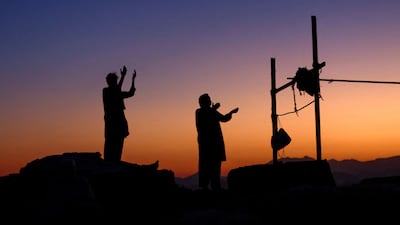
  • Pilgrims pray on Mount Al Noor, where Muslims believe the Prophet Mohammed received the first words of the Quran, in Makkah, Saudi Arabia. Reuters
    Pilgrims pray on Mount Al Noor, where Muslims believe the Prophet Mohammed received the first words of the Quran, in Makkah, Saudi Arabia. Reuters
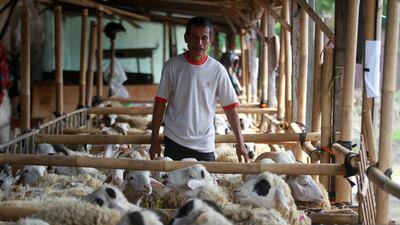
  • A man tends to his goats before the start of Eid Al Adha in Yogyakarta, Indonesia. AFP
    A man tends to his goats before the start of Eid Al Adha in Yogyakarta, Indonesia. AFP
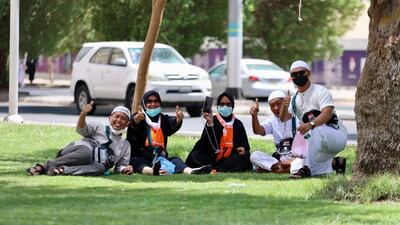
  • Muslim pilgrims relax in Makkah. Saudi Arabia hosted about one million people, including 850,000 from abroad, during this year's Hajj. AFP
    Muslim pilgrims relax in Makkah. Saudi Arabia hosted about one million people, including 850,000 from abroad, during this year's Hajj. AFP
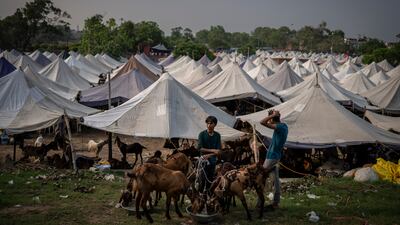
  • A vendor waits for customers at a livestock market on the outskirts of Islamabad, Pakistan. AP
    A vendor waits for customers at a livestock market on the outskirts of Islamabad, Pakistan. AP
  • Pilgrims relax on Mount Al Noor in Makkah. Reuters
    Pilgrims relax on Mount Al Noor in Makkah. Reuters
  • A child stands next to goats at a livestock market on the outskirts of the rebel-held town of Dana in Syria. AFP
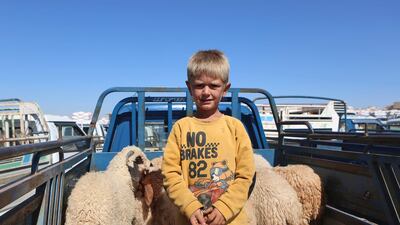
    A child stands next to goats at a livestock market on the outskirts of the rebel-held town of Dana in Syria. AFP
  • An aerial view of the livestock market on the outskirts of Dana, Syria. AFP
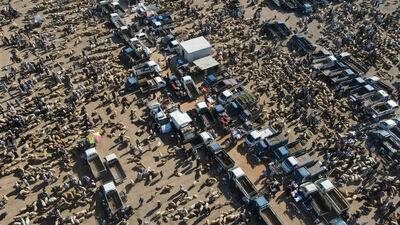
    An aerial view of the livestock market on the outskirts of Dana, Syria. AFP
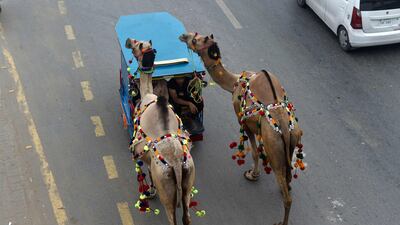
  • Camels are transported in a lorry at a livestock market in Lahore. AFP
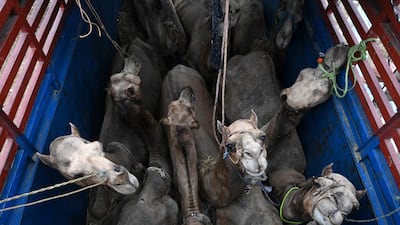
    Camels are transported in a lorry at a livestock market in Lahore. AFP
  • An ox reared on a fourth-storey rooftop in Karachi, Pakistan, is lowered by crane to be slaughtered during Eid Al Adha. AFP
    An ox reared on a fourth-storey rooftop in Karachi, Pakistan, is lowered by crane to be slaughtered during Eid Al Adha. AFP
  • Children play at a livestock market in Quetta, the capital and largest city of the Pakistani province of Balochistan. AFP
    Children play at a livestock market in Quetta, the capital and largest city of the Pakistani province of Balochistan. AFP
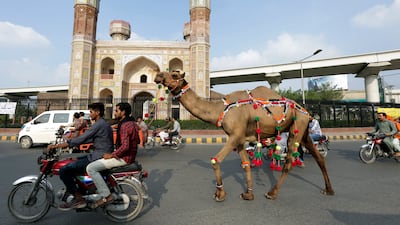
  • A camel is led to market before Eid Al Adha in Lahore, Pakistan. AP
    A camel is led to market before Eid Al Adha in Lahore, Pakistan. AP
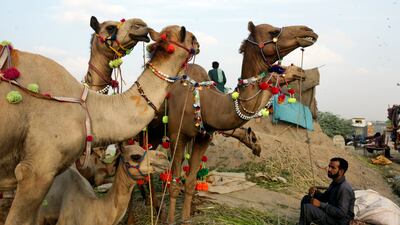
  • A Pakistani livestock merchant displays camels for sale in Lahore. AP
    A Pakistani livestock merchant displays camels for sale in Lahore. AP
  • Customers lead away camels bought at a market in Lahore. AFP
    Customers lead away camels bought at a market in Lahore. AFP
  • Camels for sale in Lahore before the Eid Al Adha festival. AFP
    Camels for sale in Lahore before the Eid Al Adha festival. AFP
  • A farmer takes cattle to market as preparations begin for Eid Al Adha in Quetta, Pakistan. EPA
    A farmer takes cattle to market as preparations begin for Eid Al Adha in Quetta, Pakistan. EPA
  • A Pakistani ironsmith sharpens knives for Eid Al Adha in Lahore. AP
    A Pakistani ironsmith sharpens knives for Eid Al Adha in Lahore. AP
  • A goat at Al Quoz Abattoir in Dubai. Reuters
    A goat at Al Quoz Abattoir in Dubai. Reuters
  • A sacrificial cow at a cattle market in Peshawar, Pakistan. Reuters
    A sacrificial cow at a cattle market in Peshawar, Pakistan. Reuters
  • A sacrificial goat in Peshawar. Reuters
    A sacrificial goat in Peshawar. Reuters
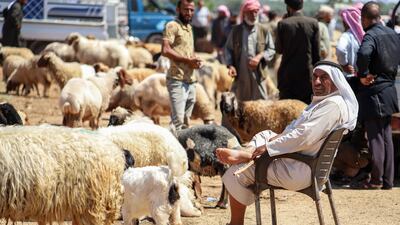
  • A farmer sells sheep for Eid Al Adha at a market near the town of Maaret Misrin in northern Syria. AFP
    A farmer sells sheep for Eid Al Adha at a market near the town of Maaret Misrin in northern Syria. AFP
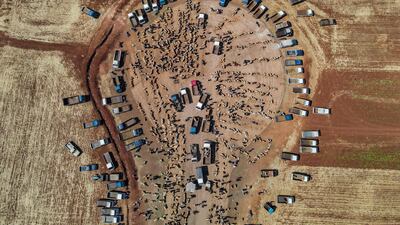
  • An aerial view of the livestock market in Maaret Misrin. AFP
    An aerial view of the livestock market in Maaret Misrin. AFP
  • A cow goes to market in Gaza. EPA
    A cow goes to market in Gaza. EPA
  • Sacrificial animals for sale before Eid Al Adha in Peshawar. EPA
    Sacrificial animals for sale before Eid Al Adha in Peshawar. EPA
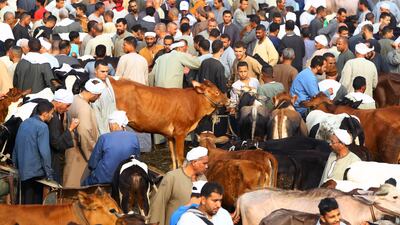
  • A crowded market in Giza, Egypt, as Muslims buy sacrificial animals for Eid Al Adha. EPA
    A crowded market in Giza, Egypt, as Muslims buy sacrificial animals for Eid Al Adha. EPA
  • Thousands of people flock to the market in Giza to buy an animal. EPA
    Thousands of people flock to the market in Giza to buy an animal. EPA
  • Potential buyers examine some of the animals for sale. EPA
    Potential buyers examine some of the animals for sale. EPA
  • A Yemeni buys a sacrificial sheep at a market in Sanaa. EPA
    A Yemeni buys a sacrificial sheep at a market in Sanaa. EPA
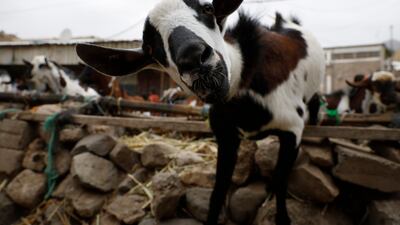
  • A goat at a market in Sanaa, Yemen. EPA
    A goat at a market in Sanaa, Yemen. EPA

Naqeebulah Khan, a resident of Peshawar in north-west Pakistan, said he was one of those who had opted to buy a goat this year, steering clear of cows.

“We bought two goats. A livestock expert accompanied us and he examined both of them. The prices are higher than normal, but we are sure they are healthy.”

Mr Khan said he had tried to stay away from livestock markets this years, which he claimed were “thick with lumpy skin disease-hit animals”.

What should be one of most profitable times of the year for cattle farmers has instead seen them left with unsold animals and facing heavy losses. Dairy farmers cannot sell their milk.

The virus is transmitted by blood-sucking insects or ticks and there have been worries it will spread more quickly among cattle herded together for Eid markets.

Cows infected with the disease develop the lesions that give it its name. They rapidly lose weight and milk productions plummets. Some die.

At least 97 animals died and 1,500 were infected on Wednesday alone in the northern province of Khyber Pakhtunkhwa, said Alamzeb Khan, director general of the local livestock department. Vets have vaccinated about a quarter of a million cattle, but that is only a fraction of the nearly nine million in the province.

Muhammad Shakoor, a cattle dealer in Bannu district, told The National he had lost eight of his herd of 70, after buying them in Punjab province.

“The people aren’t even paying the amount on which we bought these animals. The people are extremely scared because the media is replete with the news regarding the outbreak of lumpy skin disease.”

Muhammad Sultan, a resident of Mathra locality near Peshawar, said the disease was costing him and his fellow animal traders a fortune.

“Buyers are examining every animal before purchasing them,” he said.

He said he had invested 10 million rupees ($48,200) on buying animals to sell at Eid.

Last year, we earned two million rupees but this time around we have lost that, or even more
Muhammad Sultan,
livestock trader

“But the people aren’t coming to the market as they used to in previous Eid. Last year, we earned two million rupees but this time around we have lost that, or even more.”

Lumpy skin disease has long been common in parts of Africa and the southern Middle East, but in 2012 it began to spread much more quickly, said Dr Pip Beard, an expert on the disease for the animal equivalent of the World Health Organisation.

The virus swept further afield into southern Europe, Russia, Turkey and Asia and is classed as a “rapidly emerging, transboundary pathogen”, she said.

“It causes very serious disease,” she said.

Buyers lead their goats through a livestock market in Islamabad, Pakistan. Bloomberg

It is unclear why the virus suddenly spread from its normal haunts in 2012, but she said researchers were investigating whether the turmoil of the 2011 Arab uprisings might have caused a breakdown in veterinary services.

Pakistan's recent flare-up has also spread to neighbouring Afghanistan.

“I keep 70 to 80 animals in a farm. Among them, 10 or 11 have died due to this disease,” said Nazar Muhammad, a farmer in Afghanistan's Khost province.

The lumpy skin disease cannot infect people and it is a stable, slowly-evolving virus which means it is highly unlikely to mutate into something that could jump into humans.

Nizam Ali, also of Bannu district, predicted the outbreak would have a significant effect on the celebration of Eid Al Adha this year.

“We used to sacrifice a cow on Eid every year and divide its meat in three parts. One for own consumption, one for close relatives and one distribution among the poor people as per Islamic formula. But this year, more people are opting to have small animals, which they would eat themselves. It will be hard to divide the meat of a goat in three and distribute among the people,” he said.


THE BIO:

Sabri Razouk, 74

Athlete and fitness trainer 

Married, father of six

Favourite exercise: Bench press

Must-eat weekly meal: Steak with beans, carrots, broccoli, crust and corn

Power drink: A glass of yoghurt

Role model: Any good man

ESSENTIALS

The flights

Emirates flies direct from Dubai to Rio de Janeiro from Dh7,000 return including taxes. Avianca fliles from Rio to Cusco via Lima from $399 (Dhxx) return including taxes. 

The trip

From US$1,830 per deluxe cabin, twin share, for the one-night Spirit of the Water itinerary and US$4,630 per deluxe cabin for the Peruvian Highlands itinerary, inclusive of meals, and beverages. Surcharges apply for some excursions.

The biog

Hobby: Playing piano and drawing patterns

Best book: Awaken the Giant Within by Tony Robbins

Food of choice: Sushi  

Favourite colour: Orange

How to watch Ireland v Pakistan in UAE

When: The one-off Test starts on Friday, May 11
What time: Each day’s play is scheduled to start at 2pm UAE time.
TV: The match will be broadcast on OSN Sports Cricket HD. Subscribers to the channel can also stream the action live on OSN Play.

How it works

Booklava works on a subscription model. On signing up you receive a free book as part of a 30-day-trial period, after which you pay US$9.99 (Dh36.70) per month to gain access to a library of books and discounts of up to 30 per cent on selected titles. You can cancel your subscription at any time. For more details go to www.booklava.com

The burning issue

The internal combustion engine is facing a watershed moment – major manufacturer Volvo is to stop producing petroleum-powered vehicles by 2021 and countries in Europe, including the UK, have vowed to ban their sale before 2040. The National takes a look at the story of one of the most successful technologies of the last 100 years and how it has impacted life in the UAE.

Read part three: the age of the electric vehicle begins

Read part two: how climate change drove the race for an alternative 

Read part one: how cars came to the UAE

Quick facts on cancer
  • Cancer is the second-leading cause of death worldwide, after cardiovascular diseases 
  •  About one in five men and one in six women will develop cancer in their lifetime 
  • By 2040, global cancer cases are on track to reach 30 million 
  • 70 per cent of cancer deaths occur in low and middle-income countries 
  • This rate is expected to increase to 75 per cent by 2030 
  • At least one third of common cancers are preventable 
  • Genetic mutations play a role in 5 per cent to 10 per cent of cancers 
  • Up to 3.7 million lives could be saved annually by implementing the right health
    strategies 
  • The total annual economic cost of cancer is $1.16 trillion


6.30pm: Al Maktoum Challenge Round-3 Group 1 (PA) | US$95,000 | (Dirt) 2,000m
7.05pm: Meydan Classic Listed (TB) ) | $175,000) | (Turf) 1,600m
7.40pm: Handicap (TB) ) | $135,000 ) | (D) 1,600m
8.15pm: Nad Al Sheba Trophy Group 3 (TB) ) | $300,000) | (T) 2,810m
8.50pm: Curlin Handicap Listed (TB)) | $160,000) | (D) 2,000m
9.25pm: Handicap (TB)) | $175,000) | (T) 1,400m
10pm: Handicap (TB) ) | $135,000 ) | (T) 2,000m

Ten tax points to be aware of in 2026

1. Domestic VAT refund amendments: request your refund within five years

If a business does not apply for the refund on time, they lose their credit.

2. E-invoicing in the UAE

Businesses should continue preparing for the implementation of e-invoicing in the UAE, with 2026 a preparation and transition period ahead of phased mandatory adoption. 

3. More tax audits

Tax authorities are increasingly using data already available across multiple filings to identify audit risks. 

4. More beneficial VAT and excise tax penalty regime

Tax disputes are expected to become more frequent and more structured, with clearer administrative objection and appeal processes. The UAE has adopted a new penalty regime for VAT and excise disputes, which now mirrors the penalty regime for corporate tax.

5. Greater emphasis on statutory audit

There is a greater need for the accuracy of financial statements. The International Financial Reporting Standards standards need to be strictly adhered to and, as a result, the quality of the audits will need to increase.

6. Further transfer pricing enforcement

Transfer pricing enforcement, which refers to the practice of establishing prices for internal transactions between related entities, is expected to broaden in scope. The UAE will shortly open the possibility to negotiate advance pricing agreements, or essentially rulings for transfer pricing purposes. 

7. Limited time periods for audits

Recent amendments also introduce a default five-year limitation period for tax audits and assessments, subject to specific statutory exceptions. While the standard audit and assessment period is five years, this may be extended to up to 15 years in cases involving fraud or tax evasion. 

8. Pillar 2 implementation 

Many multinational groups will begin to feel the practical effect of the Domestic Minimum Top-Up Tax (DMTT), the UAE's implementation of the OECD’s global minimum tax under Pillar 2. While the rules apply for financial years starting on or after January 1, 2025, it is 2026 that marks the transition to an operational phase.

9. Reduced compliance obligations for imported goods and services

Businesses that apply the reverse-charge mechanism for VAT purposes in the UAE may benefit from reduced compliance obligations. 

10. Substance and CbC reporting focus

Tax authorities are expected to continue strengthening the enforcement of economic substance and Country-by-Country (CbC) reporting frameworks. In the UAE, these regimes are increasingly being used as risk-assessment tools, providing tax authorities with a comprehensive view of multinational groups’ global footprints and enabling them to assess whether profits are aligned with real economic activity. 

Contributed by Thomas Vanhee and Hend Rashwan, Aurifer

Updated: July 09, 2022, 8:36 AM