Auto rickshaw drivers queue to buy fuel in Colombo on July 3. AFP Photo

Sri Lanka fuel crisis continues as government issues new quota rules


  • English
  • Arabic

Sri Lanka was scrambling to limit the fallout from its fuel crisis on Tuesday, saying companies would have access to additional fuel allocations from the government if they paid in dollars.

The country is experiencing a sharp economic contraction after the Covid-19 pandemic, a crisis worsened by severe economic mismanagement that has seen foreign reserves dwindle, an increase in poverty and crippling government debt.

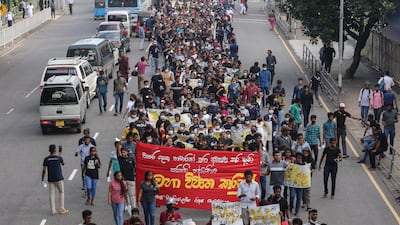
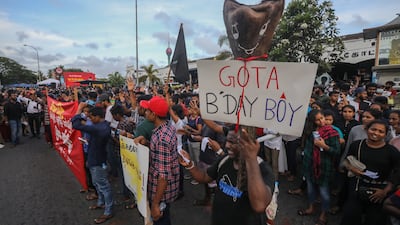
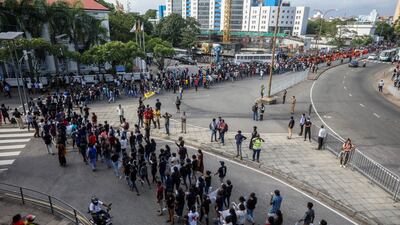
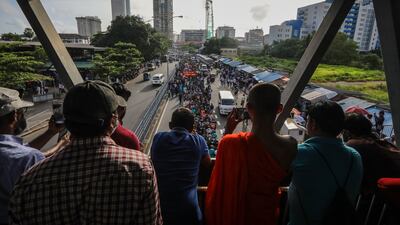
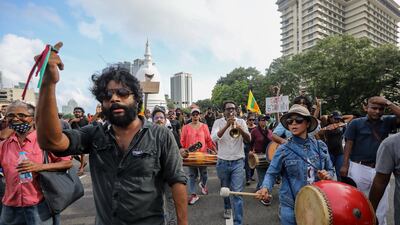
  • University students in Sri Lanka's capital Colombo attend a protest calling for the resignation of President Gotabaya Rajapaksa over his alleged failure to address the economic crisis in the country. Protests have been rocking the country for more than two months as Sri Lanka faces its worst-ever economic crisis due to the lack of foreign reserves, resulting in severe shortages in food, fuel, medicine, and imported goods. EPA
    University students in Sri Lanka's capital Colombo attend a protest calling for the resignation of President Gotabaya Rajapaksa over his alleged failure to address the economic crisis in the country. Protests have been rocking the country for more than two months as Sri Lanka faces its worst-ever economic crisis due to the lack of foreign reserves, resulting in severe shortages in food, fuel, medicine, and imported goods. EPA
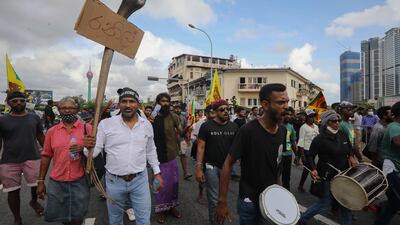
  • University students in Sri Lanka's capital Colombo attend a protest calling for the resignation of President Gotabaya Rajapaksa over his alleged failure to address the economic crisis in the country. Protests have been rocking the country for more than two months as Sri Lanka faces its worst-ever economic crisis due to the lack of foreign reserves, resulting in severe shortages in food, fuel, medicine, and imported goods. EPA
    University students in Sri Lanka's capital Colombo attend a protest calling for the resignation of President Gotabaya Rajapaksa over his alleged failure to address the economic crisis in the country. Protests have been rocking the country for more than two months as Sri Lanka faces its worst-ever economic crisis due to the lack of foreign reserves, resulting in severe shortages in food, fuel, medicine, and imported goods. EPA
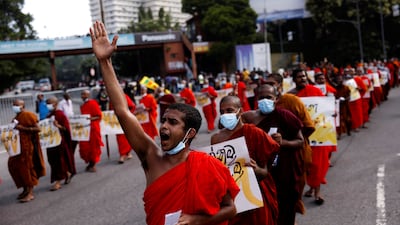
  • University students in Sri Lanka's capital Colombo attend a protest calling for the resignation of President Gotabaya Rajapaksa over his alleged failure to address the economic crisis in the country. Protests have been rocking the country for more than two months as Sri Lanka faces its worst-ever economic crisis due to the lack of foreign reserves, resulting in severe shortages in food, fuel, medicine, and imported goods. EPA
    University students in Sri Lanka's capital Colombo attend a protest calling for the resignation of President Gotabaya Rajapaksa over his alleged failure to address the economic crisis in the country. Protests have been rocking the country for more than two months as Sri Lanka faces its worst-ever economic crisis due to the lack of foreign reserves, resulting in severe shortages in food, fuel, medicine, and imported goods. EPA
  • University students in Sri Lanka's capital Colombo attend a protest calling for the resignation of President Gotabaya Rajapaksa over his alleged failure to address the economic crisis in the country. Protests have been rocking the country for more than two months as Sri Lanka faces its worst-ever economic crisis due to the lack of foreign reserves, resulting in severe shortages in food, fuel, medicine, and imported goods. EPA
    University students in Sri Lanka's capital Colombo attend a protest calling for the resignation of President Gotabaya Rajapaksa over his alleged failure to address the economic crisis in the country. Protests have been rocking the country for more than two months as Sri Lanka faces its worst-ever economic crisis due to the lack of foreign reserves, resulting in severe shortages in food, fuel, medicine, and imported goods. EPA
  • University students in Sri Lanka's capital Colombo attend a protest calling for the resignation of President Gotabaya Rajapaksa over his alleged failure to address the economic crisis in the country. Protests have been rocking the country for more than two months as Sri Lanka faces its worst-ever economic crisis due to the lack of foreign reserves, resulting in severe shortages in food, fuel, medicine, and imported goods. EPA
    University students in Sri Lanka's capital Colombo attend a protest calling for the resignation of President Gotabaya Rajapaksa over his alleged failure to address the economic crisis in the country. Protests have been rocking the country for more than two months as Sri Lanka faces its worst-ever economic crisis due to the lack of foreign reserves, resulting in severe shortages in food, fuel, medicine, and imported goods. EPA
  • University students in Sri Lanka's capital Colombo attend a protest calling for the resignation of President Gotabaya Rajapaksa over his alleged failure to address the economic crisis in the country. Protests have been rocking the country for more than two months as Sri Lanka faces its worst-ever economic crisis due to the lack of foreign reserves, resulting in severe shortages in food, fuel, medicine, and imported goods. EPA
    University students in Sri Lanka's capital Colombo attend a protest calling for the resignation of President Gotabaya Rajapaksa over his alleged failure to address the economic crisis in the country. Protests have been rocking the country for more than two months as Sri Lanka faces its worst-ever economic crisis due to the lack of foreign reserves, resulting in severe shortages in food, fuel, medicine, and imported goods. EPA
  • University students in Sri Lanka's capital Colombo attend a protest calling for the resignation of President Gotabaya Rajapaksa over his alleged failure to address the economic crisis in the country. Protests have been rocking the country for more than two months as Sri Lanka faces its worst-ever economic crisis due to the lack of foreign reserves, resulting in severe shortages in food, fuel, medicine, and imported goods. EPA
    University students in Sri Lanka's capital Colombo attend a protest calling for the resignation of President Gotabaya Rajapaksa over his alleged failure to address the economic crisis in the country. Protests have been rocking the country for more than two months as Sri Lanka faces its worst-ever economic crisis due to the lack of foreign reserves, resulting in severe shortages in food, fuel, medicine, and imported goods. EPA
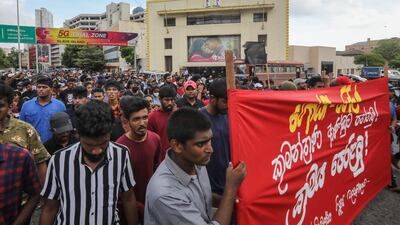
  • Members of the Inter University Students' Federation demand for Sri Lanka's President Gotabaya Rajapaksa to resign, amid the country's economic crisis, in Colombo. Reuters
    Members of the Inter University Students' Federation demand for Sri Lanka's President Gotabaya Rajapaksa to resign, amid the country's economic crisis, in Colombo. Reuters

The government has struggled to pay for basic imports, including life-saving medicine, food and fuel. Of the latter, a shortage of local refining capacity and higher oil prices following Russia's invasion of Ukraine, which has disrupted global energy markets, have worsened the situation.

Huge street protests have rocked the government, leading Prime Minister Mahinda Rajapaksa to resign. Sri Lanka has closed public schools and offices until July 10 to conserve fuel. Roads across the island have been deserted, even as thousands of vehicles queue, waiting for filling stations to be replenished.

Following the latest announcement, potential purchasers must pay as much as a month in advance to open a consumer account at state-run Ceylon Petroleum corporation, Energy Minister Kanchana Wijesekera tweeted on Sunday. Fuel will be issued on a daily or weekly basis from July 12, according to the minister.

“I see this recent announcement by the ministry of power and energy as the natural progression of increased dollarisation in Sri Lanka to meet its near-term challenges,” said Deshan Pushparajah, head of global markets and investment banking at CAL Sri Lanka.

“Dollar preference on the part of the Ceylon Petroleum Corp may drive its larger customers, including the Ceylon Electricity Board, to also make similar pronouncements in the coming weeks.”

Poverty in Sri Lanka has risen sharply and there is no end in sight for the crisis, the World Bank said. It added that 11 per cent of the population will fall below the poverty line this year.


How will Gen Alpha invest?

Mark Chahwan, co-founder and chief executive of robo-advisory firm Sarwa, forecasts that Generation Alpha (born between 2010 and 2024) will start investing in their teenage years and therefore benefit from compound interest.

“Technology and education should be the main drivers to make this happen, whether it’s investing in a few clicks or their schools/parents stepping up their personal finance education skills,” he adds.

Mr Chahwan says younger generations have a higher capacity to take on risk, but for some their appetite can be more cautious because they are investing for the first time. “Schools still do not teach personal finance and stock market investing, so a lot of the learning journey can feel daunting and intimidating,” he says.

He advises millennials to not always start with an aggressive portfolio even if they can afford to take risks. “We always advise to work your way up to your risk capacity, that way you experience volatility and get used to it. Given the higher risk capacity for the younger generations, stocks are a favourite,” says Mr Chahwan.

Highlighting the role technology has played in encouraging millennials and Gen Z to invest, he says: “They were often excluded, but with lower account minimums ... a customer with $1,000 [Dh3,672] in their account has their money working for them just as hard as the portfolio of a high get-worth individual.”

Who's who in Yemen conflict

Houthis: Iran-backed rebels who occupy Sanaa and run unrecognised government

Yemeni government: Exiled government in Aden led by eight-member Presidential Leadership Council

Southern Transitional Council: Faction in Yemeni government that seeks autonomy for the south

Habrish 'rebels': Tribal-backed forces feuding with STC over control of oil in government territory

The biog

Favourite book: Animal Farm by George Orwell

Favourite music: Classical

Hobbies: Reading and writing


The specs

Engine: 2.0-litre 4-cyl, 48V hybrid

Transmission: eight-speed automatic

Power: 325bhp

Torque: 450Nm

Price: Dh359,000

On sale: now 

The specs

Engine: 2.0-litre 4cyl turbo

Power: 261hp at 5,500rpm

Torque: 405Nm at 1,750-3,500rpm

Transmission: 9-speed auto

Fuel consumption: 6.9L/100km

On sale: Now

Price: From Dh117,059

U19 WORLD CUP, WEST INDIES

UAE group fixtures (all in St Kitts)

  • Saturday 15 January: UAE beat Canada by 49 runs 
  • Thursday 20 January: v England 
  • Saturday 22 January: v Bangladesh 

UAE squad:

Alishan Sharafu (captain), Shival Bawa, Jash Giyanani, Sailles
Jaishankar, Nilansh Keswani, Aayan Khan, Punya Mehra, Ali Naseer, Ronak Panoly,
Dhruv Parashar, Vinayak Raghavan, Soorya Sathish, Aryansh Sharma, Adithya
Shetty, Kai Smith  

In-demand jobs and monthly salaries
  • Technology expert in robotics and automation: Dh20,000 to Dh40,000 
  • Energy engineer: Dh25,000 to Dh30,000 
  • Production engineer: Dh30,000 to Dh40,000 
  • Data-driven supply chain management professional: Dh30,000 to Dh50,000 
  • HR leader: Dh40,000 to Dh60,000 
  • Engineering leader: Dh30,000 to Dh55,000 
  • Project manager: Dh55,000 to Dh65,000 
  • Senior reservoir engineer: Dh40,000 to Dh55,000 
  • Senior drilling engineer: Dh38,000 to Dh46,000 
  • Senior process engineer: Dh28,000 to Dh38,000 
  • Senior maintenance engineer: Dh22,000 to Dh34,000 
  • Field engineer: Dh6,500 to Dh7,500
  • Field supervisor: Dh9,000 to Dh12,000
  • Field operator: Dh5,000 to Dh7,000
Ten tax points to be aware of in 2026

1. Domestic VAT refund amendments: request your refund within five years

If a business does not apply for the refund on time, they lose their credit.

2. E-invoicing in the UAE

Businesses should continue preparing for the implementation of e-invoicing in the UAE, with 2026 a preparation and transition period ahead of phased mandatory adoption. 

3. More tax audits

Tax authorities are increasingly using data already available across multiple filings to identify audit risks. 

4. More beneficial VAT and excise tax penalty regime

Tax disputes are expected to become more frequent and more structured, with clearer administrative objection and appeal processes. The UAE has adopted a new penalty regime for VAT and excise disputes, which now mirrors the penalty regime for corporate tax.

5. Greater emphasis on statutory audit

There is a greater need for the accuracy of financial statements. The International Financial Reporting Standards standards need to be strictly adhered to and, as a result, the quality of the audits will need to increase.

6. Further transfer pricing enforcement

Transfer pricing enforcement, which refers to the practice of establishing prices for internal transactions between related entities, is expected to broaden in scope. The UAE will shortly open the possibility to negotiate advance pricing agreements, or essentially rulings for transfer pricing purposes. 

7. Limited time periods for audits

Recent amendments also introduce a default five-year limitation period for tax audits and assessments, subject to specific statutory exceptions. While the standard audit and assessment period is five years, this may be extended to up to 15 years in cases involving fraud or tax evasion. 

8. Pillar 2 implementation 

Many multinational groups will begin to feel the practical effect of the Domestic Minimum Top-Up Tax (DMTT), the UAE's implementation of the OECD’s global minimum tax under Pillar 2. While the rules apply for financial years starting on or after January 1, 2025, it is 2026 that marks the transition to an operational phase.

9. Reduced compliance obligations for imported goods and services

Businesses that apply the reverse-charge mechanism for VAT purposes in the UAE may benefit from reduced compliance obligations. 

10. Substance and CbC reporting focus

Tax authorities are expected to continue strengthening the enforcement of economic substance and Country-by-Country (CbC) reporting frameworks. In the UAE, these regimes are increasingly being used as risk-assessment tools, providing tax authorities with a comprehensive view of multinational groups’ global footprints and enabling them to assess whether profits are aligned with real economic activity. 

Contributed by Thomas Vanhee and Hend Rashwan, Aurifer

Updated: July 11, 2022, 11:51 AM