

Sri Lanka on Friday closed state schools and told public officials to stay at home because of an acute fuel shortage created by its worst economic crisis in decades.
The government has struggled to find money to pay for imported fuel, gas and other basic essentials in recent months, leading to shortages and price rises that have triggered widespread protests.
The Public Administration Ministry asked all official staff except for those operating essential services to stay at home from Friday, “in a view of current fuel shortage and issues in transport” across the country.
People have been queuing for days at a time for petrol, which has now almost run out. There is an acute shortage of other fuel as well.
The worsening economic conditions prompted weeks of protests against President Gotabaya Rajapaksa and his brother Mahinda Rajapaksa, who resigned as prime minister after rallies turned violent on May 9.
The president appointed veteran politician Ranil Wickremesinghe to form a unity government to deal with the crisis and swore in nine new ministers on Friday.
"Nine Cabinet ministers of the new all-party government took their oaths before President Gotabaya Rajapaksa," a presidential news statement said.
The new appointments increased the size of the Cabinet to 13 members and included ministers for the critical portfolios of health, trade and tourism.
The ministers include four independent politicians, three from the ruling party and two from the main opposition party. Four ruling party members were appointed as Cabinet ministers last week.
Mr Wickremesinghe said Sri Lanka needed about $75 billion urgently to provide essential items but the treasury was struggling to find even $1bn.
On Thursday, he warned Sri Lankans of food shortages and vowed the government would buy enough fertiliser for the next planting season to boost harvests.
Crop yields reduced drastically after the president banned all chemical fertilisers in April last year. The government has reversed the ban but no substantial imports have yet taken place.
"While there may not be time to obtain fertiliser for this Yala [May-August] season, steps are being taken to ensure adequate stocks for the Maha [September-March] season," Mr Wickremesinghe said in a message on Twitter.
-
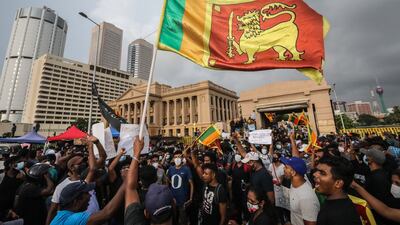
Demonstrators in Sri Lanka gather outside the Presidential Secretariat in Colombo as the country faces shortages in food, fuel and medicines after defaulting on its $51 billion debt. EPA -
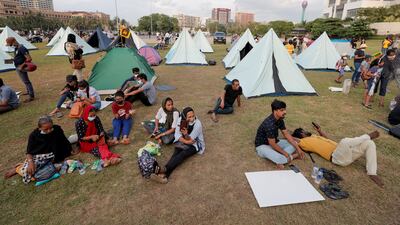
Demonstrators camp in an area nicknamed the Gota-Go Village, close to the Presidential Secretariat in Colombo, Sri Lanka. Reuters -

Residents of Gota-Go Village in Colombo use their phones to organise their protest against President Gotabaya Rajapaksa's management of the economy. Reuters -
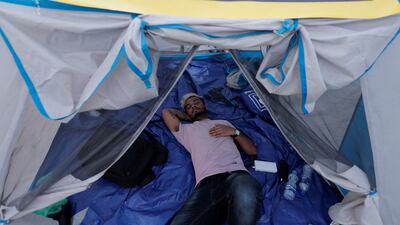
A demonstrator at Gota-Go Village in Colombo rests in one of the protest camp's many tents. Reuters -
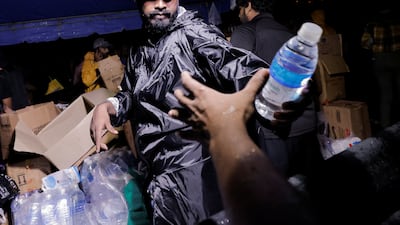
Water bottles are shared among protesters inside Gota-Go Village in Colombo, Sri Lanka. Reuters -
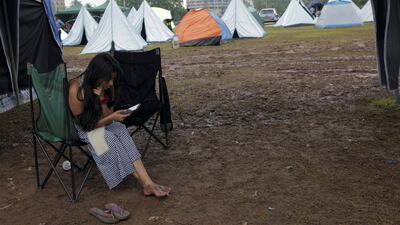
Gota-Go Village in Colombo is a focus of opposition to Sri Lanka's President Gotabaya Rajapaksa's leadership. Reuters -

The demonstrators who gather at Gota-Go Village near the Presidential Secretariat in Colombo, Sri Lanka, fear the country's medical service is near collapse. Reuters -
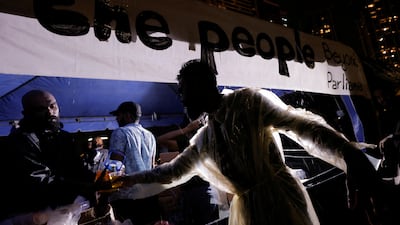
Demonstrators distribute essentials such as water at Gota-Go Village in Colombo, Sri Lanka. Reuters -
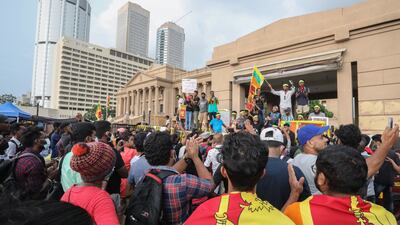
Protesters in Colombo after President Gotabaya Rajapaksa lost his parliamentary majority. EPA -
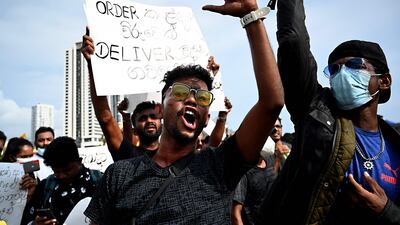
Power cuts and fuel shortages across Sri Lanka bring protesters to the doorstep of President Gotabaya Rajapaksa in Colombo. AFP -
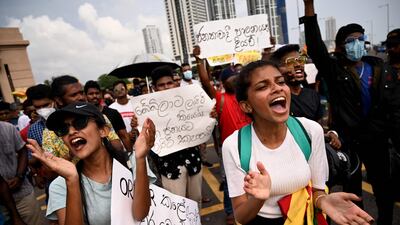
Protesters in Sri Lanka have made the centre of Colombo, the capital, the focus of their efforts to unseat President Gotabaya Rajapaksa. AFP -

People shout slogans during the protests. Reuters -
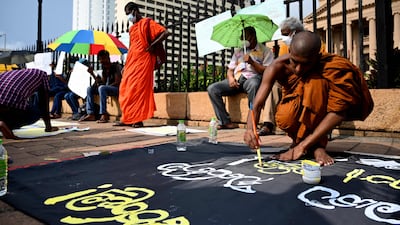
A Buddhist monk prepares a placard at a demonstration against the economic crisis. AFP -

Religious and secular groups unite in protest. AFP


Protesters accuse the Rajapaksas of causing the crisis through corruption and misrule and are calling for the president to follow in his brother's footsteps and step down as well.
The economic crisis follows the collapse of tourism, a vital source of revenue, during the Covid-19 pandemic, as well as rising global oil prices and populist tax cuts.
For months Sri Lankans have endured long lines to buy essentials such as medicines and fuel, most of which come from abroad. Shortages of hard currency have also hindered imports of raw materials for manufacturing and worsened inflation.
Authorities have announced nationwide power cuts of up to four hours a day because they cannot supply enough fuel to power generating stations.
Sri Lanka has suspended repayment of about $7bn in foreign loans due this year out of $25bn to be repaid by 2026. The country’s total foreign debt is $51bn. The Finance Ministry says the country currently has only $25 million in usable foreign reserves.
The Group of Seven economic powers supports efforts to provide debt relief for Sri Lanka, finance chiefs said on Thursday in a draft communique from a meeting in Germany after the government in Colombo defaulted on its sovereign debt.
Central bank chief P Nandalal Weerasinghe has said plans for debt restructuring were almost finalised and he would be submitting a proposal to the Cabinet soon.
"We are in pre-emptive default," he said. "Our position is very clear: until there is a debt restructure, we cannot repay."

