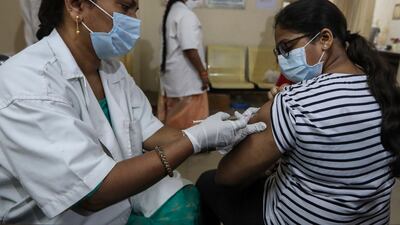
A health worker inoculates a girl with a dose of the Covaxin vaccine against the Covid-19 coronavirus at a vaccination centre in New Delhi on April 10, 2022, after government announced the paid precaution dose against Covid-19 coronavirus to be available for everyone above 18 years of age at private vaccination centres. AFP
A health worker inoculates a girl with a dose of the Covaxin vaccine against the Covid-19 coronavirus at a vaccination centre in New Delhi on April 10, 2022, after government announced the paid precau

India's Supreme Court overturns mandatory Covid-19 vaccination policy


Taniya Dutta
  • English
  • Arabic

India’s top court on Monday ruled that no person can be forced to get vaccinated and the constitution gives everyone the right to refuse vaccination, in a milestone judgement on the country’s Covid-19 policy.

A bench including Justices L Nageswara Rao and B R Gavai was hearing a petition on the mandatory inoculation policies introduced by some state governments, which barred unvaccinated people from entering certain public places.

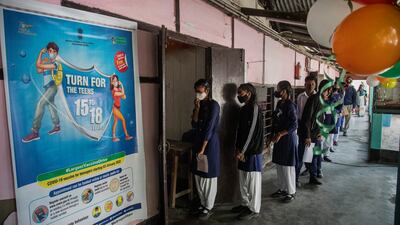
  • Indian teenagers wait to receive a Covid-19 vaccination at a government school in Gauhati. India has begun vaccinating teenagers in the age group 15 to 18, as more states enforce tighter restrictions to arrest a surge of infections driven by the Omicron variant. AP Photo
    Indian teenagers wait to receive a Covid-19 vaccination at a government school in Gauhati. India has begun vaccinating teenagers in the age group 15 to 18, as more states enforce tighter restrictions to arrest a surge of infections driven by the Omicron variant. AP Photo
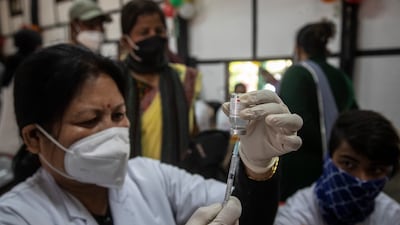
  • A health worker prepares to vaccinate a teenager in Gauhati, India. On Monday, state governments across the country administered doses at schools, hospitals and special vaccination sites amid a rapid rise in coronavirus infections. AP Photo
    A health worker prepares to vaccinate a teenager in Gauhati, India. On Monday, state governments across the country administered doses at schools, hospitals and special vaccination sites amid a rapid rise in coronavirus infections. AP Photo
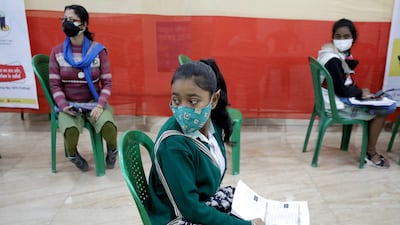
  • Indian pupils visit their school for a Covid-19 vaccine dose in Kolkata. EPA
    Indian pupils visit their school for a Covid-19 vaccine dose in Kolkata. EPA
  • Indian students visit their school for a COVID-19 vaccine dose in Kolkata Eastern India. Indian government announced a Covid-19 vaccine drive for students aged 15 to 18 at their schools from 03 January 2022. EPA
    Indian students visit their school for a COVID-19 vaccine dose in Kolkata Eastern India. Indian government announced a Covid-19 vaccine drive for students aged 15 to 18 at their schools from 03 January 2022. EPA
  • Teenage pupils queue for vaccinations at a government school in Gauhati. AP Photo
    Teenage pupils queue for vaccinations at a government school in Gauhati. AP Photo
  • A teenager receives a Covaxin Covid-19 vaccine at a government hospital in Hyderabad, India. AP Photo
    A teenager receives a Covaxin Covid-19 vaccine at a government hospital in Hyderabad, India. AP Photo
  • An Indian teenager after receiving a Covaxin inoculation in Hyderabad. India is experiencing a rapid rise in coronavirus infections, particularly in the country's densely populated cities. AP Photo
    An Indian teenager after receiving a Covaxin inoculation in Hyderabad. India is experiencing a rapid rise in coronavirus infections, particularly in the country's densely populated cities. AP Photo
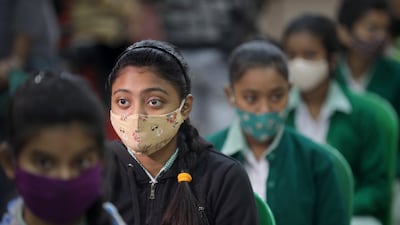
  • Pupils visit their school in Kolkata to be inoculated against Covid-19. EPA
    Pupils visit their school in Kolkata to be inoculated against Covid-19. EPA
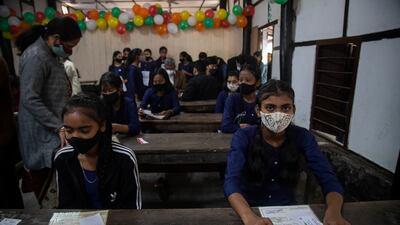
  • At a government school in Gauhati, India, pupils wait to receive a Covid-19 vaccination, part of a drive to inoculate teenagers in the age group 15 to 18. AP Photo
    At a government school in Gauhati, India, pupils wait to receive a Covid-19 vaccination, part of a drive to inoculate teenagers in the age group 15 to 18. AP Photo
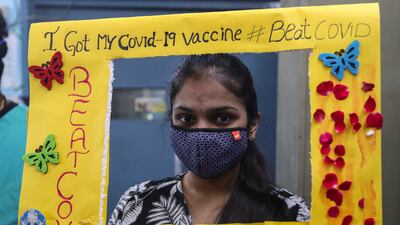
  • A teenager after being vaccinated at a government school in New Delhi, India. AP Photo
    A teenager after being vaccinated at a government school in New Delhi, India. AP Photo

"Considering bodily autonomy, bodily integrity is protected under Article 21. No one can be forced to get vaccinated. [But] government can regulate in areas of bodily autonomy," the bench said.

Article 21 of the Indian Constitution gives protection of life and personal liberty to citizens.

The bench, however, said that the current vaccine policy was not “unreasonable”, as it was based on scientific evidence, but suggested that while infection rates are low, individuals should not be restricted from accessing public places and services.

The bench was hearing a petition filed by Dr Jacob Puliyel, a former member of the National Technical Advisory Group—the highest advisory body on immunisation in the country.

Dr Puliyel was challenging the mandatory vaccination policies of many state governments for employees travelling on public transport and for access to subsidised food grains.

He had also said vaccines were not adequately tested and sought the disclosure of clinical trial data and adverse events resulting from mass Covid-19 vaccination campaigns.

The Supreme Court directed Prime Minister Narendra Modi’s government to publish reports on adverse effects caused by vaccines on a publicly accessible system.

The court also suggested that all authorities, including educational and private institutions, should review restrictions imposed on unvaccinated people.

"Regarding segregation of vaccine trial data, subject to the privacy of individuals, all trials already conducted and to be subsequently conducted, all data must be made available to the public without further delay," the court said.

Mr Modi’s government had argued that the petition was against national interest and would create vaccine hesitancy.

India has administered more than 1.89 billion Covid-19 vaccine doses since launching one of the world’s largest immunisation campaigns last January, figures compiled by the Health Ministry show.

It has been expanding the vaccine coverage and in recent weeks has opened vaccines for children above five years of age and allowed booster doses for all adults.


ARSENAL IN 1977

Feb 05 Arsenal 0-0 Sunderland

Feb 12 Manchester City 1-0 Arsenal

Feb 15 Middlesbrough 3-0 Arsenal

Feb 19 Arsenal 2-3 West Ham

Feb 26 Middlesbrough 4-1 Arsenal (FA Cup)

Mar 01 Everton 2-1 Arsenal

Mar 05  Arsenal 1-4 ipswich

March 08 Arsenal 1-2 West Brom

Mar 12 QPR 2-1 Arsenal

Mar 23 Stoke 1-1 Arsenal

Apr 02  Arsenal 3-0 Leicester

Results

6.30pm: Madjani Stakes Group 2 (PA) Dh97,500 (Dirt) 1,900m, Winner: RB Frynchh Dude, Pat Cosgrave (jockey), Helal Al Alawi (trainer)

7.05pm: Maiden (TB) Dh82,500 (D) 1,400m, Winner: Mnasek, Dane O’Neill, Doug Watson.

7.40pm: Maiden (TB) Dh82,500 (D) 1,600m, Winner: Grand Dubai, Sandro Paiva, Ali Rashid Al Raihe.

8.15pm: Handicap (TB) Dh87,500 (D) 2,200m, Winner: Meqdam, Sam Hitchcock, Doug Watson.

8.50pm: Dubai Creek Mile Listed (TB) Dh132,500 (D) 1,600m, Winner: Thegreatcollection, Pat Cosgrave, Doug Watson.

9.25pm: Conditions (TB) Dh120,000 (D) 1,900m, Winner: Sanad Libya, Richard Mullen, Satish Seemar.

10pm: Handicap (TB) Dh92,500 (D) 1,400m, Winner: Madkhal, Adrie de Vries, Fawzi Nass.

RESULTS

5pm: Maiden (PA) Dh 80,000 (Turf) 1,200m
Winner: AF Majalis, Tadhg O’Shea (jockey), Ernst Oertel (trainer).

5.30pm: Maiden (PA) Dh 80,000 (T) 1,400m
Winner: Sawt Assalam, Szczepan Mazur, Ibrahim Al Hadhrami.

6pm: Maiden (PA) Dh 80,000 (T) 1,400m
Winner: Foah, Fabrice Veron, Eric Lemartinel.

6.30pm: Wathba Stallions Cup Handicap (PA) Dh 70,000 (T) 1,400m
Winner: Faiza, Sandro Paiva, Ali Rashid Al Raihe.

7pm: Handicap (PA) Dh 80,000 (T) 1,600m
Winner: RB Dixie Honor, Antonio Fresu, Helal Al Alawi.

7.30pm: Rated Conditions (TB) Dh 100,000 (T) 1,600m
Winner: Boerhan, Ryan Curatolo, Nicholas Bachalard.

Global state-owned investor ranking by size

1.

United States

2.

China

3.

UAE

4.

Japan

5

Norway

6.

Canada

7.

Singapore

8.

Australia

9.

Saudi Arabia

10.

South Korea

Dust and sand storms compared

Sand storm

  • Particle size: Larger, heavier sand grains
  • Visibility: Often dramatic with thick "walls" of sand
  • Duration: Short-lived, typically localised
  • Travel distance: Limited 
  • Source: Open desert areas with strong winds

Dust storm

  • Particle size: Much finer, lightweight particles
  • Visibility: Hazy skies but less intense
  • Duration: Can linger for days
  • Travel distance: Long-range, up to thousands of kilometres
  • Source: Can be carried from distant regions
How does ToTok work?

The calling app is available to download on Google Play and Apple App Store

To successfully install ToTok, users are asked to enter their phone number and then create a nickname.

The app then gives users the option add their existing phone contacts, allowing them to immediately contact people also using the application by video or voice call or via message.

Users can also invite other contacts to download ToTok to allow them to make contact through the app.


The Melbourne Mercer Global Pension Index

The Melbourne Mercer Global Pension Index

Mazen Abukhater, principal and actuary at global consultancy Mercer, Middle East, says the company’s Melbourne Mercer Global Pension Index - which benchmarks 34 pension schemes across the globe to assess their adequacy, sustainability and integrity - included Saudi Arabia for the first time this year to offer a glimpse into the region.

The index highlighted fundamental issues for all 34 countries, such as a rapid ageing population and a low growth / low interest environment putting pressure on expected returns. It also highlighted the increasing popularity around the world of defined contribution schemes.

“Average life expectancy has been increasing by about three years every 10 years. Someone born in 1947 is expected to live until 85 whereas someone born in 2007 is expected to live to 103,” Mr Abukhater told the Mena Pensions Conference.

“Are our systems equipped to handle these kind of life expectancies in the future? If so many people retire at 60, they are going to be in retirement for 43 years – so we need to adapt our retirement age to our changing life expectancy.”

Saudi Arabia came in the middle of Mercer’s ranking with a score of 58.9. The report said the country's index could be raised by improving the minimum level of support for the poorest aged individuals and increasing the labour force participation rate at older ages as life expectancies rise.

Mr Abukhater said the challenges of an ageing population, increased life expectancy and some individuals relying solely on their government for financial support in their retirement years will put the system under strain.

“To relieve that pressure, governments need to consider whether it is time to switch to a defined contribution scheme so that individuals can supplement their own future with the help of government support,” he said.

Benefits of first-time home buyers' scheme
  • Priority access to new homes from participating developers
  • Discounts on sales price of off-plan units
  • Flexible payment plans from developers
  • Mortgages with better interest rates, faster approval times and reduced fees
  • DLD registration fee can be paid through banks or credit cards at zero interest rates
Updated: May 03, 2022, 10:23 AM