


A hand-plucked, golden-hued tea could make for a costly cuppa after selling for $1,314 a kilogram at an auction in India.
Manohari Gold, grown in Assam, went under the hammer at the Guwahati Tea Auction Centre in the state on Tuesday.
The tea was first processed in 2018 as an experiment by the Manohari Tea Estate in eastern Dibrugarh city. It initially cost about 39,100 rupees ($511) but the price has risen and last year it sold for 75,000 rupees a kilogram.

The batch auctioned off will be sold on for the equivalent of about $24,000 a kilogram.
Estate owner Rajan Lohia said the golden brew and soothing aftertaste of the tea made it unique.
“The tea is made from the leaves … from the one-day-old tea buds which are plucked before the sunrise. It is sophisticatedly and delicately hand-rolled. It is an art,” Mr Lohia told The National.
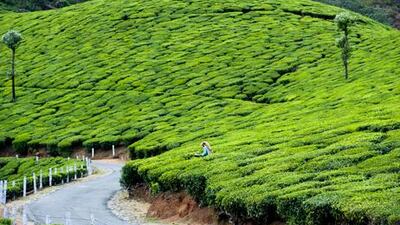
The rolling green valleys of Kerala’s tea country - in pictures
-
-

A tea picker uses shears on the Lockhart Tea Estate owned by HML, near Munnar, Kerala, India. Simon de Trey-White for The National -

A tea picker works on the Lockhart Tea Estate owned by HML, near Munnar, Kerala. Simon de Trey-White for The National -

The Lockhart Tea Estate factory owned by HML. Tea production in India is facing challenges not just from China and other competitors but from the rising cost of labour and especially fertilisers. Simon de Trey-White for The National -

Tea pickers using a motorised tea picking machine on the Lockhart Tea Estate. Simon de Trey-White for The National -
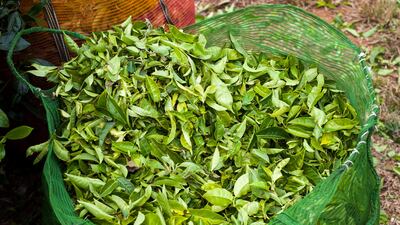
Full bags of freshly picked tea leaves on the Lockhart Tea Estate. Simon de Trey-White for The National -
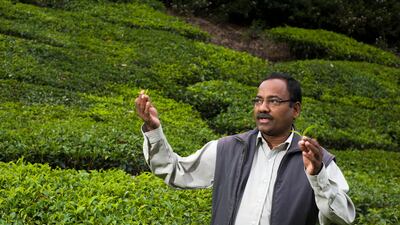
Mr J.Durairaj, Assistant Director-Advisory Services of the UPASI Tea Research Foundation Regional Centre. Simon de Trey-White for The National -
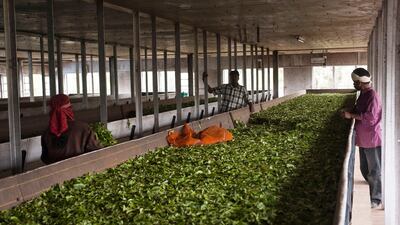
Freshly picked tea leaves in a drying trough in an orthodox production process tea factory near Munnar. This withering process has to reduce the humidity to 55%. Simon de Trey-White for The National -
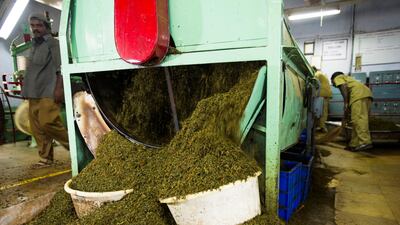
Leaf segregation machine in an orthodox production process tea factory. Simon de Trey-White for The National -

A wood fired oven that provides hot air as part of the CTC tea leaf processing in the Talayar Tea Estate CTC (Crush Tear Curl) process factory. Simon de Trey-White for The National. -
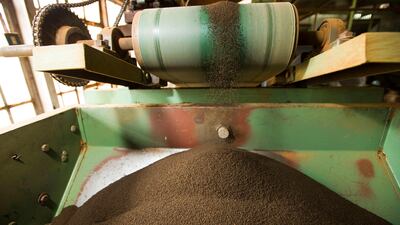
14th February 2013, Munnar, Kerala, India. Tea sifting - part of the CTC tea leaf processing in the Talayar Tea Estate CTC (Crush Tear Curl) process factory near Munnar, Kerala, India on the 14th February 2013. Simon de Trey-White for The National -

An electrostatic sifting machine sifts tea to remove large particles in an orthodox process tea factory near Munnar, Kerala, India. Simon de Trey-White for The National -

A worker handles tea in the sifing room in an orthodox process tea factory. Simon de Trey-White for The National -
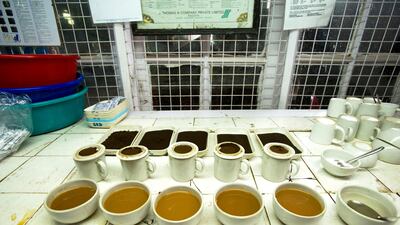
Tea lined up for tasting in the tea tasting room at the Talayar Tea Estate CTC (Crush Tear Curl) process factory. Simon de Trey-White for The National -
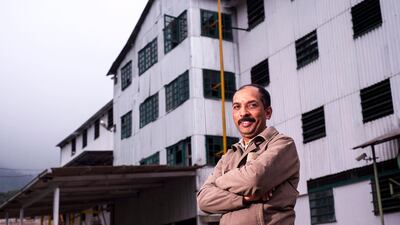
Mr Bob Devaiah, Group Manager Talayar in front of the Talayar Tea Estate CTC (Crush Tear Curl) process factory. Simon de Trey-White for The National -

Packaged Lockhart tea produced by HML. Simon de Trey-White for The National


“The tea is very rare and cannot be made as much as we want as the making procedure is tough and weather are very important. There are limited buds. It is a very costly affair,” Mr Lohia said.
The tea is the brainchild of the company’s senior planter.
Unlike a regular tea where leaves are plucked, the workers harvesting leaves for Manohari Gold painstakingly hand-pluck new buds before sunrise. The buds are then hand-rolled for 16 hours.
Occupying 400 hectares, the Manohari Tea Estate has 650 staff, but only a few have been trained to work on this variety.

Plucking takes place in June and July.
Even on a good day, the slower harvesting process means a worker can pluck only 70g to 80g of leaves, compared with 20kg of regular tea leaves within the same period.
Mr Lohia said that about 80g of buds was needed to produce about 18g of the finished product.
“The colour of the tea looks like a piece of gold. It is very rare, and we produce only 2-3 kilograms per year,” Manto Aggarwal, the the company’s legal adviser, told The National.
“We had requested them to increase the [production] cap this year as the manufacturing of our tea is very costly.”
Mr Aggarwal said the company was thrilled by the latest sale.
“We are delighted with the auction price … we manufactured this tea as an experiment in 2018 and, since then, there has been a huge demand for it.”

