

Hundreds of thousands of farmers descended on protest sites around the Indian capital on Friday to mark the first anniversary of their agitation against three contentious agriculture laws and press their demand for pro-farmer legislation.
With flags flying from their tractors, cars and motorbikes, farmers from the northern states of Punjab, Haryana and Uttar Pradesh states converged at the main three entry points to New Delhi where protest camps sprang up after they were prevented from entering the capital a year ago.
The protests have continued despite Prime Minister Narendra Modi's promise last week to scrap the laws, saying his government had failed to convince farmers about the benefits of the legislation.
-

Farmers march on the first anniversary of the their protests against the government's agricultural reform laws at the Delhi-Haryana state border in Singhu. AFP -

Millions of farmers have launched a rolling year-long protest, blocking three major highways approaching the capital New Delhi since last November. AFP -
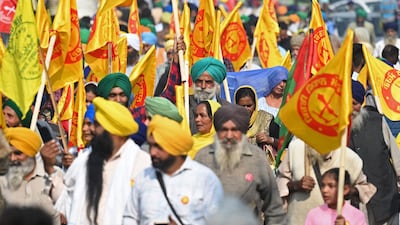
Indian Prime Minister Narendra Modi last week appealed to farmers to return to their homes after his government backed down but farmer unions have warned that the protests will continue until legislation guarantees minimum prices. AFP -

The minimum support price (MSP) helps farmers to sell their produce above the benchmark rates fixed by the government. AFP -
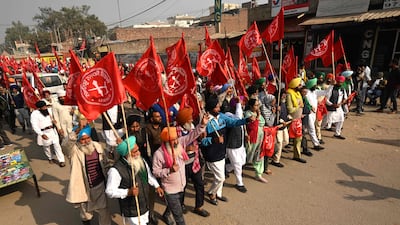
Mr Modi’s government has approved a bill to roll back the three contentious farm laws that triggered the country's longest street protests by farmers. AFP -
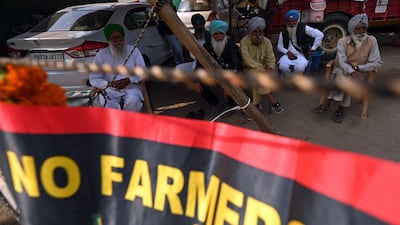
Farmers have continued to protest despite the pledge to repeal the laws. AFP -

Farming unions have called for a march to parliament on November 29, when the new bill is likely to be tabled. AFP -

Farmer Kabal Singh chains himself at a protest site in Singhu. AFP -

Farmers on the outskirts of Delhi, at Pakora Chowk, gather on first anniversary of their protests. Reuters -

Mr Modi said his government failed to convince farmers about the benefits of the reform laws. Reuters


Protesters on Friday sang songs, danced and cheered their victory after the government's surprise reversal, but pledged to continue their fight until demands such as a law ensuring a minimum support price for their produce were met.
The three laws passed in September last year dealt with the sale of produce in the free market, contract farming and deregulating food commodities from government control. Farmers described the laws as a “death warrant” that would benefit only big corporations.
Farmers staged weeks of protests in Punjab and Haryana before marching to Delhi on November 26 last year to press their demands.
The largely peaceful protests have become the biggest challenge faced so far by Mr Modi's government, which billed the laws as a “major reform” of the agriculture sector that sustains more than half of India’s 1.3 billion population.
“Today we are thanking Modi for withdrawing the black laws … he had to eventually bow to our demands,” Sandeep Singh, 55, a farmer from Ludhiana, told The National at the Singhu protest site north-west of the capital.
“We have trounced him with our patience and resilience. For a year, we fought for our rights peacefully. This is our small victory.”
Aa he spoke, protesters carrying flags and chanting slogans marched along the blocked highway dotted with thousands of makeshift structures. Dozens of Nihangs – members of a Sikh warrior sect that has promised to protect the protesters – rode about on horses carrying swords and spears.
Silence was observed to pay respect to the estimated 700 people who died over the past year as farmers continued their protests through winter cold, summer heat, monsoon rains and a deadly second wave of the Covid-19 pandemic.
“Their sacrifices will never be forgotten. This protest is for us, our children and future generations,” Manmeet Singh, another protester, told The National.
Authorities deployed hundreds of armed personnel to prevent any violence at the protest sites, which have been sealed off with concrete blocks, metal barricades, shipping containers and concertina wire.
The farmers' leaders have called for a march to parliament on Monday, when the house assembles for the winter session during which the government said it would table a bill to repeal the farm laws.
Mr Modi’s government had hoped his announcement would bring an end to the protests but organisers have responded with fresh demands that include a new law to guarantee minimum prices for their produce.
Farmers have also demanded that the government amend its electricity and pollution laws, which they say are targeted at them.
“No farmer will budge from the protest sites until the government fulfils all our demands. We do not want words; we want it in writing,” Roop Singh, a leader of Bharatiya Kisan Union, told The National.
“We do not trust Modi. He wants us to go back to our homes but we won’t unless all our demands are met,” he said.

