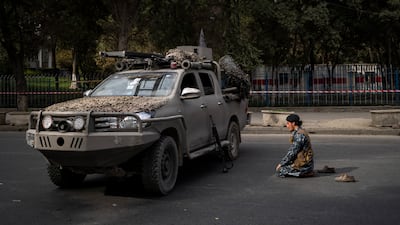
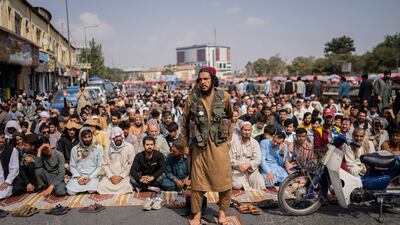
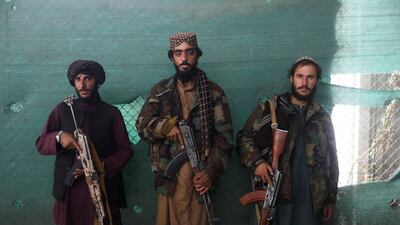
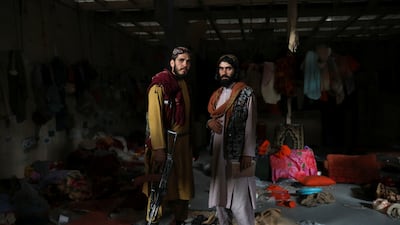
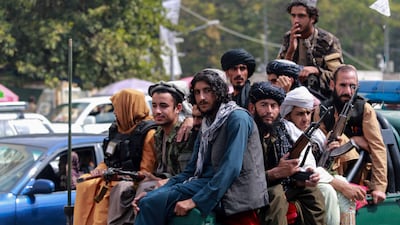
Taliban supreme leader Mawlawi Hibatullah Akhundzada has made a rare public appearance in an address to supporters in the southern Afghan city of Kandahar, the group announced on Sunday.
Akhundzada has been the spiritual chief of the movement since 2016 but has remained a reclusive figure, even after his group seized power in Afghanistan in August following the collapse of the western-backed government.
Not known for his prowess on the battlefield, having preferred a life of religious and legal study, Akhundzada's low profile has fed speculation about his role in the new Taliban government after they took over Kabul in mid-August – and even rumours of his death.
On Saturday, he visited the Darul Uloom Hakimah madrassa to "speak to his brave soldiers and disciples", according to the introduction to an audio recording circulated by Taliban social media accounts.
Akhundzada – referred to as “Amirul Momineen” or commander of the faithful – gives a religious message.
The speech did not touch on politics, but sought God's blessing for the Taliban leadership.
"May God reward the oppressed people of Afghanistan who fought the infidels and the oppressors for 20 years," Akhundzada said in the recording. "My intention here is to pray for you and you pray for me".
In the 10-minute recording, he prays for the dead Taliban members, wounded fighters and the success of officials involved in the "big test" of rebuilding what they call the Islamic Emirate of Afghanistan.
"Let's pray that we come out of this big test successfully. May Allah help us stay strong," he said.
There was tight security at the event and no photographs or video have emerged.
Akhundzada is thought to have been selected to serve more as a spiritual figurehead than a military commander, but his unusually public statements will fuel speculation that he now plans to take a more central role in leading the new government.
He rose from low-profile religious figure to leader of the Taliban in a swift transition of power after a 2016 US drone strike killed his predecessor, Mullah Akhtar Mansour.
Believed to be in his fifties at the time he took over, he is from Afghanistan’s southern province of Kandahar – once the seat of power for the Taliban's government in the late 1990s.
Before taking charge, he was one of Mansour’s deputies alongside Sirajuddin Haqqani, leader of the feared Haqqani network based out of eastern Afghanistan.
Several senior Taliban sources have said Mansour bequeathed Akhundzada the leadership in his will, though some observers have argued in the past that dynastic succession is against the Taliban’s ideology.
After being appointed leader, he secured the backing of Al Qaeda chief Ayman Al Zawahiri, who showered the cleric with praise - calling him "the emir of the faithful".
This endorsement by Osama bin Laden's heir helped seal his credentials with the Taliban's long-time allies.
Akhundzada was tasked with unifying a Taliban movement that briefly fractured during the bitter power struggle after Akhtar's assassination, and the revelation that the leadership had hidden the death of their founder Mullah Omar for years.
His public profile has largely been limited to the release of messages during Islamic holidays, and Akhundzada is believed to spend most of his time in Kandahar, the main city in the Taliban's southern Afghan heartland.
His last message was on September 7, when he told the newly appointed Taliban government in Kabul to uphold sharia law as they govern Afghanistan.
Last week, Mullah Yussef Wafa, the Taliban governor of Kandahar and a close ally of Akhundzada, told AFP he was in regular contact with his mysterious chief.
"We have regular meetings with him about the control of the situation in Afghanistan and how to make a good government," he said in an interview.
"As he is our teacher, and everyone's teacher, we are trying to learn something from him," he added.
"He gives advice to every leader of Islamic Emirate of Afghanistan and we are following his rules, advice, and if we have a progressive government in the future it's because of his advice."
Meanwhile, the UN has said that Afghanistan is heading towards a humanitarian disaster, with half of the country’s population struggling to find enough food.
The Taliban have struggled to replace services provided by the western-backed government that they overthrew in August. Donors have since cut back on funding to Afghanistan’s aid-dependent economy.

Ten tax points to be aware of in 2026
1. Domestic VAT refund amendments: request your refund within five years
If a business does not apply for the refund on time, they lose their credit.
2. E-invoicing in the UAE
Businesses should continue preparing for the implementation of e-invoicing in the UAE, with 2026 a preparation and transition period ahead of phased mandatory adoption.
3. More tax audits
Tax authorities are increasingly using data already available across multiple filings to identify audit risks.
4. More beneficial VAT and excise tax penalty regime
Tax disputes are expected to become more frequent and more structured, with clearer administrative objection and appeal processes. The UAE has adopted a new penalty regime for VAT and excise disputes, which now mirrors the penalty regime for corporate tax.
5. Greater emphasis on statutory audit
There is a greater need for the accuracy of financial statements. The International Financial Reporting Standards standards need to be strictly adhered to and, as a result, the quality of the audits will need to increase.
6. Further transfer pricing enforcement
Transfer pricing enforcement, which refers to the practice of establishing prices for internal transactions between related entities, is expected to broaden in scope. The UAE will shortly open the possibility to negotiate advance pricing agreements, or essentially rulings for transfer pricing purposes.
7. Limited time periods for audits
Recent amendments also introduce a default five-year limitation period for tax audits and assessments, subject to specific statutory exceptions. While the standard audit and assessment period is five years, this may be extended to up to 15 years in cases involving fraud or tax evasion.
8. Pillar 2 implementation
Many multinational groups will begin to feel the practical effect of the Domestic Minimum Top-Up Tax (DMTT), the UAE's implementation of the OECD’s global minimum tax under Pillar 2. While the rules apply for financial years starting on or after January 1, 2025, it is 2026 that marks the transition to an operational phase.
9. Reduced compliance obligations for imported goods and services
Businesses that apply the reverse-charge mechanism for VAT purposes in the UAE may benefit from reduced compliance obligations.
10. Substance and CbC reporting focus
Tax authorities are expected to continue strengthening the enforcement of economic substance and Country-by-Country (CbC) reporting frameworks. In the UAE, these regimes are increasingly being used as risk-assessment tools, providing tax authorities with a comprehensive view of multinational groups’ global footprints and enabling them to assess whether profits are aligned with real economic activity.
Contributed by Thomas Vanhee and Hend Rashwan, Aurifer
Zayed Sustainability Prize
MATCH INFO
Uefa Champions League semi-final, first leg
Bayern Munich v Real Madrid
When: April 25, 10.45pm kick-off (UAE)
Where: Allianz Arena, Munich
Live: BeIN Sports HD
Second leg: May 1, Santiago Bernabeu, Madrid
The Perfect Couple
Starring: Nicole Kidman, Liev Schreiber, Jack Reynor
Creator: Jenna Lamia
Rating: 3/5
Jetour T1 specs
Engine: 2-litre turbocharged
Power: 254hp
Torque: 390Nm
Price: From Dh126,000
Available: Now
The five pillars of Islam
COMPANY PROFILE
Name: HyperSpace
Started: 2020
Founders: Alexander Heller, Rama Allen and Desi Gonzalez
Based: Dubai, UAE
Sector: Entertainment
Number of staff: 210
Investment raised: $75 million from investors including Galaxy Interactive, Riyadh Season, Sega Ventures and Apis Venture Partners
Killing of Qassem Suleimani
Who's who in Yemen conflict
Houthis: Iran-backed rebels who occupy Sanaa and run unrecognised government
Yemeni government: Exiled government in Aden led by eight-member Presidential Leadership Council
Southern Transitional Council: Faction in Yemeni government that seeks autonomy for the south
Habrish 'rebels': Tribal-backed forces feuding with STC over control of oil in government territory
ARGYLLE
%3Cp%3EDirector%3A%20Matthew%20Vaughn%3C%2Fp%3E%0A%3Cp%3EStarring%3A%20Bryce%20Dallas%20Howard%2C%20Sam%20Rockwell%2C%20John%20Cena%3C%2Fp%3E%0A%3Cp%3ERating%3A%203%2F5%3C%2Fp%3E%0A
The years Ramadan fell in May
Try out the test yourself
Q1 Suppose you had $100 in a savings account and the interest rate was 2 per cent per year. After five years, how much do you think you would have in the account if you left the money to grow?
a) More than $102
b) Exactly $102
c) Less than $102
d) Do not know
e) Refuse to answer
Q2 Imagine that the interest rate on your savings account was 1 per cent per year and inflation was 2 per cent per year. After one year, how much would you be able to buy with the money in this account?
a) More than today
b) Exactly the same as today
c) Less than today
d) Do not know
e) Refuse to answer
Q4 Do you think that the following statement is true or false? “Buying a single company stock usually provides a safer return than a stock mutual fund.”
a) True
b) False
d) Do not know
e) Refuse to answer
The “Big Three” financial literacy questions were created by Professors Annamaria Lusardi of the George Washington School of Business and Olivia Mitchell, of the Wharton School of the University of Pennsylvania.
Answers: Q1 More than $102 (compound interest). Q2 Less than today (inflation). Q3 False (diversification).
Company%C2%A0profile
%3Cp%3E%3Cstrong%3ECompany%20name%3A%20%3C%2Fstrong%3Eamana%3Cbr%3E%3Cstrong%3EStarted%3A%20%3C%2Fstrong%3E2010%3Cbr%3E%3Cstrong%3EFounders%3A%3C%2Fstrong%3E%20Karim%20Farra%20and%20Ziad%20Aboujeb%3Cbr%3E%3Cstrong%3EBased%3A%20%3C%2Fstrong%3EUAE%3Cbr%3E%3Cstrong%3ERegulator%3A%20%3C%2Fstrong%3EDFSA%3Cbr%3E%3Cstrong%3ESector%3A%20%3C%2Fstrong%3EFinancial%20services%3Cbr%3E%3Cstrong%3ECurrent%20number%20of%20staff%3A%20%3C%2Fstrong%3E85%3Cbr%3E%3Cstrong%3EInvestment%20stage%3A%20%3C%2Fstrong%3ESelf-funded%3Cbr%3E%3C%2Fp%3E%0A
AI traffic lights to ease congestion at seven points to Sheikh Zayed bin Sultan Street
The seven points are:
Shakhbout bin Sultan Street
Dhafeer Street
Hadbat Al Ghubainah Street (outbound)
Salama bint Butti Street
Al Dhafra Street
Rabdan Street
Umm Yifina Street exit (inbound)
Rebel%20Moon%20-%20Part%20One%3A%20A%20Child%20of%20Fire
%3Cp%3E%3Cstrong%3EDirector%3A%20%3C%2Fstrong%3EZack%20Snyder%3Cbr%3E%3Cstrong%3EStars%3A%20%3C%2Fstrong%3ESofia%20Boutella%2C%20Djimon%20Hounsou%2C%20Ed%20Skrein%2C%20Michiel%20Huisman%2C%20Charlie%20Hunnam%3Cbr%3E%3Cstrong%3ERating%3A%20%3C%2Fstrong%3E2%2F5%3C%2Fp%3E%0A