The black beach on Iwo To, formerly known as Iwo Jima, was stormed by thousands of U.S. Marines Feb. 19, 1945 during the Battle of Iwo Jima. Many relics of the war remain in the waters and scattered among the sands.
The black beach on Iwo To, formerly known as Iwo Jima, was stormed by thousands of U.S. Marines Feb. 19, 1945 during the Battle of Iwo Jima. Many relics of the war remain in the waters and scattered a

Volcanic activity raises Japanese island, exposing sunken Second World War ships


Robert Tollast
  • English
  • Arabic

An undersea volcano and related tectonic activity near the Ogasawara island chain in Japan has raised the island of Iwo Jima, exposing a fleet of partially sunken Second World War ships.

Aerial footage from the Japanese All-Nippon News Network reported the strange phenomenon on Monday.

The ghostly fleet of wrecks, which can often be seen partially submerged, now appear beached on the small volcanic island’s black sandy beaches.

The island, the name of which translates to “sulphur island” was the site of a battle in February 1945, when more than 100,000 US soldiers fought 20,000 Japanese defenders over its volcanic terrain and the imposing Mt Suribachi.

Only 216 Japanese soldiers were captured alive, following the wartime Imperial Japanese tradition of refusing to surrender, believing that capture by enemy forces was highly dishonourable.

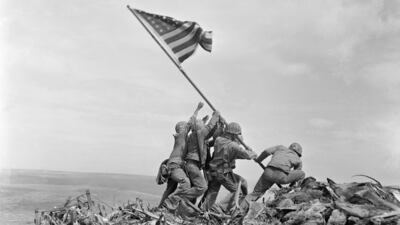
  • US marines of the Fifth Division, raise the American flag on top of Mount Suribachi on Iwo Jima, Japan, on February 23, 1945. AP
    US marines of the Fifth Division, raise the American flag on top of Mount Suribachi on Iwo Jima, Japan, on February 23, 1945. AP
  • Explosions rock the Iwo Jima shore during the pre-landing bombardment on February 19, 1945. Reuters
    Explosions rock the Iwo Jima shore during the pre-landing bombardment on February 19, 1945. Reuters
  • A wave of US marines from the Fourth Division storms Iwo Jima as another boat full of servicemen approaches on February 19, 1945. Reuters
    A wave of US marines from the Fourth Division storms Iwo Jima as another boat full of servicemen approaches on February 19, 1945. Reuters
  • US marines of the Fifth Division move inland off the landing beach after their arrival on Iwo Jima, on February 19, 1945. Reuters
    US marines of the Fifth Division move inland off the landing beach after their arrival on Iwo Jima, on February 19, 1945. Reuters
  • US marines of the Seventh Regiment wait to move inland on Iwo Jima soon after going ashore, on February 19, 1945. Reuters
    US marines of the Seventh Regiment wait to move inland on Iwo Jima soon after going ashore, on February 19, 1945. Reuters
  • US marines of the Fifth Division inch their way up a slope towards Mount Suribachi on Iwo Jima, on February 19, 1945. Reuters
    US marines of the Fifth Division inch their way up a slope towards Mount Suribachi on Iwo Jima, on February 19, 1945. Reuters
  • US marines with the Fourth Division fire on enemy positions from the black sands of an Iwo Jima beach, on February 1945. Reuters
    US marines with the Fourth Division fire on enemy positions from the black sands of an Iwo Jima beach, on February 1945. Reuters
  • A US marine flamethrower operator with K Company goes over the top to assault a Japanese pillbox on Iwo Jima's second airfield on February 1945. Reuters
    A US marine flamethrower operator with K Company goes over the top to assault a Japanese pillbox on Iwo Jima's second airfield on February 1945. Reuters
  • A US marine flame thrower operator in action, covered by a pair of riflemen, on Iwo Jima, February 1945. Reuters
    A US marine flame thrower operator in action, covered by a pair of riflemen, on Iwo Jima, February 1945. Reuters
  • A US Marine surveys the shattered landscape while hunting for remaining Japanese forces on Iwo Jima, March 1945. US National Archives. Reuters
    A US Marine surveys the shattered landscape while hunting for remaining Japanese forces on Iwo Jima, March 1945. US National Archives. Reuters
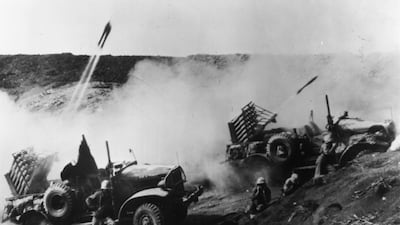
  • US Marine rocketeers attack Japanese positions on Iwo Jima in support of a leatherneck advance, on March 23, 1945. Getty Images
    US Marine rocketeers attack Japanese positions on Iwo Jima in support of a leatherneck advance, on March 23, 1945. Getty Images
  • Wrecked US Marine vehicles litter an Iwo Jima beach, in 1945. Reuters
    Wrecked US Marine vehicles litter an Iwo Jima beach, in 1945. Reuters
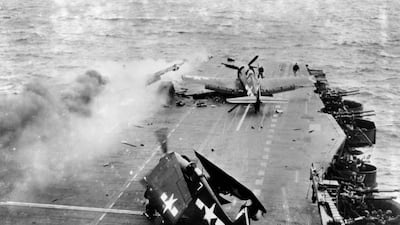
  • Damaged aircraft on the flight deck of the 'USS Saratoga' after direct hits by Japanese bombs off Iwo Jima during the Second World War. Getty Images
    Damaged aircraft on the flight deck of the 'USS Saratoga' after direct hits by Japanese bombs off Iwo Jima during the Second World War. Getty Images
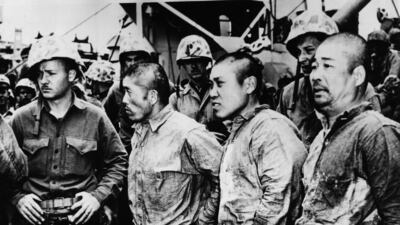
  • Japanese prisoners of war captured in the battle for Iwo Jima Island. Getty Images
    Japanese prisoners of war captured in the battle for Iwo Jima Island. Getty Images
  • US marines raise the American flag on Mount Suribachi on the Iwo Jima island, in 1945. Reuters
    US marines raise the American flag on Mount Suribachi on the Iwo Jima island, in 1945. Reuters

After the battle, US forces attempted to create a harbour on the island as a launching pad for a potential invasion of Japan, sinking a number of captured Japanese cargo ships to form a breakwater for the harbour. The effort failed, but the broken hulls of the ships remain, some of the last remnants of a grim struggle to control the Pacific.


The Saga Continues

Wu-Tang Clan

(36 Chambers / Entertainment One)

'Gold'

Director:Anthony Hayes

Stars:Zaf Efron, Anthony Hayes

Rating:3/5

Notable salonnières of the Middle East through history

Al Khasan (Okaz, Saudi Arabia)

Tamadir bint Amr Al Harith, known simply as Al Khasan, was a poet from Najd famed for elegies, earning great renown for the eulogy of her brothers Mu’awiyah and Sakhr, both killed in tribal wars. Although not a salonnière, this prestigious 7th century poet fostered a culture of literary criticism and could be found standing in the souq of Okaz and reciting her poetry, publicly pronouncing her views and inviting others to join in the debate on scholarship. She later converted to Islam.


Maryana Marrash (Aleppo)

A poet and writer, Marrash helped revive the tradition of the salon and was an active part of the Nadha movement, or Arab Renaissance. Born to an established family in Aleppo in Ottoman Syria in 1848, Marrash was educated at missionary schools in Aleppo and Beirut at a time when many women did not receive an education. After touring Europe, she began to host salons where writers played chess and cards, competed in the art of poetry, and discussed literature and politics. An accomplished singer and canon player, music and dancing were a part of these evenings.


Princess Nazil Fadil (Cairo)

Princess Nazil Fadil gathered religious, literary and political elite together at her Cairo palace, although she stopped short of inviting women. The princess, a niece of Khedive Ismail, believed that Egypt’s situation could only be solved through education and she donated her own property to help fund the first modern Egyptian University in Cairo.


Mayy Ziyadah (Cairo)

Ziyadah was the first to entertain both men and women at her Cairo salon, founded in 1913. The writer, poet, public speaker and critic, her writing explored language, religious identity, language, nationalism and hierarchy. Born in Nazareth, Palestine, to a Lebanese father and Palestinian mother, her salon was open to different social classes and earned comparisons with souq of where Al Khansa herself once recited.

%20Ramez%20Gab%20Min%20El%20Akher
%3Cp%3E%3Cstrong%3ECreator%3A%3C%2Fstrong%3E%20Ramez%20Galal%3C%2Fp%3E%0A%3Cp%3E%3Cstrong%3EStarring%3A%3C%2Fstrong%3E%20Ramez%20Galal%3C%2Fp%3E%0A%3Cp%3E%3Cstrong%3EStreaming%20on%3A%20%3C%2Fstrong%3EMBC%20Shahid%3C%2Fp%3E%0A%3Cp%3E%3Cstrong%3ERating%3A%20%3C%2Fstrong%3E2.5%2F5%3C%2Fp%3E%0A
Ten tax points to be aware of in 2026

1. Domestic VAT refund amendments: request your refund within five years

If a business does not apply for the refund on time, they lose their credit.

2. E-invoicing in the UAE

Businesses should continue preparing for the implementation of e-invoicing in the UAE, with 2026 a preparation and transition period ahead of phased mandatory adoption. 

3. More tax audits

Tax authorities are increasingly using data already available across multiple filings to identify audit risks. 

4. More beneficial VAT and excise tax penalty regime

Tax disputes are expected to become more frequent and more structured, with clearer administrative objection and appeal processes. The UAE has adopted a new penalty regime for VAT and excise disputes, which now mirrors the penalty regime for corporate tax.

5. Greater emphasis on statutory audit

There is a greater need for the accuracy of financial statements. The International Financial Reporting Standards standards need to be strictly adhered to and, as a result, the quality of the audits will need to increase.

6. Further transfer pricing enforcement

Transfer pricing enforcement, which refers to the practice of establishing prices for internal transactions between related entities, is expected to broaden in scope. The UAE will shortly open the possibility to negotiate advance pricing agreements, or essentially rulings for transfer pricing purposes. 

7. Limited time periods for audits

Recent amendments also introduce a default five-year limitation period for tax audits and assessments, subject to specific statutory exceptions. While the standard audit and assessment period is five years, this may be extended to up to 15 years in cases involving fraud or tax evasion. 

8. Pillar 2 implementation 

Many multinational groups will begin to feel the practical effect of the Domestic Minimum Top-Up Tax (DMTT), the UAE's implementation of the OECD’s global minimum tax under Pillar 2. While the rules apply for financial years starting on or after January 1, 2025, it is 2026 that marks the transition to an operational phase.

9. Reduced compliance obligations for imported goods and services

Businesses that apply the reverse-charge mechanism for VAT purposes in the UAE may benefit from reduced compliance obligations. 

10. Substance and CbC reporting focus

Tax authorities are expected to continue strengthening the enforcement of economic substance and Country-by-Country (CbC) reporting frameworks. In the UAE, these regimes are increasingly being used as risk-assessment tools, providing tax authorities with a comprehensive view of multinational groups’ global footprints and enabling them to assess whether profits are aligned with real economic activity. 

Contributed by Thomas Vanhee and Hend Rashwan, Aurifer

The specs
  • Engine: 3.9-litre twin-turbo V8
  • Power: 640hp
  • Torque: 760nm
  • On sale: 2026
  • Price: Not announced yet
UPI facts

More than 2.2 million Indian tourists arrived in UAE in 2023
More than 3.5 million Indians reside in UAE
Indian tourists can make purchases in UAE using rupee accounts in India through QR-code-based UPI real-time payment systems
Indian residents in UAE can use their non-resident NRO and NRE accounts held in Indian banks linked to a UAE mobile number for UPI transactions

FA Cup quarter-final draw

The matches will be played across the weekend of 21 and 22 March

Sheffield United v Arsenal

Newcastle v Manchester City

Norwich v Derby/Manchester United

Leicester City v Chelsea

Updated: October 19, 2021, 5:03 PM