A child on her way to school on the outskirts of Herat. Girls have returned to some secondary schools in a northern province of Afghanistan, Taliban officials and teachers said. AFP

Girls return to some secondary schools in northern Afghanistan


  • English
  • Arabic

Girls have returned to some secondary schools in a northern province of Afghanistan, Taliban officials and teachers said on Tuesday, but they remain barred from classrooms in much of the country.

The new hardline government also announced at a stage-managed rally that some female civil servants have been called back to work and that a backlog of salaries would be paid, in signs the Taliban may be trying to soften its public image after 50 days in power.

A video posted by the group's spokesman Suhail Shaheen showed dozens of schoolgirls in black, some wearing white head scarves and others with black face veils, sitting in chairs waving Taliban flags.

“Girls are going to high schools in Khan Abad, Kunduz Province,” the Doha-based spokesman said on Twitter, Mr Shaheen has been nominated as the new Afghan government's permanent representative to the United Nations.

But in Kabul, education ministry official Mohammad Abid said there had been no policy change from the Taliban's interim central government, telling AFP on Tuesday: “High schools still remain closed for girls.”

The Taliban, notorious for their brutal and oppressive rule from 1996 to 2001, have faced international disapproval after effectively excluding women and girls from education and work across the country, while incrementally stripping away Afghans' freedoms.

They permitted girls to attend primary school from the start, but have maintained that neither they nor their female teachers could return to secondary school yet.

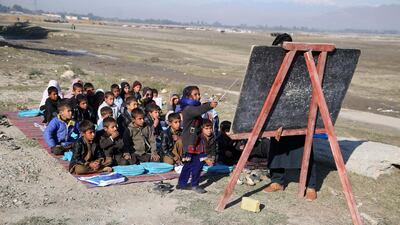
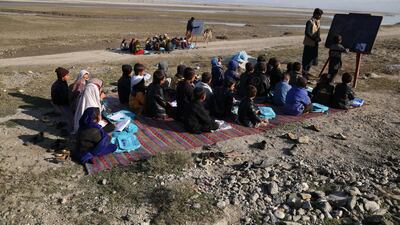
  • Afghan children take a class in open due to lack of school and facilities in Laghman, Afghanistan. According to reports, 39 percent of the 9.2 million students in the country are girls. However, three to five million children, mostly girls, are still unable to attend schools. EPA
    Afghan children take a class in open due to lack of school and facilities in Laghman, Afghanistan. According to reports, 39 percent of the 9.2 million students in the country are girls. However, three to five million children, mostly girls, are still unable to attend schools. EPA
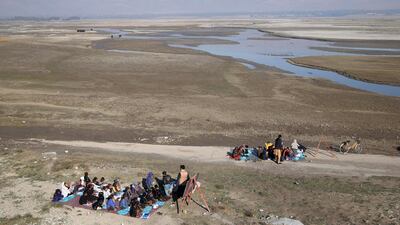
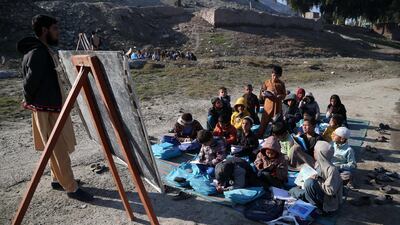
  • Afghan children take a class in open due to lack of school and facilities in Laghman. EPA
    Afghan children take a class in open due to lack of school and facilities in Laghman. EPA
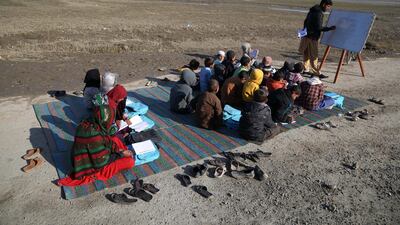
  • Afghan children take a class in open due to lack of school and facilities in Laghman. EPA
    Afghan children take a class in open due to lack of school and facilities in Laghman. EPA
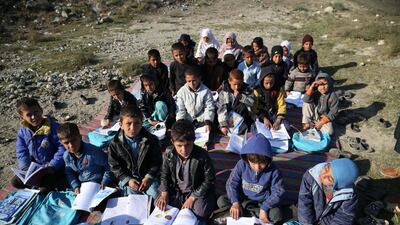
  • Afghan children take a class in open due to lack of school and facilities in Laghman. EPA
    Afghan children take a class in open due to lack of school and facilities in Laghman. EPA
  • Afghan children take a class in open due to lack of school and facilities in Laghman. EPA
    Afghan children take a class in open due to lack of school and facilities in Laghman. EPA
  • Afghan children take a class in open due to lack of school and facilities in Laghman. EPA
    Afghan children take a class in open due to lack of school and facilities in Laghman. EPA

The group have said girls can return to high school once their security and strict gender segregation under the group's restrictive interpretation of sharia law can be ensured.

Last month Taliban spokesman Zabihullah Mujahid told a press conference that work was “continuing over the issues of education and work of women and girls”, saying schools will reopen “as soon as possible”, without providing a time frame.

“More time is needed … instructions on how to deal with their work, their services and their education are needed because the system has changed and an Islamic system is in place.”

In the news clip shared by Mr Shaheen, a reporter for Radio Television Afghanistan can be heard saying “schools are open for girls, and there are no restrictions".

A Taliban member is then interviewed on camera saying girls and boys from grades seven to 12 are at school in the district, adding “there are not any issues for anyone so far".

A head teacher in Kunduz city, the provincial capital, told AFP that girls in a high school in the Imam Sahib district had gone back to classes.

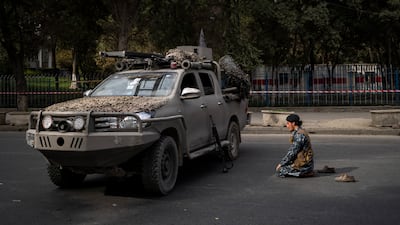
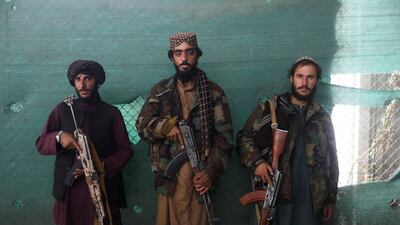
  • A Taliban fighter prays next to a demonstration organised by the Afghan Society of Muslim Youth, demanding the release of frozen international money in Kabul, Afghanistan. AP Photo
    A Taliban fighter prays next to a demonstration organised by the Afghan Society of Muslim Youth, demanding the release of frozen international money in Kabul, Afghanistan. AP Photo
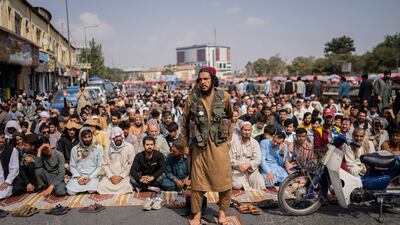
  • A Taliban fighter and a group of Afghan men attend Friday prayers in Kabul. AP Photo
    A Taliban fighter and a group of Afghan men attend Friday prayers in Kabul. AP Photo
  • Taliban soldiers in Bagram Air Base in Parwan. Reuters
    Taliban soldiers in Bagram Air Base in Parwan. Reuters
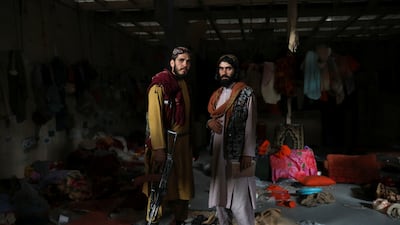
  • Taliban soldiers Seifatollah and Vasighollah stand in a prison in Bagram Air Base. Reuters
    Taliban soldiers Seifatollah and Vasighollah stand in a prison in Bagram Air Base. Reuters
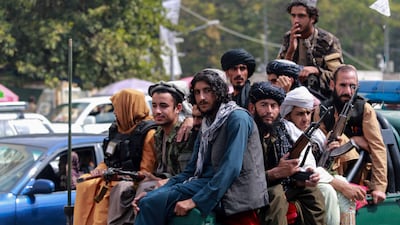
  • Taliban patrol Kabul. EPA
    Taliban patrol Kabul. EPA
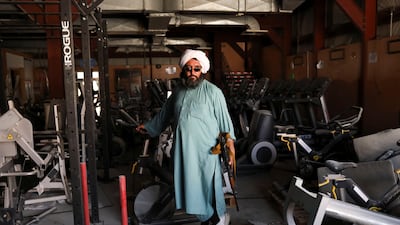
  • Vahdat, a Taliban soldier and former prisoner, stands next to exercise equipment in Bagram Air Base. Reuters
    Vahdat, a Taliban soldier and former prisoner, stands next to exercise equipment in Bagram Air Base. Reuters
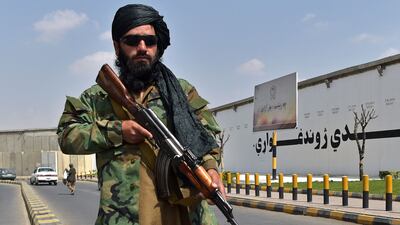
  • A Taliban fighter stands guard near Zanbaq Square in Kabul. AFP
    A Taliban fighter stands guard near Zanbaq Square in Kabul. AFP
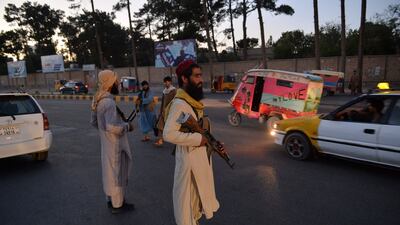
  • Taliban fighters police a road in Herat. AFP
    Taliban fighters police a road in Herat. AFP

Another teacher in Kunduz also said other schoolgirls had returned.

“Our principal informed the Directorate of Education at Kunduz and requested them for instructions,” the fourth grade teacher told AFP.

“They replied that the ban on schoolgirl is only applicable to other provinces, and not Kunduz.”

The Taliban have also restricted women's access to work.

The group imposed an extreme interpretation of sharia law during their last period of rule and this time round have said progress in women's rights will be respected “within the framework of Islamic law".

But interior ministry spokesman Qari Sayed Khosti told AFP that all employees of the passport department “including female employees” were asked to go back to their offices.

Meanwhile, a statement published by the Taliban on Facebook said the process of paying government workers their salaries was “under way” after many have gone without pay for several months.

The revelation that some Afghan girls were returning to secondary school came on World Teachers' Day on Tuesday.

“For girls' education, female teachers play an even more important role in Afghanistan,” the UN children's agency's country office said on Twitter, as it called for the encouragement and protection of women teachers.


Jebel Ali Dragons 26 Bahrain 23

Dragons
Tries: Hayes, Richards, Cooper
Cons: Love
Pens: Love 3

Bahrain
Tries: Kenny, Crombie, Tantoh
Cons: Phillips
Pens: Phillips 2

Mercer, the investment consulting arm of US services company Marsh & McLennan, expects its wealth division to at least double its assets under management (AUM) in the Middle East as wealth in the region continues to grow despite economic headwinds, a company official said.

Mercer Wealth, which globally has $160 billion in AUM, plans to boost its AUM in the region to $2-$3bn in the next 2-3 years from the present $1bn, said Yasir AbuShaban, a Dubai-based principal with Mercer Wealth.

Within the next two to three years, we are looking at reaching $2 to $3 billion as a conservative estimate and we do see an opportunity to do so,” said Mr AbuShaban.

Mercer does not directly make investments, but allocates clients’ money they have discretion to, to professional asset managers. They also provide advice to clients.

“We have buying power. We can negotiate on their (client’s) behalf with asset managers to provide them lower fees than they otherwise would have to get on their own,” he added.

Mercer Wealth’s clients include sovereign wealth funds, family offices, and insurance companies among others.

From its office in Dubai, Mercer also looks after Africa, India and Turkey, where they also see opportunity for growth.

Wealth creation in Middle East and Africa (MEA) grew 8.5 per cent to $8.1 trillion last year from $7.5tn in 2015, higher than last year’s global average of 6 per cent and the second-highest growth in a region after Asia-Pacific which grew 9.9 per cent, according to consultancy Boston Consulting Group (BCG). In the region, where wealth grew just 1.9 per cent in 2015 compared with 2014, a pickup in oil prices has helped in wealth generation.

BCG is forecasting MEA wealth will rise to $12tn by 2021, growing at an annual average of 8 per cent.

Drivers of wealth generation in the region will be split evenly between new wealth creation and growth of performance of existing assets, according to BCG.

Another general trend in the region is clients’ looking for a comprehensive approach to investing, according to Mr AbuShaban.

“Institutional investors or some of the families are seeing a slowdown in the available capital they have to invest and in that sense they are looking at optimizing the way they manage their portfolios and making sure they are not investing haphazardly and different parts of their investment are working together,” said Mr AbuShaban.

Some clients also have a higher appetite for risk, given the low interest-rate environment that does not provide enough yield for some institutional investors. These clients are keen to invest in illiquid assets, such as private equity and infrastructure.

“What we have seen is a desire for higher returns in what has been a low-return environment specifically in various fixed income or bonds,” he said.

“In this environment, we have seen a de facto increase in the risk that clients are taking in things like illiquid investments, private equity investments, infrastructure and private debt, those kind of investments were higher illiquidity results in incrementally higher returns.”

The Abu Dhabi Investment Authority, one of the largest sovereign wealth funds, said in its 2016 report that has gradually increased its exposure in direct private equity and private credit transactions, mainly in Asian markets and especially in China and India. The authority’s private equity department focused on structured equities owing to “their defensive characteristics.”

Updated: October 05, 2021, 3:02 PM