A South Korean military officer makes a test call with a North Korean officer through an inter-Koran military communication line at an undisclosed location near the demilitarised zone on Monday. Photo: AP
A South Korean military officer makes a test call with a North Korean officer through an inter-Koran military communication line at an undisclosed location near the demilitarised zone on Monday. Photo

North Korea restores cross-border hotline with South Korea


  • English
  • Arabic

North Korea reconnected a hotline with South Korea it had left silent for about two months.

North Korean officials answered a liaison phone call on Monday, AFP cited South Korean officials as saying.

The North's leader, Kim Jong-un, told his parliament in Pyongyang last week to resume communications on the hotlines established in 2018 after he and South Korean President Moon Jae-in held a series of summits aimed at decreasing tensions on their heavily armed border.

Kim Yo Jong, the sister of Kim Jong-un, said last week that North Korea is willing to consider another summit with South Korea if mutual respect between the neighbours can be assured, the official Korean Central News Agency reported.

Constructive discussions offer a chance for solutions on issues such as “the re-establishment of the North-South joint liaison office and the North-South summit, to say nothing of the timely declaration of the significant termination of the war,“ Ms Kim was cited as saying.

The South Korean government welcomed the move and said it looked forward to resuming inter-Korean talks promptly following the restoration of the communication links, the Unification Ministry said. Pyongyang announced its intent to restore the hotlines in a dispatch on Monday from KCNA.

“The south Korean authorities should make positive efforts to put the north-south ties on a right track and settle the important tasks which must be prioritised to open up the bright prospect in the future, bearing deep in mind the meaning of the restoration of communication lines,” KCNA said.

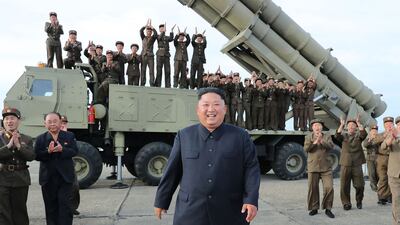
  • North Korean leader Kim Jong-un celebrating the test-firing of a 'newly developed super-large multiple rocket launcher' at an undisclosed location. AFP
    North Korean leader Kim Jong-un celebrating the test-firing of a 'newly developed super-large multiple rocket launcher' at an undisclosed location. AFP
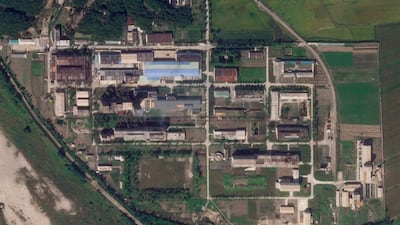
  • A uranium enrichment plant at North Korea's main Yongbyon nuclear complex. AP
    A uranium enrichment plant at North Korea's main Yongbyon nuclear complex. AP
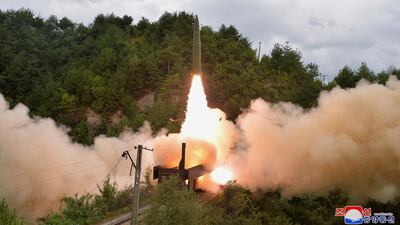
  • A test missile is launched from a train in an undisclosed location of North Korea. AP
    A test missile is launched from a train in an undisclosed location of North Korea. AP
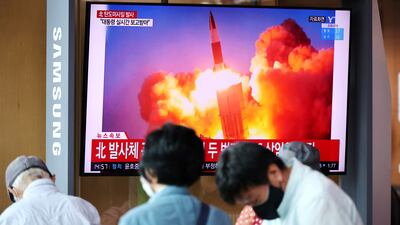
  • People in Seoul, South Korea, watch a news report on North Korea firing what appears to be a pair of ballistic missiles off its east coast. Reuters
    People in Seoul, South Korea, watch a news report on North Korea firing what appears to be a pair of ballistic missiles off its east coast. Reuters
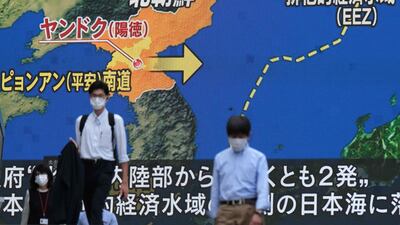
  • A map detailing North Korea's missile launch towards the Sea of Japan, part of a news broadcast at Akihabara, Tokyo. AFP
    A map detailing North Korea's missile launch towards the Sea of Japan, part of a news broadcast at Akihabara, Tokyo. AFP
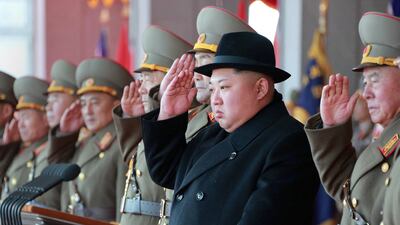
  • Kim Jong-un attending a military parade to mark the 70th anniversary of the Korean People's Army at Kim Il-sung Square in Pyongyang. AFP
    Kim Jong-un attending a military parade to mark the 70th anniversary of the Korean People's Army at Kim Il-sung Square in Pyongyang. AFP
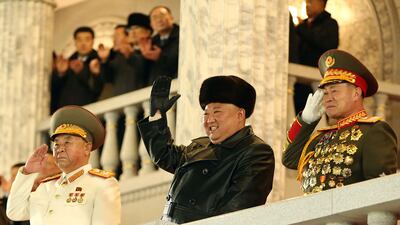
  • Kim Jong-un is all smiles as he watches the military parade in the North Korean capital Pyongyang. AFP
    Kim Jong-un is all smiles as he watches the military parade in the North Korean capital Pyongyang. AFP
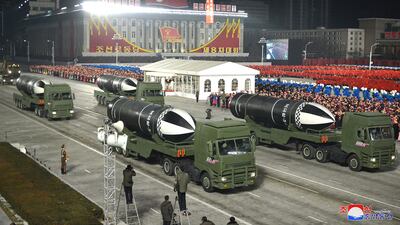
  • What appears to be submarine-launched ballistic missiles are displayed, marking the eighth Congress of the Workers' Party of Korea (WPK) in Pyongyang. AFP
    What appears to be submarine-launched ballistic missiles are displayed, marking the eighth Congress of the Workers' Party of Korea (WPK) in Pyongyang. AFP
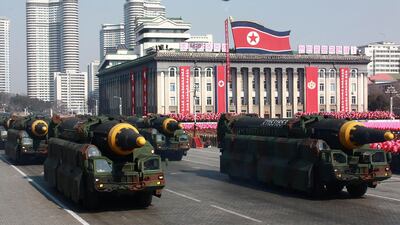
  • Hwasong-12 ballistic at Kim Il-sung Square, Pyongyang. AFP
    Hwasong-12 ballistic at Kim Il-sung Square, Pyongyang. AFP

The hotlines were briefly restored in July but cut about a month later in a show of anger from Pyongyang over joint military drills by the US and South Korea.

In his speech last week to the Supreme People’s Assembly, Mr Kim also sent a fresh warning to the US, accusing Washington of being a “fundamental danger” to the international community and saying he would boost his nuclear capabilities, a day after Pyongyang claimed it successfully tested a “hypersonic missile” that could evade American defences.

“As the actions of the past eight months of the new US administration have clearly shown, the US military threat and hostile policy towards North Korea has not changed at all,” Mr Kim said.


Haemoglobin disorders explained

Thalassaemia is part of a family of genetic conditions affecting the blood known as haemoglobin disorders.

Haemoglobin is a substance in the red blood cells that carries oxygen and a lack of it triggers anemia, leaving patients very weak, short of breath and pale.

The most severe type of the condition is typically inherited when both parents are carriers. Those patients often require regular blood transfusions - about 450 of the UAE's 2,000 thalassaemia patients - though frequent transfusions can lead to too much iron in the body and heart and liver problems.

The condition mainly affects people of Mediterranean, South Asian, South-East Asian and Middle Eastern origin. Saudi Arabia recorded 45,892 cases of carriers between 2004 and 2014.

A World Health Organisation study estimated that globally there are at least 950,000 'new carrier couples' every year and annually there are 1.33 million at-risk pregnancies.

The burning issue

The internal combustion engine is facing a watershed moment – major manufacturer Volvo is to stop producing petroleum-powered vehicles by 2021 and countries in Europe, including the UK, have vowed to ban their sale before 2040. The National takes a look at the story of one of the most successful technologies of the last 100 years and how it has impacted life in the UAE. 

Read part four: an affection for classic cars lives on

Read part three: the age of the electric vehicle begins

Read part one: how cars came to the UAE


SPECS
%3Cp%3E%3Cstrong%3EEngine%3A%3C%2Fstrong%3E%201.5-litre%204-cylinder%3Cbr%3E%3Cstrong%3EPower%3A%3C%2Fstrong%3E%20101hp%3Cbr%3E%3Cstrong%3ETorque%3A%3C%2Fstrong%3E%20135Nm%3Cbr%3E%3Cstrong%3ETransmission%3C%2Fstrong%3E%3A%20Six-speed%20auto%3Cbr%3E%3Cstrong%3EPrice%3A%3C%2Fstrong%3E%20From%20Dh79%2C900%3Cbr%3E%3Cstrong%3EOn%20sale%3A%3C%2Fstrong%3E%20Now%3C%2Fp%3E%0A
UK-EU trade at a glance

EU fishing vessels guaranteed access to UK waters for 12 years

Co-operation on security initiatives and procurement of defence products

Youth experience scheme to work, study or volunteer in UK and EU countries

Smoother border management with use of e-gates

Cutting red tape on import and export of food

Updated: October 04, 2021, 5:49 AM