



Afghan women are taking to social media to share pictures of ornate traditional clothes in an online campaign against restrictions being brought in by the new Taliban authorities.
With the hashtags #DoNotTouchMyClothes and #AfghanistanCulture, they are sharing dresses with bright colourful patterns and intricate embroidery.
The movement started this week after a protest by a group of pro-Taliban women expressing support for the militant group that now controls Afghanistan. Waving the group's small white flags, most were hidden in black dresses that cover the entire body from the top of the head to the ground.
The covering includes a low brimmed peak that comes down to where the wearers’ eyes would be, but the front is without even a discernible mesh screen to see through.
“These clothes cannot be popular and accepted clothes for all women in our society. The fashion statement behind these clothes that cover even the woman's eyes is coercion, bullying and non-recognition of women's choices and rights they gained the past 20 years,” Mursal Sayas, a master trainer at Afghanistan Human Rights Commission, told The National from Paris.
-
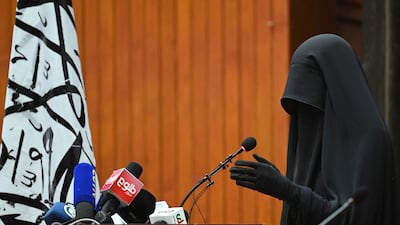
A veiled student speaks to a gathering of female students before a pro-Taliban rally. AFP -
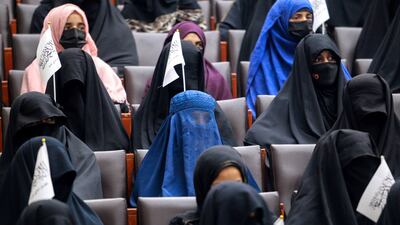
Before the capital fell to the Taliban on August 15, universities throughout Afghanistan were mixed and women were not obliged to conform to any dress code. EPA -
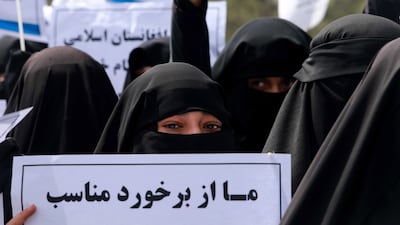
Women march to show support for the Taliban in a rally outside the Shaheed Rabbani Education University in Kabul. EPA -
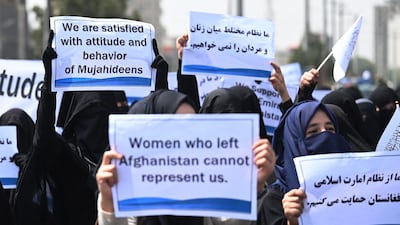
The veiled women hold banners and placards proclaiming their backing for the militant group who have taken over Afghanistan. AFP -
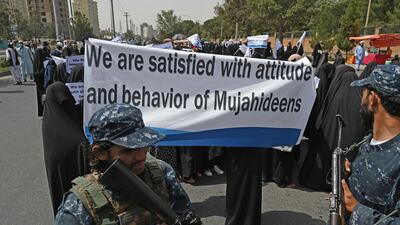
Some women fear that a form of gender apartheid will be imposed on the country under the new regime, although those attending the march, flanked by armed Taliban fighters, disagree. AFP -
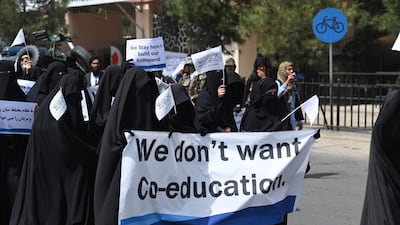
Militant leaders announced last week that women in the country will be permitted to study at university but only in classrooms where gender is separated, and while wearing Islamic dress. AFP -
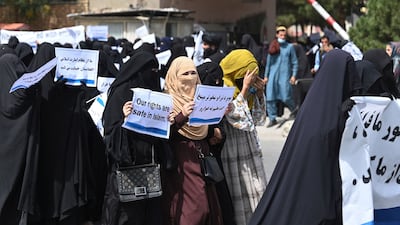
Female students will be taught by women only, the Taliban’s Education Minister Abdul Baqi Haqqani said. AFP -
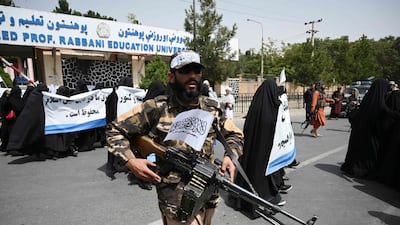
Mr Haqqani said: 'We will not allow boys and girls to study together. We will not allow co-education.' AFP -
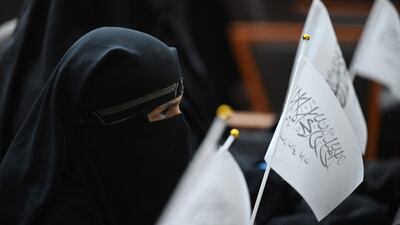
Veiled students hold Taliban flags as they listen to a speaker before the women marched in support of the Taliban. AFP


Since the Taliban took control of Kabul on August 15, there has been growing concern among human rights activists that the group would end hard-won freedoms and rights gained over the 20 years since they last ruled the country. Some saw the images of these women as a visual step in that process.
Even before the Taliban announced new dress rules, some women said they had already started changing their behaviour.
Khadija, a Kabul artist, said she and her friends worry about running afoul of the Taliban — and their fighters that now roam the streets to enforce the group’s rules — whenever they step outside their homes.
“I just don’t want to cover my eyes,” says Khadija, who requested anonymity , speaking about the clothing of the women who protested in favour of the Taliban.
“I don’t know where this dress comes from, but dressing is a very private issue and everyone should wear what they feel like wearing."
The group has not brought back the long, blue burqa or chadari that was mandatory for women under its rule in the late 1990s and early 2000s. But, in a sign the group has not changed its views, images of women on billboards and in shops around Kabul were covered up or vandalised within days of the Taliban’s return to the capital.
On Sunday, the same day as the pro-Taliban protest, Higher Education Minister Abdul Baqi Haqqani, in the Taliban interim government, ordered gender segregation and mandatory hijabs in colleges and universities.
Over the past 20 years since the US invasion ended Taliban rule, women’s dress has changed significantly — gone for many are the blue burqa, replaced with niqabs that cover the face or, increasingly common, colourful abayas or lose trousers known as salwar with matching veils.
a women’s rights activist from Kabul.
For two decades, the fashion industry has been booming, with Afghan retailers catering to fashion-conscious Kabul women who want trendy clothing that is still religiously compliant.
“We need to be careful about linking chadari or burqa to the Afghan people,” says Attia Mehraban, a women’s rights activist, who recently sought asylum in the US.
“Chadari came to Afghanistan during the wars with Soviets at the hands of extremists. The main dress of Afghan women is a long gown with a bit of stretch over the hip with a bigger scarf,” she told The National.
“Every extremist group brings a type of dress code with them. The only thing that massively changed in Afghanistan after the Taliban was women’s situation when it comes to clothing, working and dressing. People of Afghanistan has a Sufi inclination towards Islam, that’s why they always choose a middle way in the religion and that fits their view on women dressing, too, which is not too conservative.”
There is no indication that the pro-Taliban women attending the rally were either forced to wear that particular style of clothing nor has the Taliban said that this will become the enforced standard. But some still see it as a worrying sign of things to come.
It’s a matter of time, says Sabur Shah Dawod Zai, the founder of BinDawod charity group that focuses on the social welfare of women, young people and children in Afghanistan.
“Yes, we have this concern that in the future, they will tell us what to wear and how to wear it and in other parts of life, also, they will tell us what to do and how to do like in their previous period of control,” Mr Zai told The National.

