

In a matter of hours, Sara’s perfect teenage life turned upside down on August 15 as the Taliban marched into her city and took control of Afghanistan.
“I knew things were bad, but I didn't imagine that my Kabul would fall to the Taliban so quickly and easily,” she sighed.
“For days, we were hearing about how they were treating women in areas they took control of and suddenly they were in control of our city,” added Sara, whose name has been changed to protect her identity.
Now, most of her days are spent organising protests to raise her voice against the Taliban's brutal treatment of women, minorities and the media.
“The first night after they came to Kabul, a few friends and I went around with spray cans and wrote 'Death to Taliban' on the walls of the city. It was such a scary and empowering experience,” she recalled. “It felt like we were taking back our city.”
For Sara, 19, being part of life in Kabul is extremely important.
“I moved to Kabul less than a year ago for higher education, and I want to study computer science. I was a refugee before that, but then I came home to my country,” she said.
“[Kabul] has so much energy and culture. You can meet all kinds of inspiring people here, so many brave women. I am not ready to give it up yet,” she said.
Sara was born months after the attacks of September 11, 2001, which triggered the US-led invasion of Afghanistan.
In the years before that, the Taliban had harboured Al Qaeda and controlled most of Afghanistan with an iron fist, implementing a strict interpretation of Islamic law that shredded almost all freedoms for women.
But even after the Taliban were toppled in 2001, Sara’s home province remained unstable and prone to frequent insurgent attacks, forcing her parents to flee to a neighbouring country where she was raised.
“My family fled after the fall of the Taliban because our village remained insecure even after the Americans came. I never lived under the Taliban and didn’t know much about them except from what my parents told me, and that wasn’t a lot as they were trying to protect me,” she said.
Her first real glimpses of the Taliban came through books.
“In Khaled Hosseini’s The Kite Runner, I read about how the Taliban would beat women up for walking alone or for not wearing the burqa. It was so horrifying,” she said.
Years later, Sara experienced the horrors first-hand soon after the Taliban takeover.
“A few days after the Taliban came to Kabul, I went out for some work. I was walking on my street when a group of Taliban fighters stopped their vehicle close to me. One of them screamed, ‘Are you not afraid of God?’ and another Talib pulled out a belt like a whip and hit me. It was the scariest moment of my life,” she recalled.
Sara was attacked because of a tattoo on her wrist that could be seen under a rolled-up shirtsleeve.
-
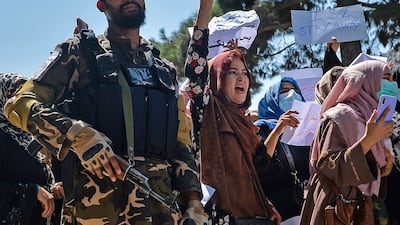
Afghan women shout slogans next to a Taliban fighter during an anti-Pakistan demonstration near the country's embassy in Kabul. AFP -
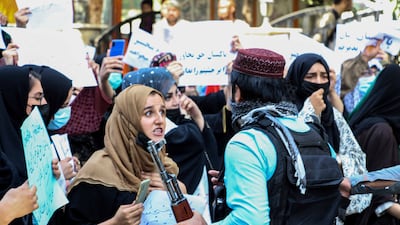
The demonstrations began after Ahmad Massoud, the leader of the National Resistance Front of Afghanistan, called for an uprising against alleged interference by Pakistan. EPA -
Fighting is continuing in Panjshir, which was also the centre of resistance against the Taliban during its previous regime in the late 1990s. EPA -

Taliban fighters stand guard during the protest in Kabul. EPA -
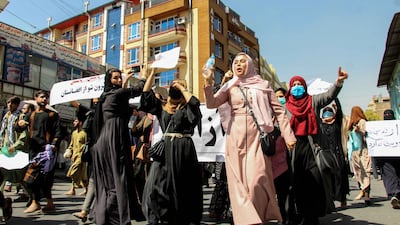
Afghan women shout anti-Pakistan slogans. EPA -
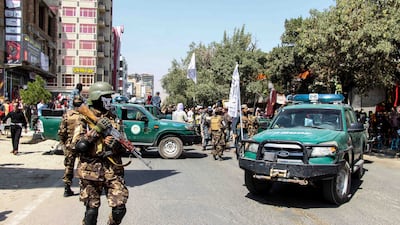
The Taliban were previously in power from 1996 to 2001. EPA -
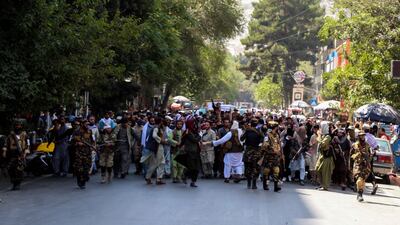
The protests followed calls for a national uprising against the Taliban. EPA -
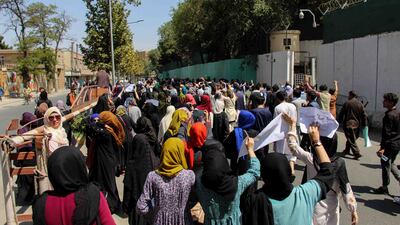
Protesters call for the Islamist group to relinquish power. EPA -
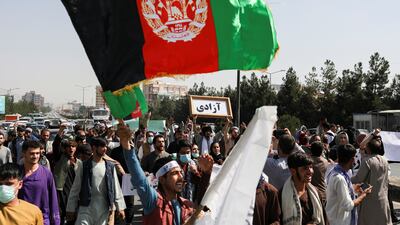
A man waves the flag of the former Afghan government. Reuters -
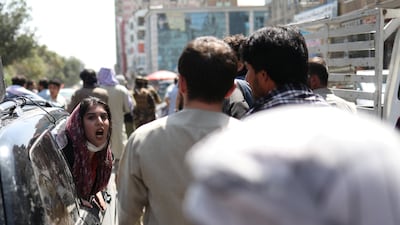
A woman chants from inside a car during the protest. Reuters -
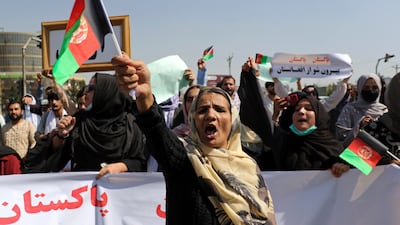
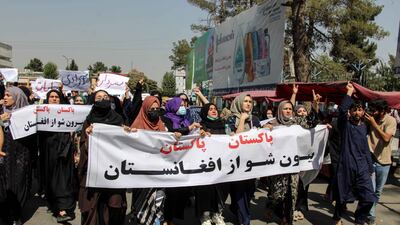
The demonstration took place near the Pakistan embassy in Kabul. The sign in Farsi reads: "Pakistan, Pakistan, get out of Afghanistan". AP Photo -

Afghan protesters speak to a Taliban fighter during the demonstration. Reuters


The lashing lasted a few minutes till Sara was able to gather courage and run.
“They were laughing at me while they beat me. Other people watched, but no one helped. I could see they were also terrified,” she said.
That experience cemented her resolve to resist the Taliban, and fight to reclaim her city and identity.
Spraying graffiti on walls was not enough, so she joined various groups of protesters, and led her own cohort of young women in the anti-Taliban marches taking place across the city and in other provinces.
But starting a revolution can be a daunting and intimidating undertaking.
“I do feel scared sometimes, especially when they shoot in our direction or beat us. But every day, I feel stronger than the day before, because every day, more people join us,” she said.
As the 20th anniversary of the September 11 attacks arrives, Sara contemplates her future in Afghanistan, a country she is determined to stay in and serve.
To that end, she promises to keep going to the protests for as long as she can. “I will do this because I still have hope that I can salvage my future from the situation that [the western forces] left us in,” she explained.
As someone born after 9/11, she is determined to seek agency over what happens next in her country.
“[The West] may have come for their own selfish reasons and left for their selfish reasons. But in between that, we were able to build a better Afghanistan that is worth saving,” she said.

