

A developing alliance in the north could be the answer to Afghanistan’s Taliban strife, security experts have told The National.
Afghan President Ashraf Ghani visited the northern city of Mazar-i-Sharif in Balkh province on Wednesday to meet leaders from the country’s northern provinces, many of which have been captured by the Taliban.
The gathering was intended to strengthen alliances in the north, under the aegis of the Afghan government, sources told The National.
In the past week, the Taliban made significant advances in five provincial capitals in the north – Faryab, Jawzjan, Sar-e-Pul, Badakhshan and Samangan.
The recent wave of violence has forced the various political factions to unite and welcome Mr Ghani.
Hosted by Mohammad Noor, a former governor of Balkh who continues to wield significant influence there, the meeting was attended by many powerbrokers and strongmen from the northern provinces.
They included Mr Noor’s former mujahideen rivals, Abdul Rashid Dostum, a former vice president, and Mohammad Mohaqiq, a former former deputy chief executive.
“This meeting is an attempt to build a consensus among the leaders of the north," an Afghan official said.
"The government wants to bring them together under one structure, under the rule of law, of course.
“Many people at that table have never gotten along with each other. But now they are trying to realise there is a common enemy."
-
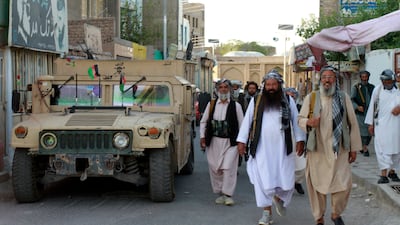
Members of the militia loyal to Ismail Khan, a former Mujahideen commander, walk in the city of Herat after security forces took back control following fighting between Taliban and Afghan security forces. AP -
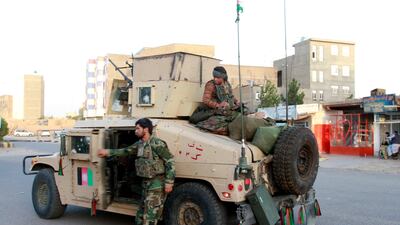
Afghan security personnel patrol the city of Herat. AP -

Members of the militia loyal to Ismail Khan, a former Mujahideen commander, congregate in Afghanistan's Herat province. AP -
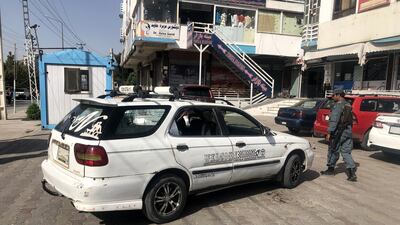
Afghan security officials inspect the scene of the assassination of Dawa Khan Menapal, the head of the Afghan government's information centre, in Kabul. EPA -
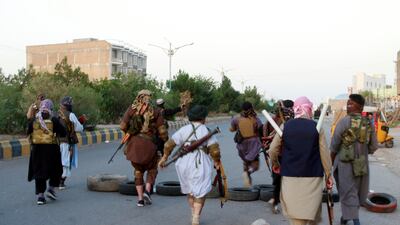
Militia members make their way through the city of Herat. AP -
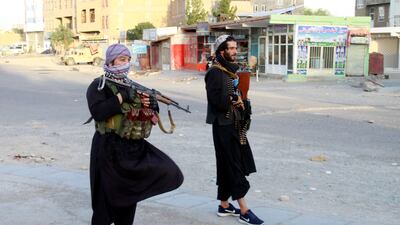
Herat's streets are deserted, apart from armed groups on patrol. AP -
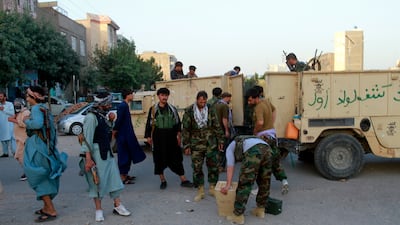
Locals in Herat are becoming increasingly worried about the prospect of war. AP


A source close to Mr Noor said: "The government is trying to hold the key cities in each of the regions — Herat, Mazar, Kandahar.
"In the north, Mazar has always been a crucial turning point for Afghan politics as well. Control of the city gives you access to the entire northern region.
“Mazar has always been the gateway to keeping Kabul strong. If Mazar is defeated, Kabul will fall."
The meeting was also a symbolic gesture intended to boost morale among the population, the official said.
“Afghans are being forced to leave their homes in the north due to violence and fear.
“Kam Air, which used to have one flight daily from Mazar, has been operating 16 flights every day. That’s almost 4,000 people leaving to Kabul only by plane daily."
After the fall of the Taliban in 2001, local strongmen played an important role in maintaining stability and preventing the insurgent group from re-emerging.
But rivalries, personal animosities and widespread corruption have often threatened the central government’s control over the provinces.
The government has also been criticised for isolating local leaders, despite their influence in the region.
“These former mujahideen were dismissed in the last two decades and labelled as warlords, but now they are being seen as Afghanistan’s saving grace,” Mr Noor’s close aide said.
In light of the government’s rapidly declining control over territory, some security experts were optimistic at the formation of new alliances.
“The negative developments in Afghanistan have surprised everyone in the security sectors,” said Abdul Hai Rauf, security analyst and former Afghan deputy minister of defence.
"Nobody really expected such a quick and rapid fall of the provinces and district.
“But this developing context has made such local alliances even more important than before – perhaps the only solution to preventing further losses.
“I'm optimistic that it will slow down the Taliban’s rapid takeover.”
Mr Rauf said that on the other hand, for the northern leaders such an alliance was a matter of survival.
“They have no other option but to get together. Their survival depends on it,” he said.
“Over the last two decades they have made a lot of investment and have businesses in the country whose very existence is threatened. They have to fight, if not for anything but themselves."
Mr Rauf said that with US support declining it was important for Afghan leaders to seek reinforcements from within the country’s borders.
With a significant decline in US air support, increased numbers of troops, which these leaders can provide, have become crucial.
“Even with the limited air strikes that Afghan forces can conduct, it increases the risks of civilian casualties,” Mr Rauf said.
“When the Taliban enter a district, several reports have indicated that they go into civilian homes to take cover, which makes it harder for Afghan and US forces to conduct strikes, which can then prolong the war and make it uglier with more casualties.
“While the air attacks are important, local uprisings can provide a stronger alternative that helps prevent civilian casualties."
Mr Noor’s aide confirmed that the northern leaders had discussed setting up a “central command in the north to fight the Taliban and defend and reclaim the territory",
He said more than 30,000 local troops were being raised across the country.
“In Mazar alone, Mr Noor has converted one of his properties into a makeshift military base to support members of the people's uprising in the north," he said.
"In just the last 10 days, nearly 6,000 Afghans joined in response to Ustad’s [Mr Noor's] call for battle."

