



Thirty-nine-year old Gulpari was forced to make some hard decisions when the Taliban was closing in on her village in the north of Afghanistan six weeks ago.
Recalling the terrifying nights her family spent fearing for their lives, she said the Taliban was shooting on the ground, while "from the sky, the government was bombarding our village”.
39, Afghan mother
Living in makeshift shelters on the outskirts of Mazar-e-Sharif city, Gulpari, a single mother of seven from a village in Jowzjan province described her ordeal.
In the days after the Taliban arrived in her village, the militant group started imposing draconian rules, particularly ones that restrict women’s freedom
“They announced that the women would not be allowed outside without a chadari," she said, referring to a full face veil.
"Soon after, they closed the girls’ school,” Gulpari told The National, adjusting her traditional blue burqa to cover most of her face while she spoke.
Before the war she wore the garment rarely but since moving to the IDP camp she keeps it close by at all times.
-

Afghan women and a boy outside a shop in the old quarter of Kabul. -
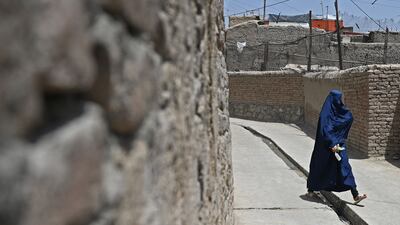
An Afghan woman in an alley in Kabul's old quarter. -
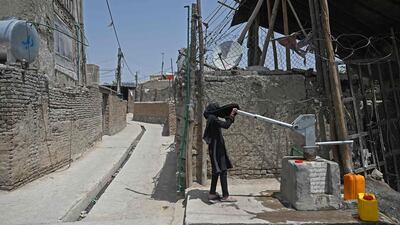
A girl uses a hand pump to fill a container with drinking water in Kabul, Afghanistan. -

A young girl in the old quarter of Kabul. -
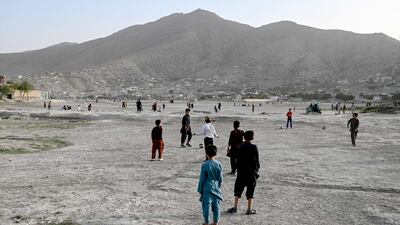
Children play football on a dried-up lake bed in Kabul. -

An Afghan security official searches a vehicle at a check point in Lashkar Gah, the provincial capital of Helmand province, Afghanistan. -
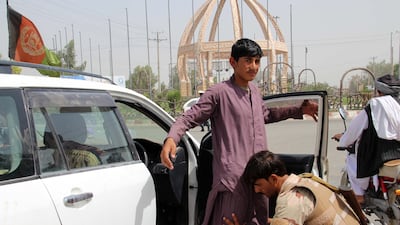
A security official checks people at a check point in Lashkar Gah, in Helmand province, Afghanistan. -

Afghan National Army soldiers at a roadside check point in Herat, the provincial capital of Herat province in Afghanistan. -
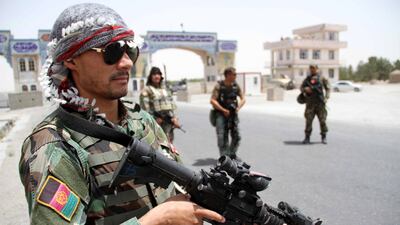
Afghan soldiers stand guard at a check point in Herat, Afghanistan.


“Most of the clinic and medical facilities were also shut and women were forbidden from visiting even the female doctors and midwives, unless they were accompanied by a mahram,” she said, referring to a male escort, which the Taliban strictly insists upon for all women.
But it was when the Taliban came for her daughters that Gulpari decided to abandon her home of more than 20 years and escape with her children in the dead of night.
“The Taliban asked to marry our daughters to them. They said if a house had two daughters, at least one should be given in marriage to the Taliban,” said Gulpari, who has two daughters aged 13 and 15.
“My girls were terrified when they heard this. They were scared and wouldn’t stop crying till we had fled the district."
Gulpari wasn’t the only woman escaping such a fate.
Many women who shared the compound for displaced families, living in small cramped tents, recounted similar experiences.
“In our district, [the Taliban] also put out an announcement in the mosque so that everyone can voluntarily list their daughters,” said Rabia, an older woman living in the same camp as Gulpari.
“Things had started to worsen since the 20th of Ramadan,” she said, referring to May 1.
“[The Taliban] blew up a police district office in Balkh. Many Afghan forces died in that attack and since then, the Taliban started to control the area, making new rules and even operating their own courts.
"Then they said they will start marrying our girls and women after Eid. We did not wait to find out if they did; we left soon after."
Similar reports of forced marriages by Taliban militants in areas they control have surfaced in the past three months.
Since the start of the year, the Taliban has launched one of its largest offensives to date, seizing control of most rural areas and surrounding major cities.
A statement bearing the militant group’s insignia was shared widely on social media, calling for religious leaders in the captured districts in Badakhshan and Takhar to refer girls older than 15 and widows younger than 45 to the “Mujahideen Cultural Commission”.
“These sisters will be married to the [Taliban fighters] and taken to Waziristan [in Pakistan] to be returned to Islam”, implying that women would be forced to adhere to the insurgents' religious edicts.
While Taliban members have denied accusations of forced marriage, calling them “baseless” and “propaganda”, women activists across the country are reporting such stories.
“Women are being married off as sexual slaves – this would be the term I would use,” said Pashtana Durrani, an education activist from Kandahar province in the south, where she has encountered similar cases.
Her family received threatening letters from the Taliban two weeks ago, said Ms Durrani, who is from Spin Boldak, a town on the border of Pakistan currently under control of the insurgents. But she said she was more furious than afraid.
“This is happening but I am not scared right now. I am furious at the people whose job it was to protect us,” she said, referring to the failure of security forces to stop the Taliban.
“The government is doing nothing and that is enabling the Taliban. Why weren’t they prepared for this?
“Still, there are things the government can do to help the women. Temporary shelters for women escaping these areas, housing for families, groceries, sanitary kits and medical help – these are just some of the things that can set the government apart from the militants.”
People would contribute to these efforts if the Afghan government took the initiative, she said.
Ms Durrani also criticised the silence and lack of solidarity from the international community.
“We were used as business cards," she said. "When they needed us for promoting women’s rights and equality campaigns to justify this war, they were here, but nothing after that. Not one side is sincere in protecting our rights.
“I am not just worried for the Afghan women but I am furious."
She said women were now on their own in this struggle, a view echoed by Gulpari, who said she was willing to fight to protect her daughters.
“If someone gives me a gun today, I will fight them. Our lives have changed and they don’t treat us like humans. We have to fight to get our homes and dignity back,” she said.

