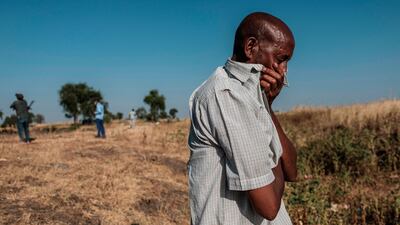
The death toll from a Wednesday attack in the western Benishangul-Gumuz region of Ethiopia has risen to 222 people, a volunteer from the country's Red Cross told Reuters on Friday.
"Yesterday we buried 207 people who are the victims and 15 more from the attackers," said Melese Mesfin.
The attack occurred in the village of Bekoji in Bulen county in the Metekel zone, and the state-appointed Ethiopian Human Rights Commission initially estimated more than 100 people had been killed.
More than 40,000 people fled their homes due to the fighting, Bulen county spokesman Kassahun Addisu said. He reported the county had buried 207 people.
Wednesday's attack by unidentified gunmen was the latest deadly assault in an area beset by ethnic violence.
Prime Minister Abiy Ahmed called the attack a "massacre" and deployed federal troops there the next day. The military killed 42 armed men accused of attacking the village.
Ethiopia has been grappling with outbreaks of deadly violence since Mr Abiy was appointed in 2018 and accelerated political reforms that loosened the state's iron grip on regional rivalries.
The Tigray region of the country has been the centre of the tumult. This video explains the conflict's background.
Elections due next June have further inflamed rivalries over land, power and resources.
An all-out civil war in Ethiopia would risk a repeat of the East Africa refugee crisis of the 1970s and 1980s, when hundreds of thousands of Ethiopians fled war to take refuge in neighbouring countries, particularly Sudan.
Chaos could also revive old territorial disputes in the Horn of Africa and threaten to drag other nations into further conflicts.

Healthy tips to remember
Here, Dr Mohamed El Abiary, paediatric consultant at Al Zahra Hospital Dubai, shares some advice for parents whose children are fasting during the holy month of Ramadan:
Gradual fasting and golden points - For children under the age of 10, follow a step-by-step approach to fasting and don't push them beyond their limits. Start with a few hours fasting a day and increase it to a half fast and full fast when the child is ready. Every individual's ability varies as per the age and personal readiness. You could introduce a points system that awards the child and offers them encouragement when they make progress with the amount of hours they fast
Why fast? - Explain to your child why they are fasting. By shedding light on the importance of abstaining from food and drink, children may feel more encouraged to give it there all during the observance period. It is also a good opportunity to teach children about controlling urges, doing good for others and instilling healthy food habits
Sleep and suhoor - A child needs adequate sleep every night - at least eight hours. Make sure to set a routine early bedtime so he/she has sufficient time to wake up for suhoor, which is an essential meal at the beginning of the day
Good diet - Nutritious food is crucial to ensuring a healthy Ramadan for children. They must refrain from eating too much junk food as well as canned goods and snacks and drinks high in sugar. Foods that are rich in nutrients, vitamins and proteins, like fruits, fresh meats and vegetables, make for a good balanced diet
No more lice
Defining head lice
Pediculus humanus capitis are tiny wingless insects that feed on blood from the human scalp. The adult head louse is up to 3mm long, has six legs, and is tan to greyish-white in colour. The female lives up to four weeks and, once mature, can lay up to 10 eggs per day. These tiny nits firmly attach to the base of the hair shaft, get incubated by body heat and hatch in eight days or so.
Identifying lice
Lice can be identified by itching or a tickling sensation of something moving within the hair. One can confirm that a person has lice by looking closely through the hair and scalp for nits, nymphs or lice. Head lice are most frequently located behind the ears and near the neckline.
Treating lice at home
Head lice must be treated as soon as they are spotted. Start by checking everyone in the family for them, then follow these steps. Remove and wash all clothing and bedding with hot water. Apply medicine according to the label instructions. If some live lice are still found eight to 12 hours after treatment, but are moving more slowly than before, do not re-treat. Comb dead and remaining live lice out of the hair using a fine-toothed comb.
After the initial treatment, check for, comb and remove nits and lice from hair every two to three days. Soak combs and brushes in hot water for 10 minutes.Vacuum the floor and furniture, particularly where the infested person sat or lay.
Courtesy Dr Vishal Rajmal Mehta, specialist paediatrics, RAK Hospital
