


Four months after his removal from power by his generals, Sudan’s authoritarian ruler of 29 years Omar Al Bashir appeared in court on Monday, the first day of his trial on charges of illegally possessing foreign currency and accepting gifts.
Monday’s hearing, held amid tight security at a Khartoum suburb, took on added symbolic significance as it came two days after Sudan celebrated the signing of a power-sharing agreement between the military and an opposition alliance behind four months of deadly street protests against Mr Al Bahsir’s rule.
The 75-year-old former president appeared in court dressed in a traditional white robe and head covering. He arrived at the courthouse in a large military convoy that brought him from Kobar prison, the jail where he detained opponents throughout his rule and his place of residence since April.
During the hearing, Mr Al Bashir listened silently to evidence from investigators on how he came to have the millions of euros and dollars in cash that security forces said they recovered from his residence. The money was found shortly after he was ousted and led to his transfer from house arrest to Kobar.
The former leader separately faces charges of inciting the killing of protesters. He is also wanted by the International Criminal Court for crimes against humanity and genocide during the war against rebels in the western Darfur region in the 2000s. The military has said it would not hand him over for trial in The Hague.
Monday’s hearing served as a reminder of the corruption that defined Mr Al Bashir’s rule and contributed to the vast country often resembling a failed state. It was also in sharp contrast to the jubilation and revelry in Khartoum that followed Saturday’s high-profile ceremony for the signing of the power-sharing agreement.
Tens of thousands of people took to the streets on Saturday night to celebrate, staying out until the small hours of Sunday, dancing, singing, waving the Sudanese flag and blowing horns in rare scenes of unbridled joy by a people more accustomed to the grief and heartache brought by war, famine, political upheavals and economic meltdowns.
That they had good reason to celebrate is beyond question, but the jubilation may, in many ways, belied the magnitude and intractability of the problems that need to be tackled and resolved in this Afro-Arab nation during a transitional period that will run until free elections are held in late 2022.
-

Sudanese protesters run for cover from tear gas canisters fired by police outside the military headquarters in the capital Khartoum on April 6, 2019. AFP -
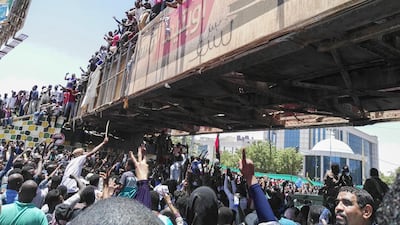
Sudanese protesters rally in front of the military headquarters in the capital Khartoum on April 8, 2019. AFP -
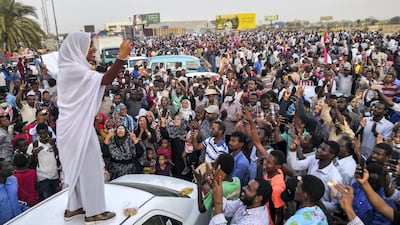
Alaa Salah, a Sudanese woman propelled to internet fame earlier this week after clips went viral of her leading powerful protest chants against President Omar Al Bashir, addresses protesters during a demonstration in front of the military headquarters in the capital Khartoum on April 10, 2019. AFP -
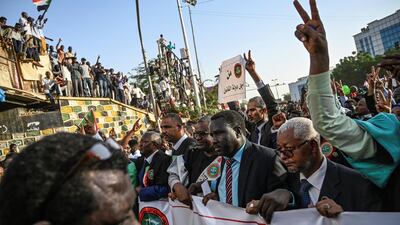
Sudanese judges, dressed in their robes, gather for a "million-strong" march outside the army headquarters in the capital Khartoum on April 25, 2019. AFP -

A Sudanese anti-regime protester kisses a soldier on the head during protests on April 11, 2019 in the area around the army headquarters in Sudan's capital Khartoum. AFP -
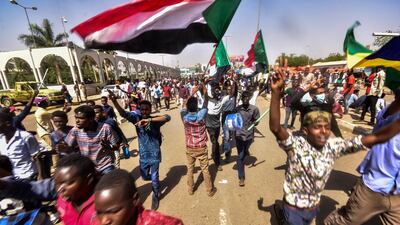
Sudanese demonstrators march with national flags as they gather during a rally demanding a civilian body to lead the transition to democracy. AFP -
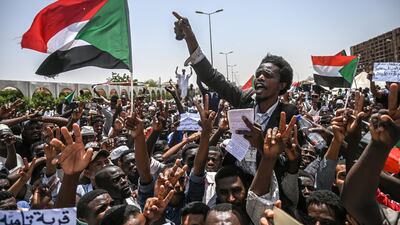
Protesters massed outside the army complex in central Khartoum on April 6, initially to demand the overthrow of longtime leader Omar Al Bashir. AFP -
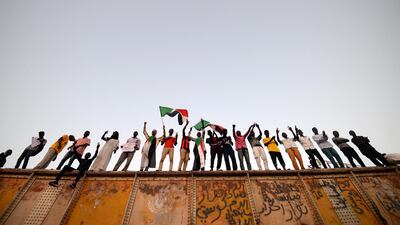
Sudanese protesters gather outside the army headquarters in Khartoum on May 6, 2019. AFP -
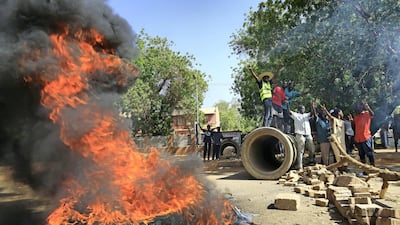
Sudanese protesters burn tyres as they block Nile Street for the second consecutive day during continuing protests in Sudan's capital Khartoum on May 13, 2019. AFP -
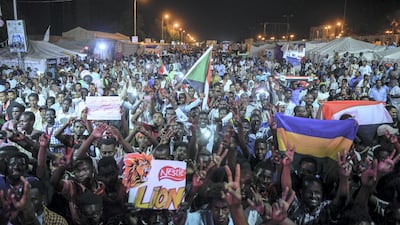
Sudanese protesters wave flags and flash victory signs as they gather for a sit-in outside the military headquarters in Khartoum on May 19, 2019. AFP -
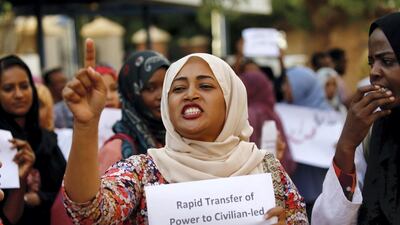
A Sudanese health worker carries a placard as scores of medics hold a rally in front of a hospital in the capital Khartoum on May 23, 2019. AFP -
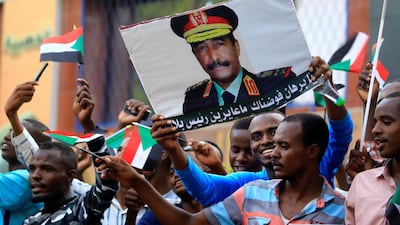
Sudanese supporters of the ruling Transitional Military Council (TMC) hold up a sign showing a portrait of its head General Abdel Fattah Al Burhan with a caption below reading in Arabic "we have delegated you Burhan, we want no president but you", during a rally in the centre of the capital Khartoum on May 31, 2019. AFP -
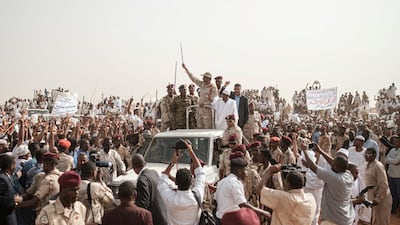
Mohamed Hamdan Dagalo, known as Himediti, deputy head of Sudan's ruling Transitional Military Council and commander of the Rapid Support Forces paramilitaries, waves a baton to supporters on a vehicle as he arrives for a rally in the village of Abraq, about 60 kilometres northwest of Khartoum, on June 22, 2019. AFP -
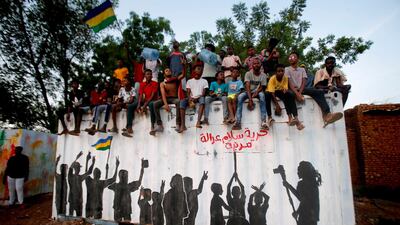
Sudanese protestors celebrate in the streets of Khartoum after ruling generals and protest leaders announced they have reached an agreement on the disputed issue of a new governing body on July 5, 2019. AFP -
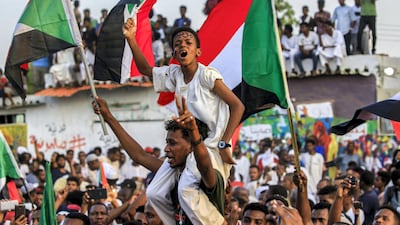
Thousands went to the streets to welcome the agreement on Saturday. AFP -
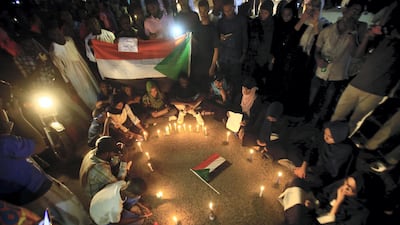
Sudanese protesters take part in a vigil in the capital Khartoum to mourn dozens of demonstrators killed last month in a raid on a Khartoum sit-in. AFP -
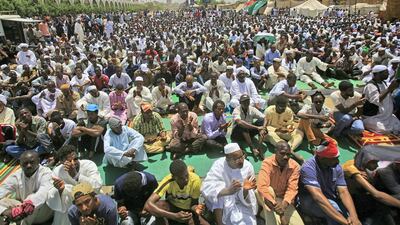
Sudanese protesters gather during Friday noon prayers outside the army headquarters in Khartoum on May 3, 2019, as they continue to protest demanding that the ruling military council hand power to a civilian administration. AFP -
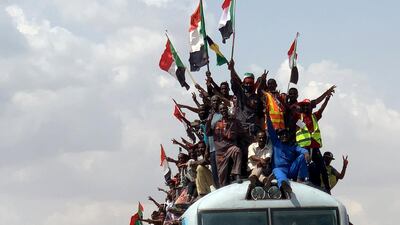
Sudanese civilians from other provinces ride on the train to join in the celebrations of the signing of Sudan's power-sharing deal. Reuters -
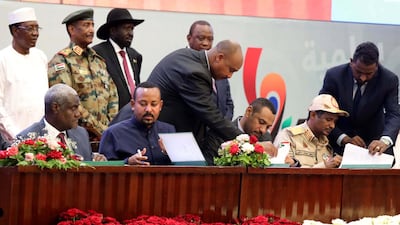
Sudan's Forces of Freedom and Change coalition leader Ahmad Rabiah (3-R) and Sudan's General and Vice President of Sudanese Transitional Military Council, Mohamed Hamdan Dagalo (2-R) sign power-sharing agreement,. EPA -
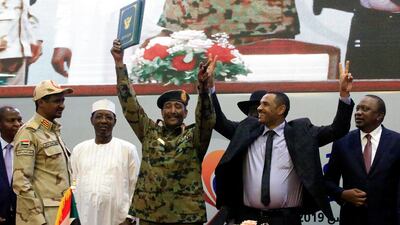
Sudan's Head of Transitional Military Council, Lieutenant General Abdel Fattah Al-Burhan, and Sudan's opposition alliance coalition's leader Ahmad Rabiah, celebrate the signing of the power-sharing deal, that paves the way for a transitional government, and eventual elections. Reuters -
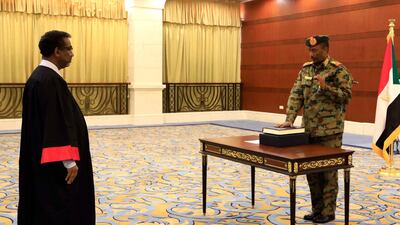
epa07783624 Leader of Sudan's transitional council, Lieutenant General Abdel Fattah Abdelrahman Burhan (R) is sworn in as the Head of the newly formed transitional Council at the presidential palace in Khartoum, Sudan, 21 August 2019. The Sudanese opposition and military council signed on 17 August a power sharing agreement. The agreement sets up a sovereign council made of five generals and six civilians, to rule the country until general elections. Protests had erupted in Sudan at the end of 2018, culminating in a long sit-in outside the army headquarters which ended with more than one hundred people being killed and others injured. Sudanese President Omar Hassan al-Bashir stepped down on 11 April 2019. EPA/STRINGER -
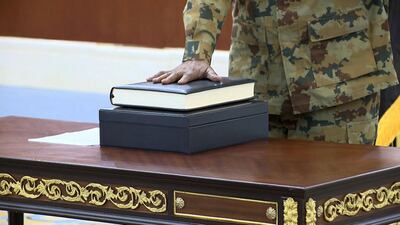
A pictured released by Sudan's Presidential Palace shows General Abdel Fattah al-Burhan, the head of Sudan's ruling military council, during a swearing in ceremony in Khartoum on August 21, 2019. Burhan was sworn today as chairman of Sudan's new sovereign council that will steer the country through a three-year transition to civilian rule. "General Abdel Fattah al-Burhan Abdel Rahman was sworn in as president of the sovereign council," the official SUNA news agency reported. / AFP / SUDAN PRESIDENTIAL PALACE / - / RESTRICTED TO EDITORIAL USE - MANDATORY CREDIT "AFP PHOTO / SUDAN PRESIDENTAIL PALACE" - NO MARKETING NO ADVERTISING CAMPAIGNS - DISTRIBUTED AS A SERVICE TO CLIENTS -
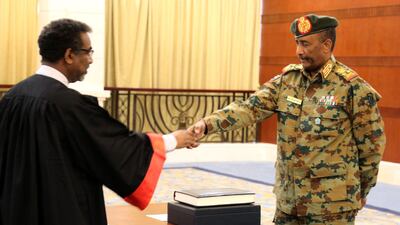
A picture released by Sudan's Presidential Palace shows General Abdel Fattah al-Burhan, the head of Sudan's ruling military council, during a swearing in ceremony in Khartoum on August 21, 2019. Burhan was sworn today as chairman of Sudan's new sovereign council that will steer the country through a three-year transition to civilian rule. "General Abdel Fattah al-Burhan Abdel Rahman was sworn in as president of the sovereign council," the official SUNA news agency reported. / AFP / SUDAN PRESIDENTIAL PALACE / - / RESTRICTED TO EDITORIAL USE - MANDATORY CREDIT "AFP PHOTO / SUDAN PRESIDENTAIL PALACE" - NO MARKETING NO ADVERTISING CAMPAIGNS - DISTRIBUTED AS A SERVICE TO CLIENTS -
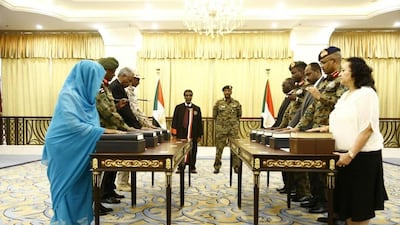
A picture released by Sudan's Presidential Palace shows General Abdel Fattah al-Burhan (C-R), the head of Sudan's ruling military council, standing during a swearing in of the new sovereign council, in Khartoum on August 21, 2019. Sudan took further steps in its transition towards civilian rule today with the swearing in of a new sovereign council, to be followed by the appointment of a prime minister. The body replaces the Transitional Military Council (TMC) that took charge after months of deadly street protests brought down longtime ruler Omar al-Bashir in April. Burhan, who already headed the TMC, was sworn in as the chairman of the new sovereign council in the morning. / AFP / SUDAN PRESIDENTIAL PALACE / - / RESTRICTED TO EDITORIAL USE - MANDATORY CREDIT "AFP PHOTO / SUDAN PRESIDENTAIL PALACE" - NO MARKETING NO ADVERTISING CAMPAIGNS - DISTRIBUTED AS A SERVICE TO CLIENTS -
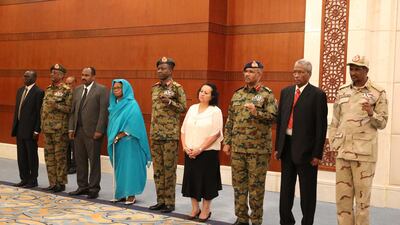
epa07784051 Members of Sudan's newly formed transitional Council (R-L) General Mohamed Hamdan Dagalo, Hassan Sheikh Idris, Genereal Ibrahim Jaber, Raja Nicola Issa Abdul-Masseh, General Shams al-Din Kabashi, Aisha Moussa, Mohamed Alfaki, General Yasser al-Atta and Sadeek Tawer look on during their sweaing-in ceremony at the presidential palace in Khartoum, Sudan, 21 August 2019. The Sudanese opposition and military council signed on 17 August a power sharing agreement. The agreement sets up a sovereign council made of five generals and six civilians, to rule the country until general elections. Protests had erupted in Sudan at the end of 2018, culminating in a long sit-in outside the army headquarters which ended with more than one hundred people being killed and others injured. Sudanese President Omar Hassan al-Bashir stepped down on 11 April 2019. EPA/MORWAN ALI -

Demonstrators march with banners and the old (L) and current (R) flags of Sudan outside a courthouse complex in the capital's twin city of Omdurman on August 21, 2019 during the trial of 40 members of Sudan's now-dissolved National Intelligence and Security Service facing charges over the death in custody of Ahmed al-Kheir, a teacher from the eastern town of Khashma el-Girba, in the early days of the wave of nationwide protests that eventually brought longtime ruler Omar al-Bashir. / AFP / Ahmed Mustafa -
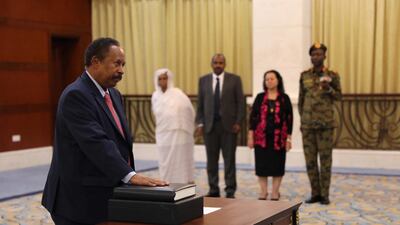
epa07784904 Sudan's new Prime Minister Abdalla Hamdok (L) swears in during a ceremony at the presidential palace in Khartoum, Sudan, 21 August 2019. The Sudanese opposition and military council signed on 17 August a power sharing agreement. The agreement sets up a sovereign council made of five generals and six civilians, to rule the country until general elections. Protests had erupted in Sudan in December 2018, culminating in a long sit-in outside the army headquarters which ended with more than one hundred people being killed and others injured. Sudanese President Omar Hassan al-Bashir stepped down on 11 April 2019. EPA/MARWAN ALI -
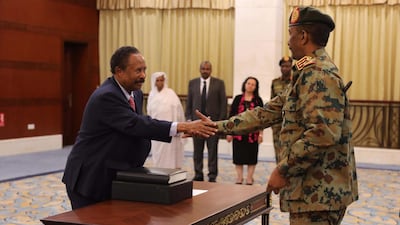
epa07784903 Sudan's new Prime Minister Abdalla Hamdok (L) shakes hands with Abdel Fattah Abdelrahman Burhan (R) after being sworn in during a ceremony at the presidential palace in Khartoum, Sudan, 21 August 2019. The Sudanese opposition and military council signed on 17 August a power sharing agreement. The agreement sets up a sovereign council made of five generals and six civilians, to rule the country until general elections. Protests had erupted in Sudan in December 2018, culminating in a long sit-in outside the army headquarters which ended with more than one hundred people being killed and others injured. Sudanese President Omar Hassan al-Bashir stepped down on 11 April 2019. EPA/MARWAN ALI -
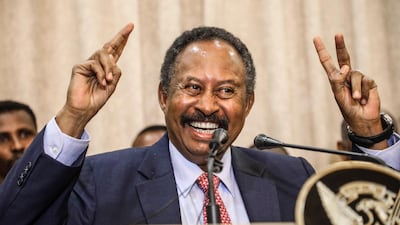
Sudan's new Prime Minister Abdalla Hamdok speaks duringa press conference in Khartoum, Sudan, Wednesday, Aug. 21, 2019. (AP Photo)


Sudan’s military removed Mr Al Bashir just two months short of what would have been the 30th anniversary of the military coup he led against an elected but dysfunctional government. It was the third and longest spell of military rule Sudan has endured since independence in 1956, with the other two accounting for a total of 22 years. Mr Al Bashir’s was by far the worst of the three.
"There isn't a crime that the regime did not commit," Nagi Al Asaam, a leader of the opposition movement behind the uprising against Mr Al Bashir, told the ceremony marking the signing of the power-sharing agreement.
It did not take long after that ceremony for some of the problems facing Sudan to rear their heads again.
Showcasing the fragility of the country’s ageing infrastructure and weakness of emergency services, torrential rains and subsequent floods across much of Sudan – something that occurs annually – claimed nearly 50 lives in the last few days, according to health ministry figures published in the media on Monday.
On Sunday, the day after the ceremony, long bread lines could be seen outside bakeries in Khartoum and motorists had to wait for up to an hour to fill up at petrol stations.
Politically, Monday's swearing-in of an 11-member council that will operate as a collective head of state during the transitional period was delayed for 48 hours because of differences within the main opposition alliance over its nominees.
It would have been the first in a series of steps to create the institutions that will govern Sudan for the next 39 months. The other two are a cabinet of technocrats and a 300-seat legislature.
Artists, meanwhile, are enraged by the whitewashing of graffiti in the area surrounding the headquarters of the armed forces, the site of a weeks-long sit-in encampment that was violently broken up by security forces on June 3. Some of the graffiti there included perceived insults against the military but the artists say they are determined to restore them to keep alive memories of the uprising, something that could ignite friction, and perhaps violence, between them and security forces.
The protest movement is also sticking to demands that are likely to cause friction with the military and possibly deepen the country’s divisions.
It is insisting, for example, that a thorough, transparent and comprehensive investigation is launched to determine those behind the violence on June 3. It is also demanding that a proposed process of national reconciliation includes bringing to justice anyone found guilty of crimes against the people.
But the litmus test of Sudan’s transitional period may lie in how the youth-dominated protest movement and the military will accommodate each other between now and 2022 and whether the generals are genuinely willing to step down then.
To many Sudanese, for example, the military and associated paramilitary forces are responsible for widespread abuses against civilians in regions where rebels took up arms against the government – in Darfur and Nuba Mountains in the west as well as Blue Nile south of Khartoum. Rebel leaders from those areas have rejected the agreement signed on Saturday, arguing that they were not part of the negotiations that led to it. Still, the document says the first six months of the transitional period would be devoted to ending those conflicts.
It is not an impossible target, but it is a difficult one to achieve given that the longtime demands of the rebels – self-rule, a fair share of national resources and an end to what they see as political monopoly by Arabised Muslims from the north – would fundamentally alter the country’s power structure.
Moreover, rebel leaders might have difficulty trusting the generals they blame for the death of hundreds of thousands of civilians in their regions and the displacement of many more, and would eventually demand self-determination. Already the mainly animist and Christian south of Sudan seceded in 2011 after decades of ruinous wars with the north, taking with it most of the country’s oil wealth.
The rebels are also demanding that Mr Al Bashir is handed over to the International Criminal Court to face trial for his alleged crimes in Darfur.
“The difficulty of the peace issue is that meeting the demands of those marginalised requires a complete overhaul of the entire political system,” said Hany Raslan, an expert on Sudan from Egypt’s Al Ahram Centre for Political and Strategic Studies. “They are not just about demands, participation or positive discrimination.”
The economy is another major challenge facing Sudan as it enters the transitional period. Predictably, it is an area where the Sudanese who sacrificed so much during the uprising – hundreds were killed and thousands injured by security forces – could lose faith in their leaders if progress is not shown in the next few months. The list of what needs to be done is long and daunting, from unemployment, inflation, lack of productivity and foreign investment to dismantling entrenched corruption.
"The transitional period will not be easy. The legacy is heavy and Sudan needs something akin to reconstruction. The dream of a civilian state is not easy either in this part of the world," Ghassan Charbel, editor of the pan-Arab daily Asharq Al-Awsat, wrote on Monday. "The balance of power dictates the success of this necessary tango dance between civilians and the military … In tango, you must understand your partner, appreciate his concerns and synchronise your steps with his."

