

Mali’s former president Ibrahim Boubacar Keita, who led the West African country from 2013 until his removal in a coup in 2020, died on Sunday. He was 76.
“President IBK died this morning at 0900 GMT in his home” in the capital, Bamako, a relative told AFP, using his initials.
The cause of death was not given.
Looming over most of Keita’s presidency was the extremist insurgency that has plagued Mali since 2012.
His toppling marked the rise of the military junta, which is now under regional sanctions for failing to restore civilian rule.
Keita was forced out of office on August 18, 2020 by young military officers.
They staged an uprising at a base near Bamako before heading into the city, where they seized him and other leaders.
Foreign Minister Abdoulaye Diop said he was “saddened to learn of the death of former president Ibrahim Boubacar Keita”.
“It is with great emotion that I bow before his memory,” he said.
Former Nigerien president Mahamadou Issoufou, who was a comrade of Keita in the Socialist International, hailed him as “a cultured man, a great patriot and a pan-Africanist”.
At Keita’s home, south-west of Bamako, on Sunday afternoon, numerous cars brought politicians and other public figures to offer their condolences. Police guarded the entrances, AFP reported.

Mali’s public television said that funeral plans would be announced later.
In the weeks before the 2020 coup, Keita had struggled with protests fuelled by his handling of the extremist insurgency and his failure to turn around Mali’s floundering economy.
Snail-paced political reform, decrepit public services and schools, and a widely shared perception of government corruption also fed anti-Keita sentiment, driving tens of thousands of protesters on to the streets.
Seized by the putschists, the junta that emerged from the rebellion – under pressure from the West African bloc Ecowas – released Keita weeks later and returned him to his home in Bamako, albeit under surveillance.
He suffered a mini-stroke the following month, and was sent to the UAE for treatment. He had remained in Bamako home since then and stayed out of public life.
The ruling junta staged another coup in May last year, toppling the civilian transitional government.
The junta had vowed to hold elections next month to transition the country back to civilian rule. But at the end of the last year, the junta revised its timetable, saying it it could stay in power for up to five years.
In response, this month Ecowas imposed a trade embargo on Mali and sealed its borders.
The sanctions were backed by the US, EU and former colonial power France.
Mali’s refugee crisis - in pictures
-
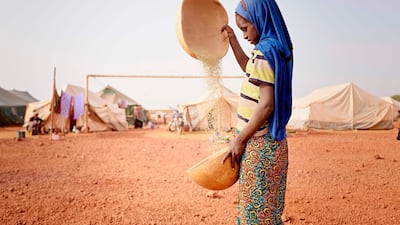
A little girl is seen while she's sifting the mile with two bowls in a camp in the town of Sevare for internally displaced people from the ongoing conflict in Mali, on February 28, 2020. In total 151 households and 712 individuals have fled their villages in central Mali and found a shelter in the camp. AFP -
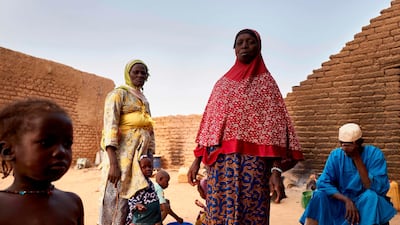
A displaced family stands in a courtyard in Sevare where they found a shelter after fleeing their village of Guerri in central Mali, on February 27, 2020. AFP -
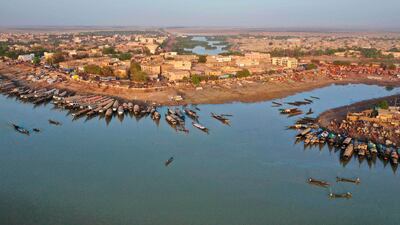
An aerial view shows the harbor of Mopti in central Mali on February 29, 2020. Two months earlier 400 Dogon people fled their village of Toou finding a shelter in a school in Sevare. AFP -
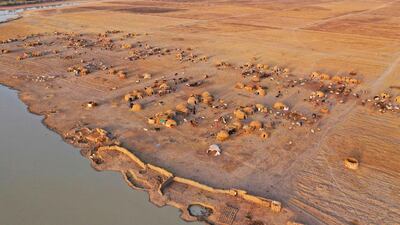
An aerial view shows a village of cattle breeders in the outskirts of Mopti in central Mali, on February 29, 2020. AFP -
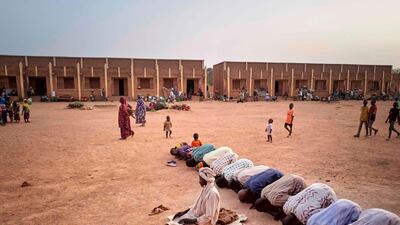
Displaced men worship in a courtyard in Sevare in central Mali, on February 26, 2020. Two months earlier 400 Dogon people fled their village of Toou finding a shelter in a school of Sevare. AFP -
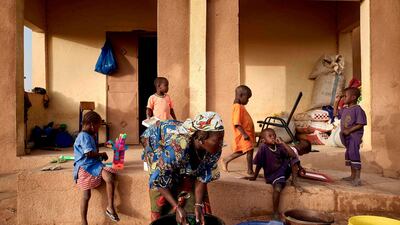
A displaced woman does the laundry while a group of children is playing behind here, in Sevare in central Mali on February 26, 2020. AFP -
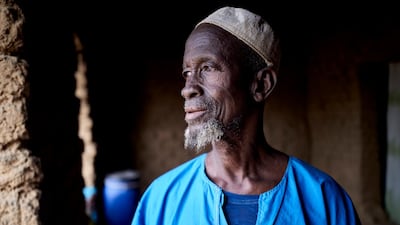
Amadou Diakite, 75, poses in a courtyard of Sevare after fleeing his village of Guerri in central Mali, on February 27, 2020. In January 2019 Jihadists broke in the village, setting fire on it, killing 3 villagers, and stealing all the livestock. AFP -
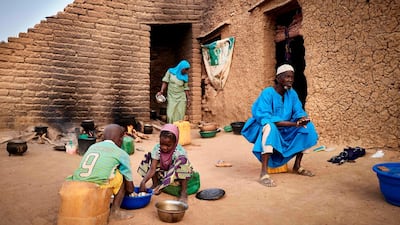
A displaced family is seen in a courtyard of Sevare where they found a shelter after fleeing their village of Guerri in central Mali, on February 27, 2020. In January 2019 Jihadists broke in the village, setting fire on it, killing 3 villagers, and stealing all the livestock. AFP -
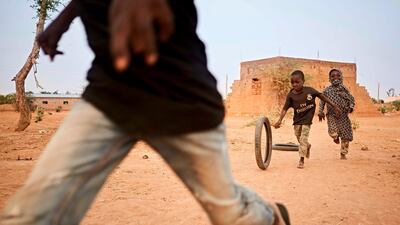
Displaced children play with old tires in a courtyard in Sevare in central Mali, on February 26, 2020. AFP


Landlocked Mali, one of the world’s poorest countries, is already feeling the effects of the penalties.
Thousands protested in Bamako on Friday after the junta called for demonstrations to oppose the measures.
Keita was born in the southern industrial city of Koutiala, the declining heartland of cotton production.
He was the son of a civil servant, and his great-grandfather was a French colonial soldier who died in the Battle of Verdun in the First World War.
After studying literature in Mali, Senegal and France, Keita became an adviser for the EU’s overseas development fund, then led a development project in northern Mali.
He campaigned against general Moussa Traore, the former Malian president who was removed in 1991 by a military coup.
Keita rose through the ranks under Alpha Oumar Konare, the country’s first democratically elected president.
As a socialist prime minister between 1994 and 2000, he quelled a series of strikes, earning a reputation as a firm leader and helping to set up his landslide election in 2013, in which he at last ascended to the presidency after losing runs in 2002 and 2007.
Keita was re-elected in 2018, beating opposition leader Soumaila Cisse.
Cisse’s kidnapping by extremists in March 2020 demonstrated Keita’s inability to stop the violence, with rising public outrage culminating in the coup months later.

