
A 21-story building collapsed in Lagos on Monday, trapping an estimated 50 people in the rubble.
The building, on a construction site in the city's Ikoyi neighbourhood — known for its luxury apartments and opulent homes — came crashing down by a busy street. It is feared that passers-by have been buried in the collapse.
By Monday afternoon, only five survivors had been rescued, in a joint effort by the National Emergency Management Agency (NEMA) and the Lagos State Emergency Management Agency.
More than a dozen bodies have been recovered, as rescue operations continue. Families desperately searched for their loved ones, scrambling over the rubble and shouting names.
Gabriel Olakunle, a real estate facility manager, said he was lucky to have escaped the incident, having left the scene just minutes before the collapse.
“I learnt about the collapsed building 10 minutes after I had left the place for an inspection. I didn’t even know it was the building I inspected a few minutes after, until a colleague showed me an online video of the collapsed building,” he told The National.
“I spent less than 30 minutes at the site, I spoke to a few contract workers handling the building project and found out it's a building of 21 floors. I had anticipated that I would have to bring my clients here as soon as it was completed.”
-
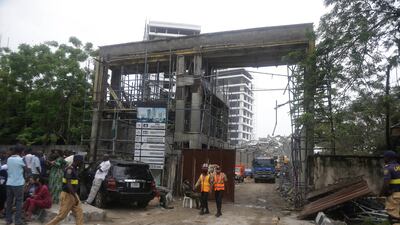
Rescue workers at the site of the collapsed 21-story apartment building under construction in Lagos. AP -

People watch as rescue workers search for survivors in the rubble. AP -
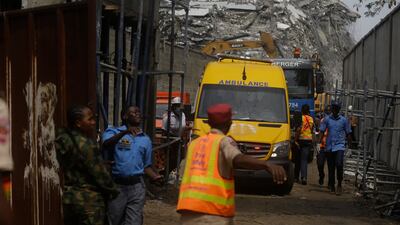
Rescue workers gather around an ambulance with a survivor who was found in the rubble. AP -
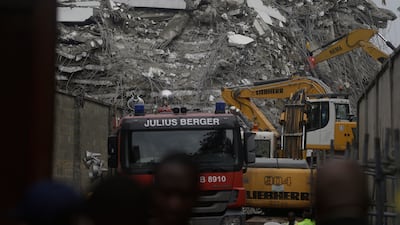
A view of the rubble of the collapsed building. Authorities in Nigeria's largest city said the owner of the building has been arrested. AP -
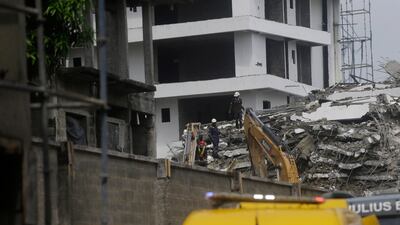
Officials announced that 14 people had been confirmed dead following the collapse. AP -

Nigerian rescue crews pulled two more survivors and were communicating with others buried inside the rubble, a day after the disaster. AFP -

A woman who is a relative of a victim of a collapsed building is consoled by family members at the site of a collapsed building in Ikoyi district in Lagos, Nigeria, 02 November 2021. The Lagos state emergency rescue agency says it is yet to ascertain the number of people trapped in the 21-storey building under construction which collapsed on 01 November 2021, and no full information yet on the cause of the collapse. EPA / AKINTUNDE AKINLEYE -
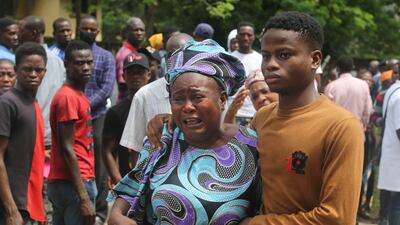
A woman who is a relative of a victim of the disaster is supported by family members at the site. EPA -
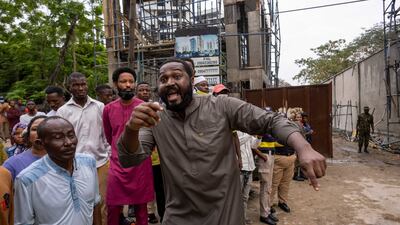
A family member of a person trapped in the rubble. AFP -
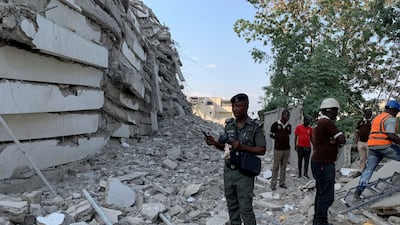
A policeman stands by the debris of the collapsed building in Ikoyi, Lagos. Reuters -
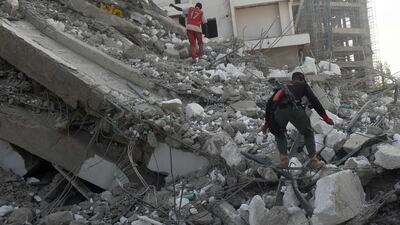
A police orderly climbs to search for his boss in the rubble. AFP -

Several people have been trapped while an unspecified number of people, mostly construction workers, were feared dead. AFP


It took ambulances, paramedics and other emergency responders more than two hours to get to the scene of the collapsed building.
Ibrahim Farinloye, an acting co-ordinator at NEMA, told local media that most of the emergency service responders came from the mainland — about 20 kilometres from the scene.
“When you talk of response time, the immediate people affected by the disaster become the first responders because they are the closest people. Their major responsibility is to give information and call for emergencies,” Mr Farinloye said.
“When you talk about ambulances and paramedics, the Dodan Military Barracks is very close here, they deploy their men to control the situation. And when we got here, we did an assessment of the situation and involved the appropriate agencies to come up with emergency services.”
Building collapses have become an increasingly common occurrence in Lagos, an emerging megacity of nearly 24 million people and a commercial hub in Sub-Saharan Africa, which is developing quickly, and chaotically.
Between 2005 and 2020, 152 buildings collapsed in the city, according to research by planning expert Dr Okunola Olasunkanmi.
civil engineer
More than three quarters of those buildings were residential properties, many of them multistorey.
Lagos experienced one of its worst disasters in 2014, when a six-storey building collapsed during a service by Nigeria-based televangelist TB Joshua, killing 116 people.
Gerald Igboabuchi, a civil engineer, said a lot of basic standards in the construction of high rise buildings have been compromised by corruption.
“The use of substandard building materials and a combination of other problems are responsible for the large number of building collapses in Lagos. It happens frequently in Lagos because the soil load bearing capacity isn’t as good as it is in other cities outside Lagos. Disasters such as this also happen when you cut corners or there are defects in designs, or analysis of the building”, he said.
Mr Igboabuchi told The National that the use of substandard materials was a common problem.
“You may get to the market with the intention of buying quality material but the strength of that material is not up to what the design engineer had in mind", and it should be checked, he said.
The collapsed building was part of a complex called 360 Degree Towers, which was intended to house luxury apartments, town houses and penthouses, according to the development's website, which has since been taken offline.
The housing scheme was being developed by Fourscore Homes Limited, which claims to have a portfolio of projects in the UK, US, South Africa and other areas of Nigeria, with the lowest cost housing units available starting at $1.2 million.

