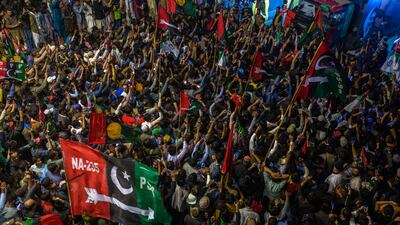
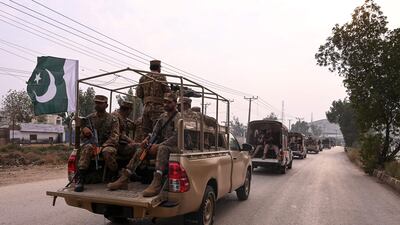
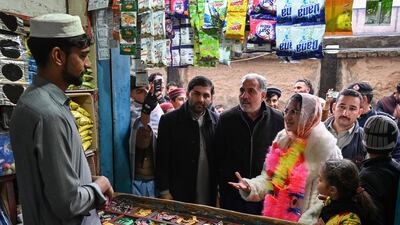
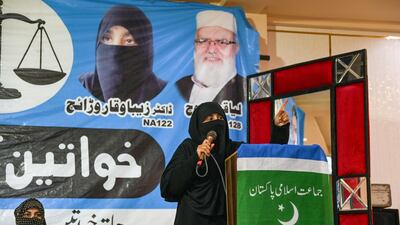
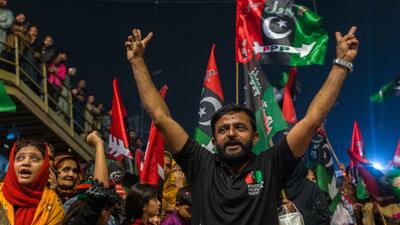
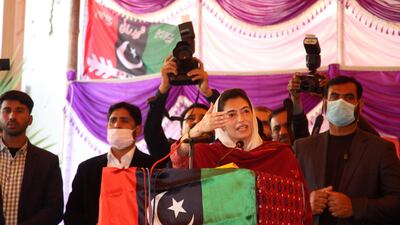
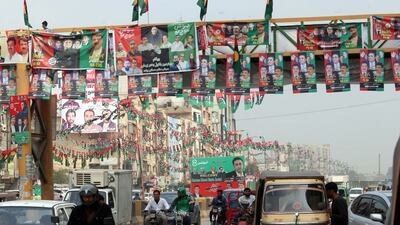
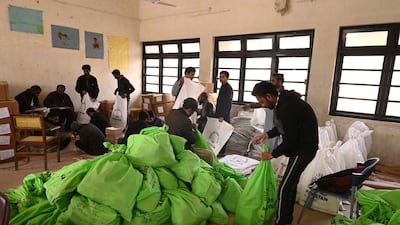
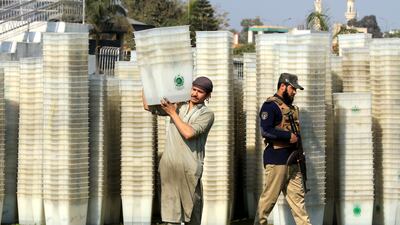
Pakistan is heading to the polls to elect its 16th parliament on February 8.
More 128 million voters are registered to elect 266 legislators for the national assembly and 749 for provincial seats, Pakistan’s election commission said.
But political uncertainty, a deteriorating security situation and record high inflation are some of the challenges the country is facing as it holds elections.
On Wednesday two bombings at the election offices in south-west Pakistan killed and injured dozens, officials said.
The two bombs were caused by motorbikes planted with explosives.
Last week, Pakistan’s former prime minister, Imran Khan, was sentenced to 10 years in prison for leaking state secrets and 14 years along with his wife for illegally selling state gifts.
The leader of the Pakistan Tehreek-e-Insaf (PTI) party is barred from standing in the elections.
“Our leader Khan has been jailed in illegal cases, but we still support Khan and we remain committed to vote for our party's independent candidates,” Muhammad Ali Shah, a PTI supporter told The National.
Party supporters as well as observers say the charges against Khan are of a political nature.
Dr Amjad Ali, standing as an independent candidate, but affiliated with the PTI and a former Khyber Pakhtunkhwa minister, told The National that “opposition parties were free to do campaigns, but PTI-backed candidates are not being allowed to campaign.“
“The way the establishment, bureaucracy, and state are dealing with PTI is increasing public resentment towards them,” he said.
There are 5,121 candidates in this election. They belong either to one of Pakistan’s 167 registered political parties or are independents.
Shabir Gigyani, an advocate of Pakistan's Supreme Court, told The National that “the weak political structure persists as political entities consistently lean on the establishment for support.”
The army is locally referred to as the establishment. The military, however, has repeatedly denied interfering in the country’s politics.
Economy woes
Pakistan is struggling with high inflation and steep prices. The inflation rate, according to Pakistan’s Bureau of Statistics, stood at more than 29 per cent in January. The highest inflation rate on record was 37.9 per cent in May last year.
The economic troubles the country is facing have led to distrust of politicians among many Pakistanis.
‘’Elections may not bring political and economic stability to Pakistan, we are hopeless from all of the political parties leaders,” Ibad Ullah, a Ph.D student, told The National.
Analyst and author Fakhar Kakakhel said the country's stability relies on free and fair elections, leading to democratic governance.
"Political leaders must demonstrate maturity and sincerity for the new government's success,” he said.
Security concerns
Pakistan is facing a surge in violence, limiting voters' ability to participate in political gatherings.
This week, ten officers were killed and six wounded in an attack on a police station in the southern district of Dera Ismail Khan.
Last month, an independent candidate was shot and killed in the Bajaur district of Khyber Pakhtunkhwa province
That same day, a leader of the Awami National Party was killed during a party campaign event in Balochistan province.
Political rallies and corner meetings have drawn less engagement from the public.
Aslam Ghauri, spokesman of Jamiat Ulema-e-Islam (JUI-F) told The National that security agencies were struggling to tackle regional security problems.
“Daily, terrorism is affecting JUI-F and its election campaign. But despite the challenges, we won’t boycott, we’ll continue the fight," he said.
Figures compiled by the Centre for Research and Security Studies show Pakistan had more than 1,500 violence-related deaths, as well as 1,463 injuries, from 789 terror attacks and counter-terror operations in 2023.
This marks a 56 per cent surge in violence, marking a six-year high.
Syed Irfan Ashraf, a defence analyst and assistant professor at Peshawar University’s journalism department, told The National that Pakistan has a history of political instability and security challenges during elections, citing instances in 2002 and 2008 marked by targeted killings.
He said there was a "a new wave of terror against parties opposing the establishment."
The country's last elections in 2018 had a 51 per cent turnout.
Former police chief of Khyber Pakhtunkhwa, Akhtar Ali Shah, said while there were security concerns, the elections would proceed smoothly.
“I believe that there will be threats of terrorism and various incidents may occur, but they are less likely on a large scale to postpone elections,” Mr Shah told The National.
Caretaker Information Minister Murtaza Solangi recently said the government had made arrangements to ensure security and integrity of the process, providing protection for polling stations.

Palestine and Israel - live updates
The Light of the Moon
Director: Jessica M Thompson
Starring: Stephanie Beatriz, Michael Stahl-David
Three stars
World Cup final
Who: France v Croatia
When: Sunday, July 15, 7pm (UAE)
TV: Game will be shown live on BeIN Sports for viewers in the Mena region
Monster Hunter: World
Capcom
PlayStation 4, Xbox One
FA Cup quarter-final draw
The matches will be played across the weekend of 21 and 22 March
Sheffield United v Arsenal
Newcastle v Manchester City
Norwich v Derby/Manchester United
Leicester City v Chelsea
Mercer, the investment consulting arm of US services company Marsh & McLennan, expects its wealth division to at least double its assets under management (AUM) in the Middle East as wealth in the region continues to grow despite economic headwinds, a company official said.
Mercer Wealth, which globally has $160 billion in AUM, plans to boost its AUM in the region to $2-$3bn in the next 2-3 years from the present $1bn, said Yasir AbuShaban, a Dubai-based principal with Mercer Wealth.
“Within the next two to three years, we are looking at reaching $2 to $3 billion as a conservative estimate and we do see an opportunity to do so,” said Mr AbuShaban.
Mercer does not directly make investments, but allocates clients’ money they have discretion to, to professional asset managers. They also provide advice to clients.
“We have buying power. We can negotiate on their (client’s) behalf with asset managers to provide them lower fees than they otherwise would have to get on their own,” he added.
Mercer Wealth’s clients include sovereign wealth funds, family offices, and insurance companies among others.
From its office in Dubai, Mercer also looks after Africa, India and Turkey, where they also see opportunity for growth.
Wealth creation in Middle East and Africa (MEA) grew 8.5 per cent to $8.1 trillion last year from $7.5tn in 2015, higher than last year’s global average of 6 per cent and the second-highest growth in a region after Asia-Pacific which grew 9.9 per cent, according to consultancy Boston Consulting Group (BCG). In the region, where wealth grew just 1.9 per cent in 2015 compared with 2014, a pickup in oil prices has helped in wealth generation.
BCG is forecasting MEA wealth will rise to $12tn by 2021, growing at an annual average of 8 per cent.
Drivers of wealth generation in the region will be split evenly between new wealth creation and growth of performance of existing assets, according to BCG.
Another general trend in the region is clients’ looking for a comprehensive approach to investing, according to Mr AbuShaban.
“Institutional investors or some of the families are seeing a slowdown in the available capital they have to invest and in that sense they are looking at optimizing the way they manage their portfolios and making sure they are not investing haphazardly and different parts of their investment are working together,” said Mr AbuShaban.
Some clients also have a higher appetite for risk, given the low interest-rate environment that does not provide enough yield for some institutional investors. These clients are keen to invest in illiquid assets, such as private equity and infrastructure.
“What we have seen is a desire for higher returns in what has been a low-return environment specifically in various fixed income or bonds,” he said.
“In this environment, we have seen a de facto increase in the risk that clients are taking in things like illiquid investments, private equity investments, infrastructure and private debt, those kind of investments were higher illiquidity results in incrementally higher returns.”
The Abu Dhabi Investment Authority, one of the largest sovereign wealth funds, said in its 2016 report that has gradually increased its exposure in direct private equity and private credit transactions, mainly in Asian markets and especially in China and India. The authority’s private equity department focused on structured equities owing to “their defensive characteristics.”
Multitasking pays off for money goals
Tackling money goals one at a time cost financial literacy expert Barbara O'Neill at least $1 million.
That's how much Ms O'Neill, a distinguished professor at Rutgers University in the US, figures she lost by starting saving for retirement only after she had created an emergency fund, bought a car with cash and purchased a home.
"I tell students that eventually, 30 years later, I hit the million-dollar mark, but I could've had $2 million," Ms O'Neill says.
Too often, financial experts say, people want to attack their money goals one at a time: "As soon as I pay off my credit card debt, then I'll start saving for a home," or, "As soon as I pay off my student loan debt, then I'll start saving for retirement"."
People do not realise how costly the words "as soon as" can be. Paying off debt is a worthy goal, but it should not come at the expense of other goals, particularly saving for retirement. The sooner money is contributed, the longer it can benefit from compounded returns. Compounded returns are when your investment gains earn their own gains, which can dramatically increase your balances over time.
"By putting off saving for the future, you are really inhibiting yourself from benefiting from that wonderful magic," says Kimberly Zimmerman Rand , an accredited financial counsellor and principal at Dragonfly Financial Solutions in Boston. "If you can start saving today ... you are going to have a lot more five years from now than if you decide to pay off debt for three years and start saving in year four."
The biog
Simon Nadim has completed 7,000 dives.
The hardest dive in the UAE is the German U-boat 110m down off the Fujairah coast.
As a child, he loved the documentaries of Jacques Cousteau
He also led a team that discovered the long-lost portion of the Ines oil tanker.
If you are interested in diving, he runs the XR Hub Dive Centre in Fujairah
What are the main cyber security threats?
Cyber crime - This includes fraud, impersonation, scams and deepfake technology, tactics that are increasingly targeting infrastructure and exploiting human vulnerabilities.
Cyber terrorism - Social media platforms are used to spread radical ideologies, misinformation and disinformation, often with the aim of disrupting critical infrastructure such as power grids.
Cyber warfare - Shaped by geopolitical tension, hostile actors seek to infiltrate and compromise national infrastructure, using one country’s systems as a springboard to launch attacks on others.
Ten tax points to be aware of in 2026
1. Domestic VAT refund amendments: request your refund within five years
If a business does not apply for the refund on time, they lose their credit.
2. E-invoicing in the UAE
Businesses should continue preparing for the implementation of e-invoicing in the UAE, with 2026 a preparation and transition period ahead of phased mandatory adoption.
3. More tax audits
Tax authorities are increasingly using data already available across multiple filings to identify audit risks.
4. More beneficial VAT and excise tax penalty regime
Tax disputes are expected to become more frequent and more structured, with clearer administrative objection and appeal processes. The UAE has adopted a new penalty regime for VAT and excise disputes, which now mirrors the penalty regime for corporate tax.
5. Greater emphasis on statutory audit
There is a greater need for the accuracy of financial statements. The International Financial Reporting Standards standards need to be strictly adhered to and, as a result, the quality of the audits will need to increase.
6. Further transfer pricing enforcement
Transfer pricing enforcement, which refers to the practice of establishing prices for internal transactions between related entities, is expected to broaden in scope. The UAE will shortly open the possibility to negotiate advance pricing agreements, or essentially rulings for transfer pricing purposes.
7. Limited time periods for audits
Recent amendments also introduce a default five-year limitation period for tax audits and assessments, subject to specific statutory exceptions. While the standard audit and assessment period is five years, this may be extended to up to 15 years in cases involving fraud or tax evasion.
8. Pillar 2 implementation
Many multinational groups will begin to feel the practical effect of the Domestic Minimum Top-Up Tax (DMTT), the UAE's implementation of the OECD’s global minimum tax under Pillar 2. While the rules apply for financial years starting on or after January 1, 2025, it is 2026 that marks the transition to an operational phase.
9. Reduced compliance obligations for imported goods and services
Businesses that apply the reverse-charge mechanism for VAT purposes in the UAE may benefit from reduced compliance obligations.
10. Substance and CbC reporting focus
Tax authorities are expected to continue strengthening the enforcement of economic substance and Country-by-Country (CbC) reporting frameworks. In the UAE, these regimes are increasingly being used as risk-assessment tools, providing tax authorities with a comprehensive view of multinational groups’ global footprints and enabling them to assess whether profits are aligned with real economic activity.
Contributed by Thomas Vanhee and Hend Rashwan, Aurifer
The specs: 2018 Nissan Patrol Nismo
Price: base / as tested: Dh382,000
Engine: 5.6-litre V8
Gearbox: Seven-speed automatic
Power: 428hp @ 5,800rpm
Torque: 560Nm @ 3,600rpm
Fuel economy, combined: 12.7L / 100km
Pots for the Asian Qualifiers
Pot 1: Iran, Japan, South Korea, Australia, Qatar, United Arab Emirates, Saudi Arabia, China
Pot 2: Iraq, Uzbekistan, Syria, Oman, Lebanon, Kyrgyz Republic, Vietnam, Jordan
Pot 3: Palestine, India, Bahrain, Thailand, Tajikistan, North Korea, Chinese Taipei, Philippines
Pot 4: Turkmenistan, Myanmar, Hong Kong, Yemen, Afghanistan, Maldives, Kuwait, Malaysia
Pot 5: Indonesia, Singapore, Nepal, Cambodia, Bangladesh, Mongolia, Guam, Macau/Sri Lanka