


Many countries are experiencing a surge in Covid-19 cases, as a new variant of the virus that causes the disease spreads around the globe.
The World Health Organisation designated JN.1 as a “variant of interest” last week, after it was found in countries including China, India and the US.
JN.1 is ultimately descended from the Omicron variant of Sars-CoV-2, although it has more than two dozen mutations that distinguish it from Omicron.
Medical experts that spoke to The National had mixed views on whether controls and restrictions on movement were realistic, given than much of the global population has some level of immunity.
University of East Anglia
At least 700 million cases were officially recorded in the pandemic that killed 6.9 million people - and the actual number of cases is widely believed to be much higher.
Dr Bharat Pankhania, a senior consultant in communicable disease control and senior clinical lecturer at the University of Exeter in the UK, said that new variants emerge “all the time”.
“Is it spreading faster? I don’t think so, but it’s more a case of people have dropped their infection-prevention guard,” he said.
He said that he was concerned people were “under-immunised” at a time when there was “a lot of socialising” that could spread the virus.
“[There is a] strong perception that a virus comes, it mutates, then becomes like the common cold. That's not always the case,” he said.
“I think governments should take it seriously. Here, in the UK, we have no public health messaging [saying]: 'The virus is here to stay, don't get infected. If you're unwell and by yourself, try not to spread it to others.'”
JN.1 was identified in the US in September and has since spread widely to the extent that it makes up a growing proportion of cases in numerous countries.
While the WHO said that JN.1 posed a “low” public health risk, the organisation also warned that, with the Northern Hemisphere experiencing winter, the variant “could increase the burden of respiratory infections in many countries”.

Ian Jones, professor of virology at the University of Reading in the UK, said it was “always concerning” if a new variant is significant enough to spread through the population.
He said there was a worry that any new variant, if sufficiently different from previous ones, would be better able to evade the immune protection that people had developed against Covid-19.
However, he indicated that, for the moment, JN.1 did not appear to be creating a much greater threat.
“I still don’t think there’s evidence it’s an alarming development,” he said.
“We have to keep in mind anything that spreads will find those particular individuals, people who will become poorly. For them, it’s important to keep up to date with the vaccine.”
While JN.1 has many mutations that distinguish it from the Omicron or the B.1.1.529 variant, it is more directly descended from the BA.2.86 variant.
A study published last week in The Lancet medical journal indicated that JN.1 could have “significantly enhanced” ability to evade the immune response to Covid-19 compared to BA.2.86.
However, Paul Hunter, professor of medicine at the University of East Anglia in the UK, said “at the moment there's no evidence” that JN.1 is likely to cause more severe illness than other forms of Sars-CoV-2.
While it was spreading more quickly than other variants, he said it was not doing so “overwhelmingly more” than other variants did when they arrived.
Prof Hunter said that a Covid-19 infection this year “is much less likely” to cause an illness severe enough to cause a person to have to go into hospital, compared to the same time last year.
“If you caught Covid this time last year, you were probably two to three times more likely to end up in hospital than if you caught Covid this year,” he said.
“It’s a lot less severe [now] than last year, and last year was a lot less severe than the previous year. There’s quite a bit of evidence Covid isn’t as severe as a year ago.”
He said the reduction in the severity of disease was likely to be mostly because people had built up immunity to Covid-19 through repeated infections, but also because the virus had evolved to become less pathogenic.
“Almost all of us have had repeated infections, whether we know it or not,” Prof Hunter said. “It’s very unlikely we’ll see anything close to the same pressures on healthcare services we saw even a year ago.”
He added that on “the balance of evidence” introducing stricter restrictions now to try to curb the spread of Sars-CoV-2 “would not be that helpful”.
“I’m not convinced that non-pharmaceutical interventions – being cautious – actually helps anyone,” he said.
“The latest data [in the UK] suggests one in 30 people are currently infected with Covid. Every bus you get on, there will be an average of one person with Covid.
“If we went back to restrictions, I don’t think it would make a blind bit of difference.”
Global fight against Covid-19 – in pictures
-
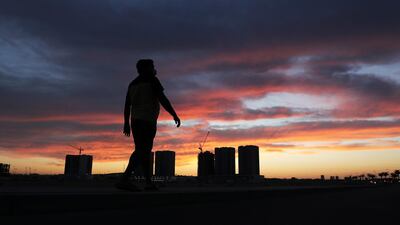
A man wearing a facemask in Dubai in April 2020, shortly after the first outbreak. Pawan Singh / The National -

Staff from the Wuhan Hygiene Emergency Response Team conduct searches on the closed Huanan Seafood Market in Wuhan, China, at the start of the outbreak on January 11, 2020. AFP -
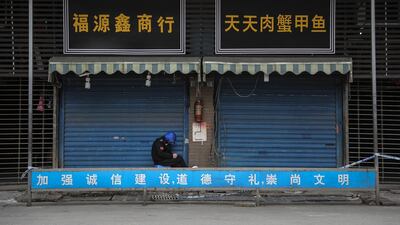
A security guard sits outside the closed Huanan market in Wuhan, Hubei province. Getty Images -
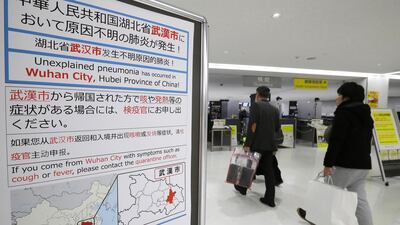
A notice displayed near a quarantine control station at Narita Airport, Japan, in January 2020. EPA -

An empty Times Square after a coronavirus lockdown was ordered in New York City, March 18, 2020. Reuters -
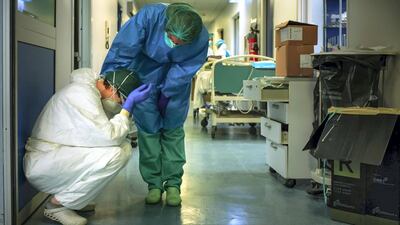
A nurse wearing PPE comforts another as they change shifts on March 13, 2020 at Cremona Hospital, north-eastern Italy. AFP -
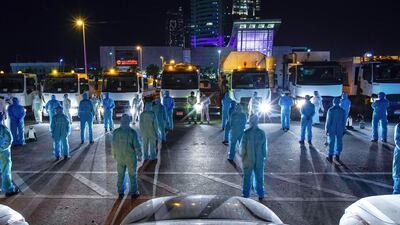
Sanitation workers from Tadweer on the first day of the UAE cleaning campaign in March 2020. Victor Besa / The National -
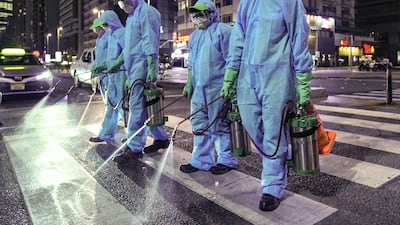
The pedestrian crossing on Hamdan and Fatima Bint Mubarak Street is sprayed on March 27, 2020. Victor Besa / The National -

A commuter enters the sterilisation area at the entrance of the Abu Dhabi Central Bus Terminal in March 2020. Victor Besa / The National -
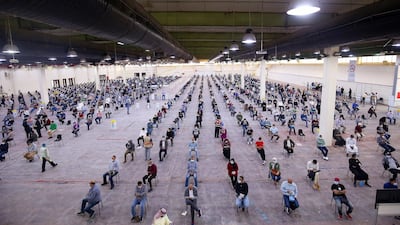
Travellers returning to Kuwait from Egypt, Syria and Lebanon arrive to be re-tested at a containment and screening zone in Kuwait City on March 16, 2020. AFP -
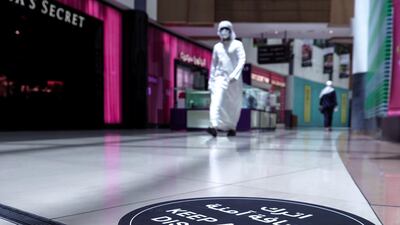
Al Wadha Mall in Abu Dhabi reopens in May 2020 with measures in place to protect shoppers. Victor Besa / The National -
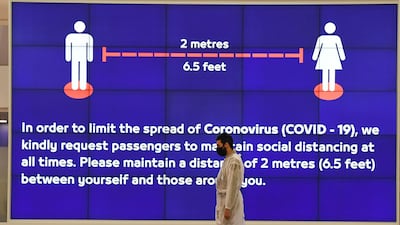
Safety reminders at Dubai International Airport after the resumption of scheduled operations by Emirates on May 22, 2020. AFP -
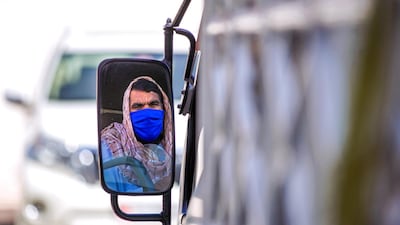
A delivery driver wearing a face mask in downtown Abu Dhabi. Victor Besa / The National -
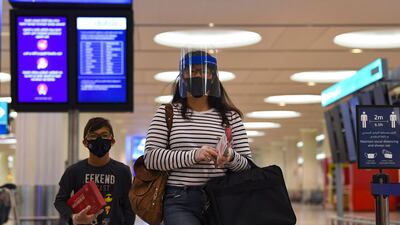
Passengers of an Emirates flight prepare to board a plan to Sydney at Dubai International Airport. AFP -
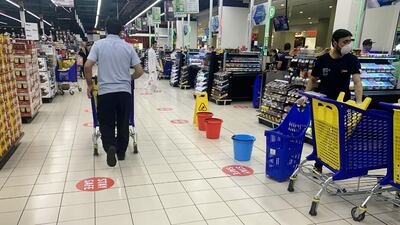
Systems put in place at a supermarket in Dubai to slow the spread of the coronavirus. AFP



