
North Korea launched another long-range ballistic missile with the potential capability of striking the US, Seoul and Tokyo, officials have said.
The latest launch, on Monday, has extended an already record-breaking number of weapons tests this year.
North Korea used a solid-fuel-based intercontinental ballistic missile.
South Korea's military condemned what it called North Korea's reckless provocations, adding Pyongyang would be held responsible for any consequences from its actions.
“North Korea was strongly condemned for posing a serious threat to the peace and safety of the Korean peninsula and the international community by launching a solid-fuelled ICBM,” it said after an emergency National Security Council meeting.
The US reaffirmed its commitment to the defence of Japan and South Korea after the ballistic missile launch, the White House said late on Sunday.
US National Security Adviser Jake Sullivan spoke with South Korea's National Security Office director Cho Taeyong and Gen Akiba Takeo of Japan and condemned the test, “which is a flagrant violation of multiple UN Security Council resolutions”, the White House said.
The firing followed the test of a shorter-range missile on Sunday night, with the back-to-back launches coming immediately in the wake of another bout between North Korea and the US-South Korean allies.
South Korea's military said it detected the launch of a long-range ballistic missile from the Pyongyang area on Monday morning, adding that it flew 1,000km before splashing down in the East Sea.
US in range
Japan's Defence Ministry said the weapon was an ICBM-class missile with a potential range of more than 15,000km that would cover all of the US.
Japanese Prime Minister Fumio Kishida described the two launches as a “threat to peace and stability”, while the US State Department also quickly condemned them.
“These launches, like the other ballistic missile launches Pyongyang has conducted this year, are in violation of multiple United Nations Security Council resolutions,” a State Department official said.
The UN Security Council has adopted many resolutions calling on North Korea to halt its nuclear and ballistic missile programmes since it first conducted a nuclear test in 2006.
-
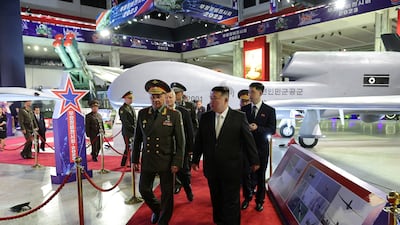
North Korean leader Kim Jong-un and Russia's Defence Minister Sergei Shoigu visit an arms exhibition on the 70th anniversary of the Korean War armistice. Reuters -
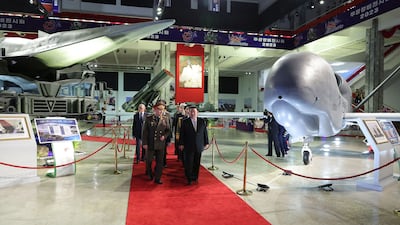
Mr Kim and Mr Shoigu discussed military issues and the regional security environment. AFP -
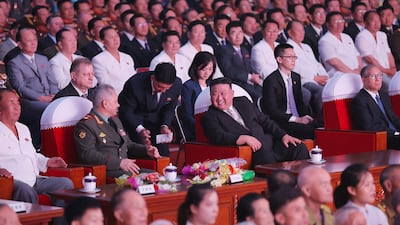
North Korea invited delegations from Russia and China to attend the events marking the armistice. AP -
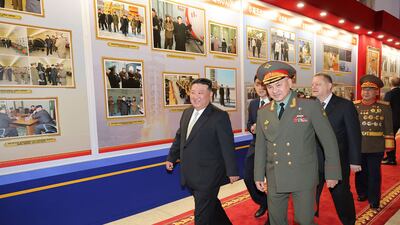
The exhibition showcased some of North Korea’s newest weapons. AFP -
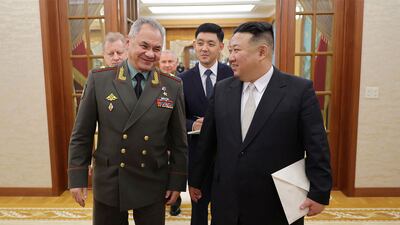
Mr Kim briefed the Russian Defence Minister on plans to expand North Korea’s military capabilities. AFP -
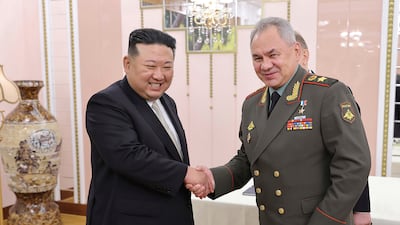
The Russian delegation arrived in North Korea late on Tuesday. AP -
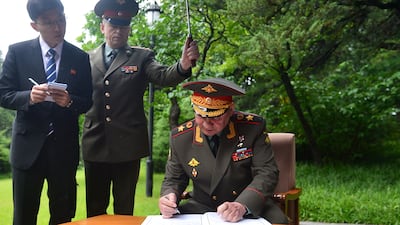
Mr Shoigu signs a guest book during a visit to Mangyongdae. Reuters -
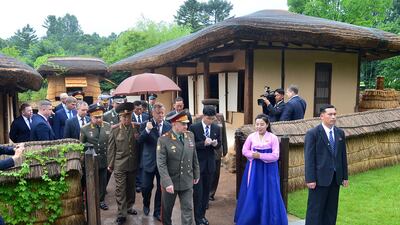
Mr Shoigu and members of the Russian military delegation visit Mangyongdae. Reuters -
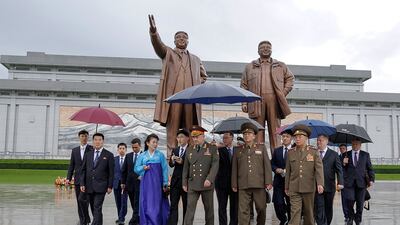
Mr Shoigu's visit also comes against the backdrop of rising tension between the US and Russia over the Ukraine war. AFP -
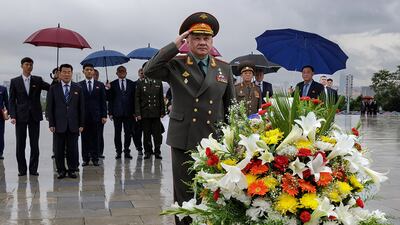
Mr Shoigu salutes before the statues of the late North Korean leaders Kim Il-sung and Kim Jong-il at Mansu Hill in Pyongyang. AFP -
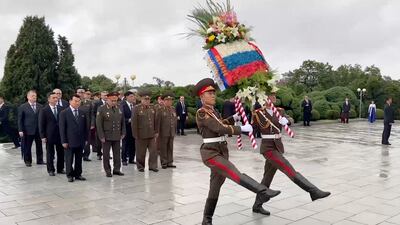
Mr Shoigu attends a wreath-laying ceremony at the Liberation Monument in Pyongyang. EPA -
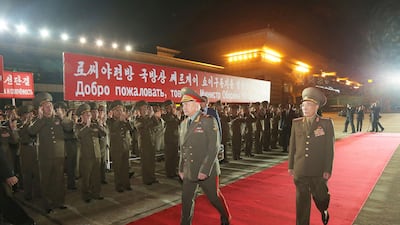
Mr Shoigu soon after arriving at Pyongyang International Airport. AFP


North Korea previously test-fired four ICBMs this year. It first launched the Hwasong-18 – its most advanced and powerful ICBM – in April, then again in July.
The Hwasong-18 is North Korea's first ICBM to use solid fuel, which makes it easier to transport and faster to launch than liquid-fuelled versions.
South Korea's Joint Chiefs of Staff representative said the country's top military officials were analysing whether Monday's launch was a solid-fuelled ICBM.
North Korea last year declared itself an “irreversible” nuclear power and has repeatedly said it would never give up its nuclear programme, which the regime views as essential for its survival.

