Mohammed Hassan, the Pakistani porter died on the K2 Bottleneck. @Alpine_Pakistan / Twitter

Pakistani K2 porter death inquiry will hear claims of negligence


  • English
  • Arabic

A Pakistani inquiry will look into the circumstances of the death of Muhammad Hassan, 25, a mountain porter who accompanied an international team in their attempt to climb K2, the world's second-highest peak.

Reports said that during the push to the summit on July 27, Mr Hassan fell from a narrow path known as the Bottleneck on the 8,600-metre mountain.

Until his attempt to scale the mountain, Mr Hassan had limited his climbing to the K2 base camp but decided to go to the summit to earn more money to treat his mother, who is in poor health.

“Hassan had told me he wanted to earn enough before winter to be able to shift the family to an area with moderate weather,” Mr Hassan’s brother Muhammad Hussain told The National.

“Our mother suffers from asthma and has trouble breathing. This area’s weather is too harsh for her.”

Tourism authorities in Pakistan's Gilgit Baltistan, who are responsible for climbing permits, said on Friday they had opened an inquiry into the incident.

Mr Hassan was an employee of Lela Peak Expedition. Seven Summit Club, a company offering services to mountaineers, had assigned him to assist the rope fixers during the summit push.

A dispute broke out in the climbing community after a video emerged that appeared to show a train of climbers stepping past Mr Hassan to reach the top.

Crowds heading to summit of K2. Photo: @lakpa_8K / twitter

Drone footage posted on social media showed the team of Norwegian mountaineer Kristin Harila, who was heading to the summit in a world record attempt to become the fastest climber to climb all peaks above 8,000 metres, leaving behind the injured Mr Hassan in a condition that purportedly led to his death.

Mr Hassan was not part of Ms Harila's team.

She told the BBC that she and her team tried everything to help Mr Hassan, denying accusations that he was left to die.

He is survived by three sons.

“It is a tragedy that the team, which Hassan was part of, could not even bring his body with them when they descended from K2,” Mr Hussain said.

“If someone from an affluent family were to face such a tragedy, a helicopter would have been used to rescue the body. In this country, no one cares about the poor.”

K2, on the Chinese-Pakistani border in the Karakoram range, has a deadly reputation, with climbers most often dying on the descent, where the slightest mistake can trigger an avalanche.

Only a few hundred climbers have reached the summit.

In contrast, the summit of Mount Everest has been reached more than 9,000 times.

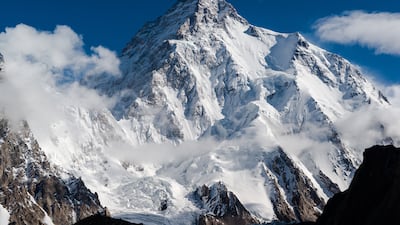
  • K2 as seen from Broad Peak base camp on the Baltoro Glacier in Pakistan. All photos: Getty Images
    K2 as seen from Broad Peak base camp on the Baltoro Glacier in Pakistan. All photos: Getty Images
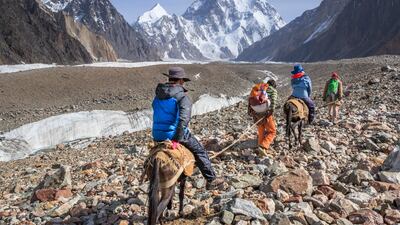
  • Tourists ride horses on the Godwin-Austen glacier between Concordia and K2 base camp in northern Pakistan.
    Tourists ride horses on the Godwin-Austen glacier between Concordia and K2 base camp in northern Pakistan.
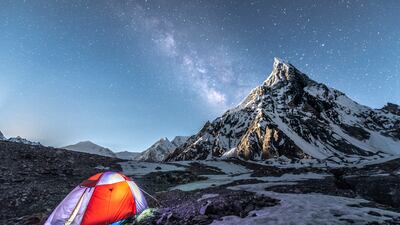
  • The Milky Way seen over Concordia camp on the way to K2 base camp, Pakistan.
    The Milky Way seen over Concordia camp on the way to K2 base camp, Pakistan.
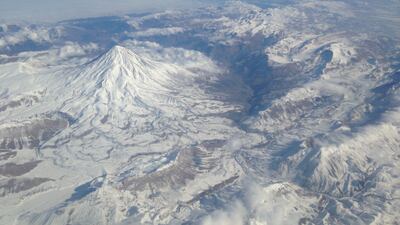
  • The Karakoram range seen from the air.
    The Karakoram range seen from the air.
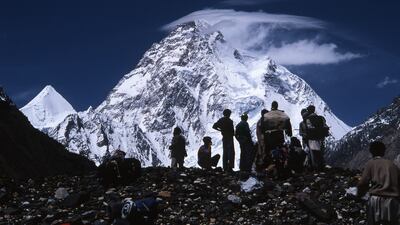
  • Climbers view K2 from Concordia.
    Climbers view K2 from Concordia.

Last village

Iskolai is the last village from the mountaineers begin their journey to K2's summit.

Accompanying the mountaineers are porters, each of whom carries up to 25kg of luggage to base camp.

High-altitude porters take over at base camp and accompany the mountaineers to the summit.

While the Iskolai-to-base camp porters earn 1,500 rupees ($5) for each trip, the charges increase up to 5,000 rupees for the high-altitude porters.

“Some high-altitude porters go ahead of their team to fix ropes during the climb, this is why their job is very difficult,” said Hamza Murad, who serves as assistant commissioner of the district.

Climbers pass Muhammad Hassan, who wears black trousers and a yellow jacket. Photo: @lakpa_8K / Twitter

Mr Murad told The National it was not possible to recover Mr Hassan’s body from the Bottleneck, where it is lying at an altitude of more than 7,900 metres, because of the harsh conditions.

“Even a helicopter cannot go there to rescue it,” he said.

Mr Hussain also used to work as a porter but was advised not to climb the mountains because his feet were affected with a disease.

“Hassan was the lone breadwinner for our family,” he said.

Neighbour Ahmed Chotsar said Mr Hassan was a hardworking porter.

“Several porters work only for a few months of the year, but Hassan used to work in these extremely cold area all round the year,” he said.

  • Volunteer mountaineers joined the Nimsdai Foundation during the #bigmountaincleanup campaign on K2 in Pakistan. Photo: Nimsdai Foundation
    Volunteer mountaineers joined the Nimsdai Foundation during the #bigmountaincleanup campaign on K2 in Pakistan. Photo: Nimsdai Foundation
  • Oxygen tanks, tents, food and clothes were among some of the items collected. Photo: Nimsdai Foundation
    Oxygen tanks, tents, food and clothes were among some of the items collected. Photo: Nimsdai Foundation
  • The milky way over Concordia camp, on the way to K2 base camp in Pakistan. Photo: Getty
    The milky way over Concordia camp, on the way to K2 base camp in Pakistan. Photo: Getty
  • Clearing litter at high altitude is tough and labour intensive. Photo: Nimsdai Foundation
    Clearing litter at high altitude is tough and labour intensive. Photo: Nimsdai Foundation
  • Volunteers said the rubbish collected during this month's clean up was an accumulation of nearly 70 years' worth. Photo: Nimsdai Foundation
    Volunteers said the rubbish collected during this month's clean up was an accumulation of nearly 70 years' worth. Photo: Nimsdai Foundation
  • Tourists riding horses on the Godwin-Austen glacier, on the route between Concordia and K2 base camp in Pakistan. Photo: Getty
    Tourists riding horses on the Godwin-Austen glacier, on the route between Concordia and K2 base camp in Pakistan. Photo: Getty

Ayaz Shigri, who serves as president of the Baltistan Tour Operators Association, told The National that a big problem for local mountaineers was the lack of proper training.

While the government had announced plans to set up a mountaineering school in the area several years ago, they were not put into action, he said.

Also, he said the local mountaineers and high-altitude porters often use second-hand equipment and many do not have equipment of the calibre used by the foreign climbers.

Mr Hassan was “not properly equipped for the climb”, wearing neither a down suit nor gloves, Ms Harila wrote on Instagram.

The Bottleneck area is considered the riskiest point on the final K2 ascent.

Pakistani mountaineer Ali Sadpara died on K2 along with a fellow climber in February 2021.

Mercer, the investment consulting arm of US services company Marsh & McLennan, expects its wealth division to at least double its assets under management (AUM) in the Middle East as wealth in the region continues to grow despite economic headwinds, a company official said.

Mercer Wealth, which globally has $160 billion in AUM, plans to boost its AUM in the region to $2-$3bn in the next 2-3 years from the present $1bn, said Yasir AbuShaban, a Dubai-based principal with Mercer Wealth.

Within the next two to three years, we are looking at reaching $2 to $3 billion as a conservative estimate and we do see an opportunity to do so,” said Mr AbuShaban.

Mercer does not directly make investments, but allocates clients’ money they have discretion to, to professional asset managers. They also provide advice to clients.

“We have buying power. We can negotiate on their (client’s) behalf with asset managers to provide them lower fees than they otherwise would have to get on their own,” he added.

Mercer Wealth’s clients include sovereign wealth funds, family offices, and insurance companies among others.

From its office in Dubai, Mercer also looks after Africa, India and Turkey, where they also see opportunity for growth.

Wealth creation in Middle East and Africa (MEA) grew 8.5 per cent to $8.1 trillion last year from $7.5tn in 2015, higher than last year’s global average of 6 per cent and the second-highest growth in a region after Asia-Pacific which grew 9.9 per cent, according to consultancy Boston Consulting Group (BCG). In the region, where wealth grew just 1.9 per cent in 2015 compared with 2014, a pickup in oil prices has helped in wealth generation.

BCG is forecasting MEA wealth will rise to $12tn by 2021, growing at an annual average of 8 per cent.

Drivers of wealth generation in the region will be split evenly between new wealth creation and growth of performance of existing assets, according to BCG.

Another general trend in the region is clients’ looking for a comprehensive approach to investing, according to Mr AbuShaban.

“Institutional investors or some of the families are seeing a slowdown in the available capital they have to invest and in that sense they are looking at optimizing the way they manage their portfolios and making sure they are not investing haphazardly and different parts of their investment are working together,” said Mr AbuShaban.

Some clients also have a higher appetite for risk, given the low interest-rate environment that does not provide enough yield for some institutional investors. These clients are keen to invest in illiquid assets, such as private equity and infrastructure.

“What we have seen is a desire for higher returns in what has been a low-return environment specifically in various fixed income or bonds,” he said.

“In this environment, we have seen a de facto increase in the risk that clients are taking in things like illiquid investments, private equity investments, infrastructure and private debt, those kind of investments were higher illiquidity results in incrementally higher returns.”

The Abu Dhabi Investment Authority, one of the largest sovereign wealth funds, said in its 2016 report that has gradually increased its exposure in direct private equity and private credit transactions, mainly in Asian markets and especially in China and India. The authority’s private equity department focused on structured equities owing to “their defensive characteristics.”

The biog

Hometown: Birchgrove, Sydney Australia
Age: 59
Favourite TV series: Outlander Netflix series
Favourite place in the UAE: Sheikh Zayed Grand Mosque / desert / Louvre Abu Dhabi
Favourite book: Father of our Nation: Collected Quotes of Sheikh Zayed bin Sultan Al Nahyan
Thing you will miss most about the UAE: My friends and family, Formula 1, having Friday's off, desert adventures, and Arabic culture and people
 

Updated: August 13, 2023, 4:01 PM