The Middle Eastern origins of certain precious jewels have been traced in an innovative move by researchers.
They used a technique with the potential to prise open the backstory of valuable stones, including those set in royal crown jewels.
Gemstones from ancient mines were analysed using modern spectroscopy to provide unprecedented insight into historical trade routes.
Researchers were able to decipher a gem's past and the journeys it has taken, unlocking previously hidden histories.
“Gemstones such as emerald and peridot have been mined since antiquity,” study author Adel Surour said. “For example, royal crowns in Europe are decorated with peculiar gemstones that originate from either Africa or Asia.”
The new approach enables a precise differentiation between natural and synthetic gems and offers a deeper understanding of their respective characteristics.
Some of the gemstones have provided a window into historical trade routes thanks to their particular elemental composition and atomic make-up, which act as a type of identifying fingerprint.
A study, published in AIP Advances, involved rapid analysis of gemstones found in the Arabian-Nubian Shield, which were compared with counterparts from around the world.
The shield is a vast treasure trove of mineral deposits in present-day Egypt and Saudi Arabia dating back to Earth’s earliest geological age.
“We showed the main spectroscopic characteristics of gemstones from these Middle East localities to distinguish them from their counterparts in other world localities,” Mr Surour said.
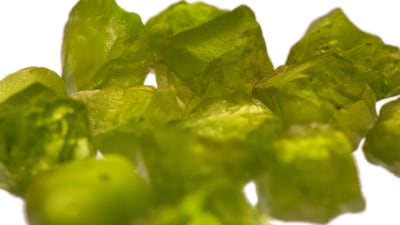
Peridot, a semi-precious olive green crystal used in jewellery. All photos: Getty Images
Peridot, pictured here in its rough form, has been mined since antiquity.
Beryl crystals come in a variety of colours - when they're green, they are better known as emeralds.
Amethyst gets its signature violet hue from iron impurities.
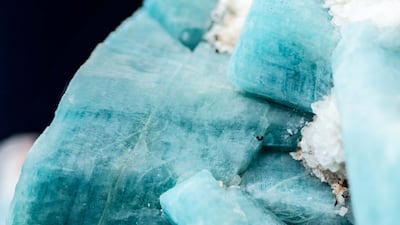
Modern spectroscopy techniques allow researchers to determine the origin of gems like Amazonite, pictured here.
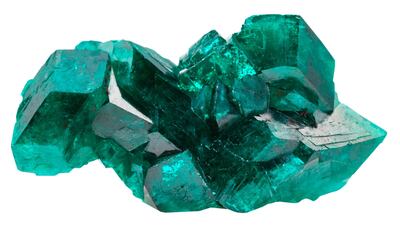
The deep green colour of dioptase crystals comes from its copper content.
The team focused on various silicate gems such as emeralds from Cleopatra’s mines in ancient Egypt, plus other stones from historical sites mostly dating back to Roman times.
The study was able to conclude that specific gemstones including amethyst, peridot, amazonite and emerald are originally from Egypt and Saudi Arabia.
For each, analysis allowed for the identification of their unique fingerprint, which helped in the determination of their origin and differences.
The study concludes that, despite their unique lines, these gemstones share elements due to their collection from various environments.
Locations of the investigated gem minerals from Egypt and Saudi Arabia. 1. Peridot, Zabargad (St. John’s), off the Egyptian Red Sea coast. 2. Peridot from Harrat Kishb (volcanic field), Saudi Arabia. 3. Emerald and amazonite, Wadi Sikait, Wadi El Gemal area, Egypt. 4. Low-grade emerald (beryl), Wadi Ghazala, Sinai Peninsula, Egypt. 5, Amethyst, Aswan area, Eastern Desert, Egypt. Photo: Khedr et al
The researchers used three types of spectroscopy to identify elements that influence colour, differentiating stones found in and outside the region, and distinguishing between natural and synthetic gems.
The iron content, for instance, correlates to the purple in amethysts, while elements such as copper, chromium and vanadium play significant roles in colour.
A unique water peak is present in lab-grown synthetic gems, distinguishing them from their natural counterparts, despite their otherwise identical appearance.
Royal crowns in Europe are decorated with peculiar gemstones that originate from either Africa or Asia
Adel Surour, study author
The crystalline structure of amazonite beads also highlighted differences among those from Mexico, Jordan and Egypt.
“We need to have precise methods to distinguish the source of a gemstone and trace ancient trade routes to have accurate information about the original place from which it was mined,” Mr Surour said.
Not only is the study the first to successfully distinguish certain silicate gemstones – peridot, beryl/emerald, amazonite and amethyst – originating from ancient Egyptian mines using molecular and elemental spectroscopic methods, but it also characterises gems from Saudi Arabia.
Beyond geology and archaeology, the study's implications could be crucial to the gem industry itself.
The ability to differentiate natural gems from synthetics and accurately determine their origins could lead to better authenticity checks and regulations, researchers said.

Mercer, the investment consulting arm of US services company Marsh & McLennan, expects its wealth division to at least double its assets under management (AUM) in the Middle East as wealth in the region continues to grow despite economic headwinds, a company official said.
Mercer Wealth, which globally has $160 billion in AUM, plans to boost its AUM in the region to $2-$3bn in the next 2-3 years from the present $1bn, said Yasir AbuShaban, a Dubai-based principal with Mercer Wealth.
“Within the next two to three years, we are looking at reaching $2 to $3 billion as a conservative estimate and we do see an opportunity to do so,” said Mr AbuShaban.
Mercer does not directly make investments, but allocates clients’ money they have discretion to, to professional asset managers. They also provide advice to clients.
“We have buying power. We can negotiate on their (client’s) behalf with asset managers to provide them lower fees than they otherwise would have to get on their own,” he added.
Mercer Wealth’s clients include sovereign wealth funds, family offices, and insurance companies among others.
From its office in Dubai, Mercer also looks after Africa, India and Turkey, where they also see opportunity for growth.
Wealth creation in Middle East and Africa (MEA) grew 8.5 per cent to $8.1 trillion last year from $7.5tn in 2015, higher than last year’s global average of 6 per cent and the second-highest growth in a region after Asia-Pacific which grew 9.9 per cent, according to consultancy Boston Consulting Group (BCG). In the region, where wealth grew just 1.9 per cent in 2015 compared with 2014, a pickup in oil prices has helped in wealth generation.
BCG is forecasting MEA wealth will rise to $12tn by 2021, growing at an annual average of 8 per cent.
Drivers of wealth generation in the region will be split evenly between new wealth creation and growth of performance of existing assets, according to BCG.
Another general trend in the region is clients’ looking for a comprehensive approach to investing, according to Mr AbuShaban.
“Institutional investors or some of the families are seeing a slowdown in the available capital they have to invest and in that sense they are looking at optimizing the way they manage their portfolios and making sure they are not investing haphazardly and different parts of their investment are working together,” said Mr AbuShaban.
Some clients also have a higher appetite for risk, given the low interest-rate environment that does not provide enough yield for some institutional investors. These clients are keen to invest in illiquid assets, such as private equity and infrastructure.
“What we have seen is a desire for higher returns in what has been a low-return environment specifically in various fixed income or bonds,” he said.
“In this environment, we have seen a de facto increase in the risk that clients are taking in things like illiquid investments, private equity investments, infrastructure and private debt, those kind of investments were higher illiquidity results in incrementally higher returns.”
The Abu Dhabi Investment Authority, one of the largest sovereign wealth funds, said in its 2016 report that has gradually increased its exposure in direct private equity and private credit transactions, mainly in Asian markets and especially in China and India. The authority’s private equity department focused on structured equities owing to “their defensive characteristics.”
JUDAS AND THE BLACK MESSIAH
Directed by: Shaka King
Starring: Daniel Kaluuya, Lakeith Stanfield, Jesse Plemons
Brunch has been around, is some form or another, for more than a century. The word was first mentioned in print in an 1895 edition of Hunter’s Weekly, after making the rounds among university students in Britain. The article, entitled Brunch: A Plea, argued the case for a later, more sociable weekend meal. “By eliminating the need to get up early on Sunday, brunch would make life brighter for Saturday night carousers. It would promote human happiness in other ways as well,” the piece read. “It is talk-compelling. It puts you in a good temper, it makes you satisfied with yourself and your fellow beings, it sweeps away the worries and cobwebs of the week.” More than 100 years later, author Guy Beringer’s words still ring true, especially in the UAE, where brunches are often used to mark special, sociable occasions.
Founder of the Muslim Brotherhood, Hassan al Banna, "accepted the political utility of violence"
Views of key Muslim Brotherhood ideologue, Sayyid Qutb, have “consistently been understood” as permitting “the use of extreme violence in the pursuit of the perfect Islamic society” and “never been institutionally disowned” by the movement.
Muslim Brotherhood at all levels has repeatedly defended Hamas attacks against Israel, including the use of suicide bombers and the killing of civilians.
Laying out the report in the House of Commons, David Cameron told MPs: "The main findings of the review support the conclusion that membership of, association with, or influence by the Muslim Brotherhood should be considered as a possible indicator of extremism."