


The James Webb Space Telescope has captured Saturn's rings in striking detail for the first time since it was launched into space in 2021.
Raw images show the gas giant against the darkness of space, with its rings shining bright.
Saturn is the second largest planet in the solar system after Jupiter and is known for its stunning ringlets, which are thought to be made up of billions of pieces of ice and rocks coated with dust.
The images are yet to be processed but have already been posted on the Webb telescope feed website, which shares data captured by the $10 billion “time machine”.
“Adorned with thousands of beautiful ringlets, Saturn is unique among the planets. It is not the only planet to have rings – made of chunks of ice and rock – but none are as spectacular or as complicated as Saturn's,” Nasa said on its website.
“Like fellow gas giant Jupiter, Saturn is a massive ball made mostly of hydrogen and helium.”
The Hubble Space Telescope, Webb's predecessor, has captured Saturn before and other Nasa missions have also studied the planet.
The US space agency has said previously that the planet's rings could disappear in 100 million years.
It said that the rings are being “pulled into Saturn by gravity as a dusty rain of ice particles under the influence of Saturn’s magnetic field”.
Saturn will be at its closest point to Earth on August 27, appearing brighter than usual.
The James Webb Space Telescope has also captured Jupiter before. Previous images included a picture taken in August that showed the planet’s faint rings, two tiny moons called Amalthea and Adrastea, and striking views of its aurorae, with galaxies in the background.
The planet, which is believed to have 79 moons, has a unique composition and inner structure that researchers want to study more.
The James Webb Space Telescope was launched into space on Christmas Day 2021 to study the birth of the universe, find signs of life and help scientists learn more about the solar system.
James Webb Telescope captured images
-
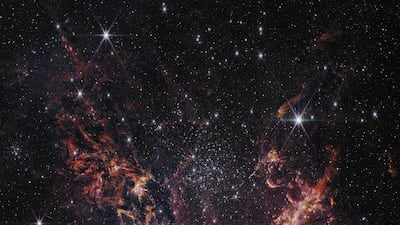
A cluster of stars in the Small Magellanic Cloud in an image taken by the James Webb Space Telescope. PA -
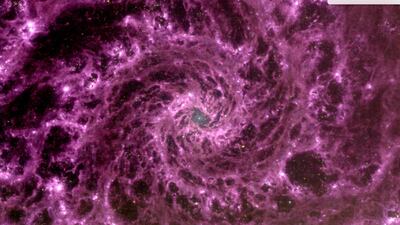
A colour composite image of the Messier 74 galaxy. Photo: Gabriel Brammer (Cosmic Dawn Center, Niels Bohr Institute, University of Copenhagen) / James Webb Space Telescope -
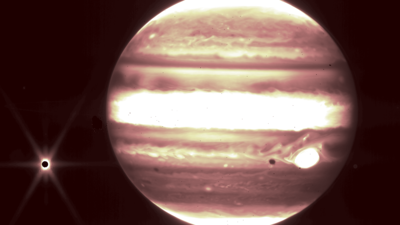
Jupiter and its moon Europa, left, are seen through the James Webb Space Telescope. Photo: Nasa -
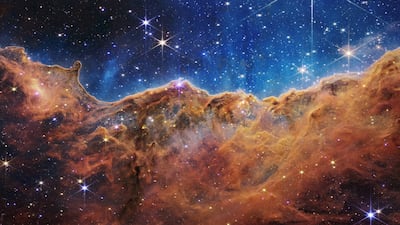
Captured in infrared light by Nasa's new James Webb Space Telescope, this image reveals areas of star birth in Carina Nebula. All photos: James Webb Space Telescope -
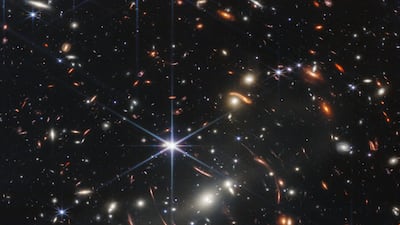
Known as Webb's First Deep Field, the picture showcases a galaxy cluster called SMACS 0723 as it appeared 4.6 billion years ago. The image was revealed by US President Joe Biden on July 11 during an event at the White House. -
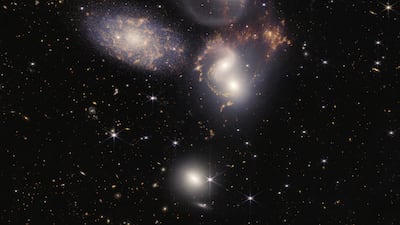
An image of Stephan's Quintet, an area in space with a group of five galaxies. -
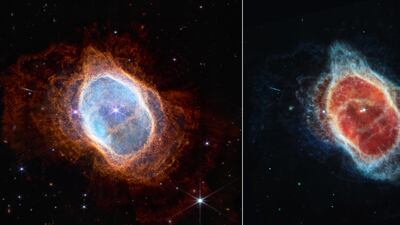
Side-by-side comparison shows observations of the Southern Ring Nebula in near-infrared light (left) and mid-infrared light. -
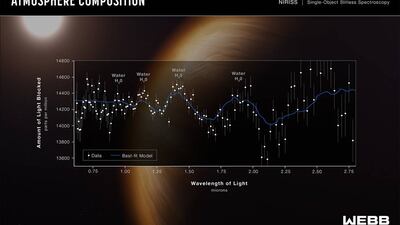
The telescope has captured the distinct signature of water, along with evidence for clouds and haze, in the atmosphere surrounding a hot, puffy gas giant planet orbiting a distant Sun-like star, called WASP-96 b. Photo: James Webb Space Telescope



