


The James Webb Space Telescope has discovered water around a comet, Nasa announced on Monday.
Water vapour was confirmed around a comet called Read, which is located in the main asteroid belt between Mars and Jupiter.
The findings, published in the Nature science journal, could help scientists learn more about the origins of Earth’s abundant water.
“Our water-soaked world, teeming with life and unique in the universe as far as we know, is something of a mystery — we’re not sure how all this water got here,” said Stefanie Milam, Webb deputy project scientist for planetary science and a co-author of the study.
“Understanding the history of water distribution in the solar system will help us to understand other planetary systems and if they could be on their way to hosting an Earth-like planet.”

The findings also indicate that water ice from the primordial solar system can be preserved in that region.
Previously, it was always understood that only comets in the Kuiper Belt and Oort Cloud, beyond the orbit of Neptune, would preserve ice because they were farther from the Sun.
“Scientists have long speculated that water ice could be preserved in the warmer asteroid belt, inside the orbit of Jupiter, but definitive proof was elusive — until Webb,” Nasa said.
Scientists were also surprised to find that no carbon dioxide was detected in the comet.
Nasa said that carbon dioxide typically makes up about 10 per cent of the volatile material in a comet that can be easily vaporised by the Sun’s heat.
Scientists think that Comet Read may have had carbon dioxide when it formed but lost that because of warm temperatures.
“Being in the asteroid belt for a long time could do it — carbon dioxide vaporises more easily than water ice, and could percolate out over billions of years,” said the study's lead author Michael Kelley, of the University of Maryland.
Scientists now hope to research other comets in the main asteroid belt to see how they compare with Read.
The $10 billion James Webb Space Telescope was launched on Christmas Day 2021 to help scientists learn about the birth of the universe and the Solar System.
Since then, it has been capturing breathtaking images of cosmic events, including exploding stars and ancient galaxies.
The first image from the telescope was revealed by US President Joe Biden on July 11 last year. It showed the galaxy cluster Smacs 0723 as it was 4.6 billion years ago.
Ten stunning images captured from space by Emirati astronaut Sultan Al Neyadi
-
UAE astronaut Sultan Al Neyadi captured a stunning image of the Eye of Sahara - a unique geological structure made up of ancient rocks - from the International Space Station on May 4, 2023. All photos: Sultan Al Neyadi Twitter -
Dr Al Neyadi captures a massive sandstorm sweeping across the Sahara desert on March 30, 2023. -
Dr Al Neyadi's first image of the UAE from the International Space Station on March 14, 2023. -
Astronaut Sultan Al Neyadi shows how he sleeps while on the International Space Station. -
Dr Al Neyadi during his historic spacewalk on April 28, 2023. -
The English Channel captured by Dr Al Neyadi on April 18, 2023. -
Dr Al Neyadi captured an image of his hometown of Umm Ghafa in Al Ain on April 12, 2023. -
Dr Al Neyadi has shared his first selfies taken from inside the International Space Station on March 8, 2023. -
Dr Al Neyadi and Suhail - the MBRSC mascot - in front of the cupola on the International Space Station on March 17, 2023. -
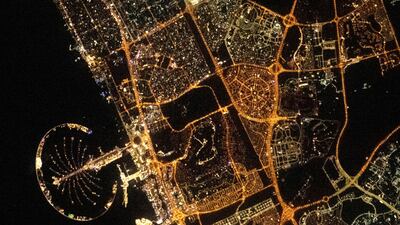
An image of Dubai at night captured by Dr Al Neyadi on May 3, 2023. The photo shows Palm Jumeirah, Jebel Ali Industrial area and large parts of residential areas in Dubai.


