


Russia is mapping critical undersea assets, posing a significant risk that Moscow could attack infrastructure in Europe and North America, Nato’s intelligence chief warned on Wednesday.
“There are heightened concerns that Russia may target undersea cables and other critical infrastructure in an effort to disrupt western life and gain leverage against those nations that are providing support to Ukraine,” David Cattler, Nato’s assistant secretary general for intelligence and security, told reporters.
Nato members have been racing to better protect undersea critical infrastructure after Nord Stream pipelines blasts last autumn highlighted the difficulty of monitoring and identifying attackers.
At issue is protecting systems such as undersea cables, which account for 95 per cent of internet communications and carry an estimated $10 trillion worth of financial transactions every day, Nato says.
“Russia is actively mapping allied critical infrastructure both on land and on the seabed," Mr Cattler said. "This effort is supported by Russia’s military and civilian intelligence services."
He warned of “a persistent and significant risk” that Russia could attack allied systems.
Moscow has blamed “Anglo-Saxon” allies for blowing up the Nord Stream gas pipelines, denying western accusations that it hit its own links.
More incidents in recent months of what appear to be Russian spy ships operating near allied systems have increased concern.
Admiral Henrique Gouveia e Melo, the head of the Portuguese Navy, told state-owned broadcaster RTP in March that a Russian vessel near the Portuguese island region of Madeira was a spy ship that was following and measuring submarine cables.
Russia's Gazprom gas pipelines to Europe - in pictures
-
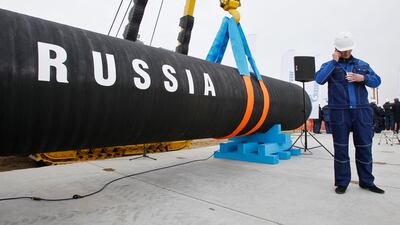
A Russian construction worker speaks on a mobile phone during a ceremony marking the construction of the Nord Stream pipeline in Portovaya Bay, 170 kilometres north-west of St Petersburg in Russia. AP Photo -

A turbine of the Nord Stream 1 pipeline at the Siemens Energy plant in western Germany. AFP -
The logo of Russia's energy giant Gazprom is pictured at one of its petrol stations in Sofia, Bulgaria. AFP -
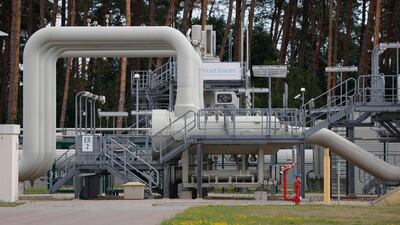
Facilities to receive and distribute natural gas are pictured on the grounds of gas transport and pipeline network operator Cascade in Lubmin, north-eastern Germany, close to the border with Poland. AFP -
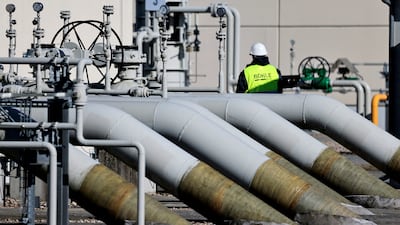
Pipes at the landfall facilities of the 'Nord Stream 1' gas pipeline in Lubmin. Reuters -
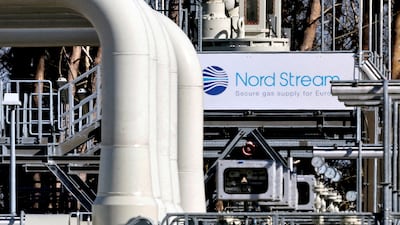
The Nord Stream 1 gas pipeline in Lubmin, Germany. Reuters


A joint investigation published in April by Danish, Finnish, Swedish and Norwegian public broadcasters said that Russian military and civilian ships were mapping seabed infrastructure in the Baltic and North Seas.
Russia’s “patrols into the Atlantic and throughout the Atlantic are at a high level, most of the time at a higher level than what we’ve seen in recent years", Mr Cattler said.
He said Russia appeared to be focusing on undersea infrastructure in the broad Atlantic, the Baltic Sea and the North Sea.
Mr Cattler pointed to Russia’s military strategy — which calls for rapid destruction of critical infrastructure in the early stages of a conflict, a tactic seen in Ukraine — as one reason for the heightened concern.
Moscow’s efforts are led in part by an underwater reconnaissance programme in the Ministry of Defence and are supported by military and civilian intelligence services, with considerable resources at their disposal across the digital, space, air, land and maritime domains, he said.
While China is also active in the domain, Mr Cattler said, it is more interested in buying infrastructure than testing the vulnerabilities of others.
He said threats also existed from terrorists and other groups, particularly where the cables or infrastructure meet land.
Nato recently established an undersea infrastructure co-ordination cell, led by Lt Gen Hans-Werner Wiermann, which aims to boost the security of allied systems by sharing best practices, information and wielding technologies to secure the links.
With monitoring undersea infrastructure a particularly difficult challenge, Gen Wiermann said Nato wants to add another layer of surveillance to its systems to identify suspicious behaviour close to or above critical undersea cables, pipelines and connectors by analysing signal data that could point to tampering.

