



King Charles III made history by attending his first commissioning parade as sovereign at Sandhurst on Friday.
The monarch also gave the military academy the honour of being the first unit to receive new colours bearing his unique “CRIII” cypher.
A Kuwaiti soldier, Officer Cadet Jabar Alasabah, also received the “International Sword” awarded to the overseas cadet considered by Sandhurst’s commandant to be the best of their intake.
Addressing the 600 cadets on parade and their families looking on from the stands, the king recalled his own experiences at Sandhurst.
“I think I have some idea of the challenges which are inherent of military training,” he told them during a murky, overcast day.

“I have experienced the nerves, exhaustion even the self-doubt, but despite such recollections it is the lifelong friendships which are forged through shared hardship and the humour that you find in the darkest hours of the coldest and wettest nights which remain with you.”
The monarch also referred to the Ukraine conflict, which he described as a war not seen on such a scale in Europe since 1945.

“I am particularly impressed and proud of the role the British Army alongside wider Defence has played in supporting Ukraine,” he said. “The UK has been a leading nation in delivering training expertise, equipment, and advice. Through discussions I had with President Zelenskyy I have learnt at first-hand about this support. For as long as the conflict endures you will, no doubt, have some part to play in our unrelenting support.”
The ceremony was also attended by Jordan's King Abdullah II and Crown Prince Hussein Bin Abdullah, who are both Sandhurst graduates.
King Abdullah presented the academy’s Al Hussein Medal, awarded to the non-British cadet who showed the most significant improvement in performance during training, to Bahraini Officer Cadet Sheikh Al Waleed Khalid Ahmed Al Khalifa
He also met King Charles and Grand Duke Henri of Luxembourg on the sidelines of the ceremony.
-
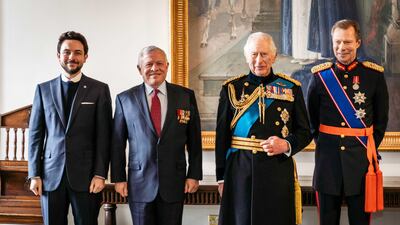
Jordan's King Abdullah II, accompanied by Crown Prince Al Hussein, meets with Britain's King Charles III and Grand Duke Henri of Luxembourg, on the sidelines of Sandhurst’s 200th Sovereign’s Parade in the UK. All photos: Royal Hashemite Court -

King Abdullah presents Sandhurst’s Al Hussein Medal to Bahraini Officer Cadet Sheikh Al Waleed Khalid Ahmed Al Khalifa, awarded to non-British cadets who showed the most significant improvement in performance during training -
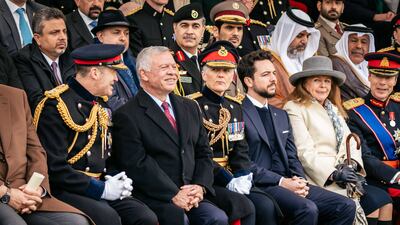
King Abdullah and Crown Prince Al Hussein, pictured centre -

The parade marks the end of 44 weeks of training for 171 cadets -

King Abdullah graduated from Sandhurst in 1981


Friday's ceremony also marked the 200th anniversary of the academy’s commissioning parade, along with the 40,000th officer cadet to pass out from the academy since 1947.
The colours, that in earlier conflicts were the flag rallying point for troops on the battlefield, were the first to be presented to the British armed forces bearing the new sovereign’s cypher.
A total of 177 Officer cadets of the Senior Division, including 26 international cadets from 15 countries, passed out to become commissioned officers in either the British army or their own country’s military on Friday.
The king was escorted by the Commandant, Major General Zac Stenning, who previously served on operations in both Iraq and Afghanistan. “It was with an immense sense of pride and honour that His Majesty came here to our academy and awarded us colours and a new Sovereign’s Banner, the first for British defence,” he said.

