Laila Haidari went from restaurateur to education activist overnight

Turning bullets into beauty: Afghan enterprise keeps girls in school


  • English
  • Arabic

Laila Haidari was a trailblazer before 2021 and is still making waves under Taliban rule — if under the cover of secrecy.

Before the collapse of the previous Afghan government, the 43-year-old owned and operated a popular restaurant.

The Taj Begum was known for its progressiveness, allowing both men and women to dine together regardless of marital status and for female customers to do without a hijab.

The profits generated from the restaurant went towards supporting the Mother Camp drug rehabilitation clinic, which she founded.

But her entrepreneurial spirit risked being quashed when an employee called in August 2021 to say the Taliban had seized control of Kabul. Ms Haidari said she was in a state of “shock, and believed that the arrival of the apocalypse was imminent.”

“I felt as though an earthquake had struck and taken everything away from me,” she said of her beloved restaurant closing. But leaving with the thousands of others fearing a return to the Taliban's brutal rule of the 1990s was not an option.

Bullets serve as a tragic reminder of the destruction that war and conflict bring to our lives, cities, and hopes
Laila Haidari

“I chose to remain in Afghanistan and provide a safety umbrella for some of the millions of women who had nowhere else to go, as everyone was engulfed by a paralysing sense of helplessness,” she said.

“Half of society has been wiped out from the face of the earth. As a woman, I have taken it upon myself to act not only for my own benefit, but for the benefit of all women.”

Rising from the ashes

Laila Haidari trains young Afghan women to bring in income through art. MEC

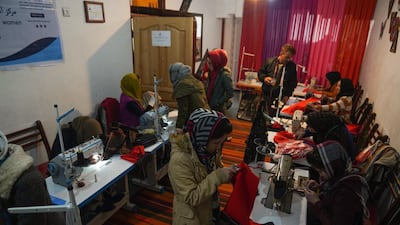
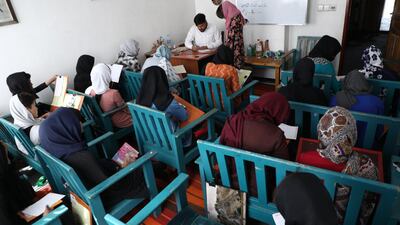
Ms Haidari sprang into action, founding the Mother Educational Centre (MEC). The centre provides an opportunity for 500 girls to receive education in diverse subjects, such as photography, jewellery design, painting, maths, physics and the English language.

When MEC first opened, there were two centres, one hidden away in the backstreets of Kabul, another in the central Afghan province of Daikundi. Due to a lack of funds, the Daikundi outpost shut down last year, but girls still attend classes in the capital.

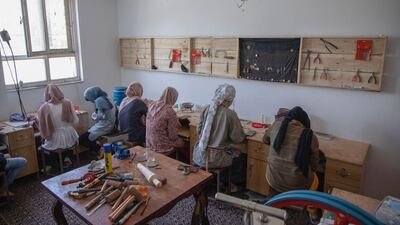
They are not only learning valuable skills in diverse subjects, but also beginning to earn an income from making jewellery and other items from discarded ammunition.

In most other nations, ammunition would be hard to come by. But in Afghanistan, scarred by 40 years of almost consecutive conflict, a number of shops sell decommissioned arms ranging from the Soviet era to the US invasion.

The jewellery has been exhibited in Paris and exported to be sold internationally, funding the MEC's work.

  • Before the Taliban's ascent to power in Afghanistan in 2021, Laila Haidari was a trailblazer and operated a popular restaurant known for its progressive policies. Photos: Mother Education Centre
    Before the Taliban's ascent to power in Afghanistan in 2021, Laila Haidari was a trailblazer and operated a popular restaurant known for its progressive policies. Photos: Mother Education Centre
  • Ms Haidari now runs Mother Educational Centre in Kabul that provides education to girls in diverse subjects such as photography, jewellery design, painting, math, physics and English language
    Ms Haidari now runs Mother Educational Centre in Kabul that provides education to girls in diverse subjects such as photography, jewellery design, painting, math, physics and English language
  • More than 500 girls at the centre are also learning to earn an income from making jewllery and other items from discarded ammunition
    More than 500 girls at the centre are also learning to earn an income from making jewllery and other items from discarded ammunition
  • A piece of jewellery made from discarded ammunition
    A piece of jewellery made from discarded ammunition
  • The jewellery designed by Ms Haidari students has been exhibited in Paris
    The jewellery designed by Ms Haidari students has been exhibited in Paris
  • Some of items prepared by Ms Haidari's students are sold in international markets to fund the centre's work
    Some of items prepared by Ms Haidari's students are sold in international markets to fund the centre's work
  • The location of the centre is kept secret
    The location of the centre is kept secret
  • 'We use discarded ammunition to express our resolute rejection of war and conflict', says Ms Haidari
    'We use discarded ammunition to express our resolute rejection of war and conflict', says Ms Haidari

The use of ammunition as a material for jewellery provides a powerful message of transformation and resilience.

“Bullets serve as a tragic reminder of the destruction that war and conflict bring to our lives, cities, and hopes. We use discarded ammunition to express our resolute rejection of war and conflict,” Ms Haidari said.

“It is quite conceivable that over the past four decades of war, the number of bullets acquired or gifted to us surpasses that of any other commodity.”

Each artwork originating from the MEC in Afghanistan reflects a unique story and serves as a testament to the students' remarkable talents and experiences.

Despite facing systemic obstacles and cultural norms that restrict women's access to education and artistic expression, the students at the centre demonstrate resilience by honing their artistic skills and producing powerful works that convey their personal stories and struggles. They are shattering stereotypes and redefining societal expectations of female artists, Ms Haidari said.

“As a woman, my purpose is to assist other women in their battles and help them emerge victorious.”


KINGDOM%20OF%20THE%20PLANET%20OF%20THE%20APES
%3Cp%3E%3Cstrong%3EDirector%3A%3C%2Fstrong%3E%20Wes%20Ball%3C%2Fp%3E%0A%3Cp%3E%3Cstrong%3EStarring%3A%3C%2Fstrong%3E%20Owen%20Teague%2C%20Freya%20Allen%2C%20Kevin%20Durand%3C%2Fp%3E%0A%3Cp%3E%3Cstrong%3ERating%3A%20%3C%2Fstrong%3E3.5%2F5%3C%2Fp%3E%0A
Ten tax points to be aware of in 2026

1. Domestic VAT refund amendments: request your refund within five years

If a business does not apply for the refund on time, they lose their credit.

2. E-invoicing in the UAE

Businesses should continue preparing for the implementation of e-invoicing in the UAE, with 2026 a preparation and transition period ahead of phased mandatory adoption. 

3. More tax audits

Tax authorities are increasingly using data already available across multiple filings to identify audit risks. 

4. More beneficial VAT and excise tax penalty regime

Tax disputes are expected to become more frequent and more structured, with clearer administrative objection and appeal processes. The UAE has adopted a new penalty regime for VAT and excise disputes, which now mirrors the penalty regime for corporate tax.

5. Greater emphasis on statutory audit

There is a greater need for the accuracy of financial statements. The International Financial Reporting Standards standards need to be strictly adhered to and, as a result, the quality of the audits will need to increase.

6. Further transfer pricing enforcement

Transfer pricing enforcement, which refers to the practice of establishing prices for internal transactions between related entities, is expected to broaden in scope. The UAE will shortly open the possibility to negotiate advance pricing agreements, or essentially rulings for transfer pricing purposes. 

7. Limited time periods for audits

Recent amendments also introduce a default five-year limitation period for tax audits and assessments, subject to specific statutory exceptions. While the standard audit and assessment period is five years, this may be extended to up to 15 years in cases involving fraud or tax evasion. 

8. Pillar 2 implementation 

Many multinational groups will begin to feel the practical effect of the Domestic Minimum Top-Up Tax (DMTT), the UAE's implementation of the OECD’s global minimum tax under Pillar 2. While the rules apply for financial years starting on or after January 1, 2025, it is 2026 that marks the transition to an operational phase.

9. Reduced compliance obligations for imported goods and services

Businesses that apply the reverse-charge mechanism for VAT purposes in the UAE may benefit from reduced compliance obligations. 

10. Substance and CbC reporting focus

Tax authorities are expected to continue strengthening the enforcement of economic substance and Country-by-Country (CbC) reporting frameworks. In the UAE, these regimes are increasingly being used as risk-assessment tools, providing tax authorities with a comprehensive view of multinational groups’ global footprints and enabling them to assess whether profits are aligned with real economic activity. 

Contributed by Thomas Vanhee and Hend Rashwan, Aurifer

Updated: April 06, 2023, 1:03 PM