Iraqi Prime Minister Mohammed Shia Al Sudani. Reuters

Al Sudani says he is not opposed to keeping US forces in Iraq


Robert Tollast
  • English
  • Arabic

Iraq’s Prime Minister Mohammed Shia Al Sudani has said he is not opposed to a continued US troop presence in Iraq, a statement that is likely to anger Iran-backed militias aligned to his political coalition.

In an interview with The Wall Street Journal, Mr Al Sudani said that the “elimination of ISIS needs some more time”, when asked about the US troop presence, which has been authorised by the Iraqi government to train the Iraqi army since 2014.

About 2,500 US soldiers remain in Iraq, from a high of over 5,000 during the war against ISIS between 2014 and 2018. The small contingent was deployed to Iraq following a withdrawal of US forces in 2011 after eight years of occupation. At its peak, the force numbered 170,000 in 2007, when Iraq was beset with sectarian violence and fighting between international coalition forces and insurgents.

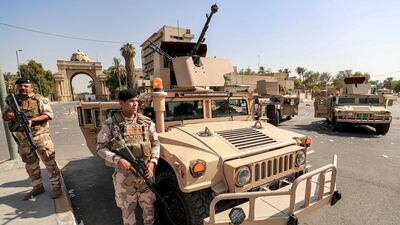
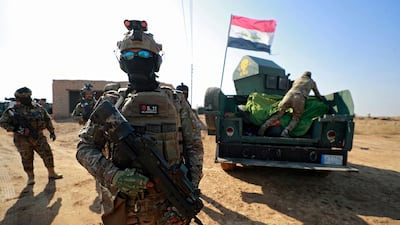
  • Iraqi army forces guard the entrance of the high-security Green Zone in Baghdad. AFP
    Iraqi army forces guard the entrance of the high-security Green Zone in Baghdad. AFP
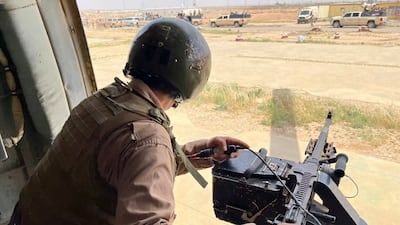
  • An Iraqi army helicopter takes off at a base in Sinjar on a mission to clear out a Kurdish-linked militia. AP
    An Iraqi army helicopter takes off at a base in Sinjar on a mission to clear out a Kurdish-linked militia. AP
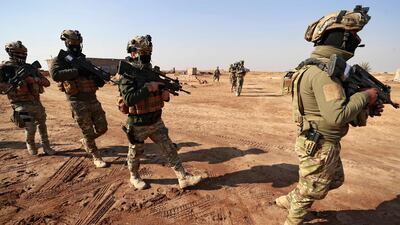
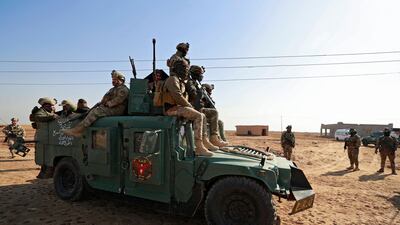
  • Iraq's Rapid Intervention forces patrol a village in the Hawi Al Azim area of Diyala province. AFP
    Iraq's Rapid Intervention forces patrol a village in the Hawi Al Azim area of Diyala province. AFP
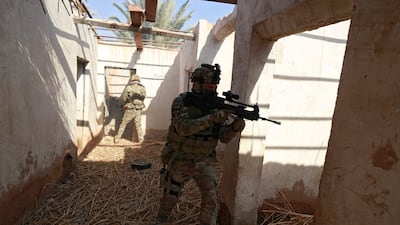
  • Iraqi forces inspect a structure in a village in Diyala. AFP
    Iraqi forces inspect a structure in a village in Diyala. AFP
  • Soldiers patrolling in Diyala province. AFP
    Soldiers patrolling in Diyala province. AFP
  • Members of Iraq's Rapid Intervention forces in a village in the Hawi Al Azim area. AFP
    Members of Iraq's Rapid Intervention forces in a village in the Hawi Al Azim area. AFP
  • Iraqi forces patrol in Diyala province. AFP
    Iraqi forces patrol in Diyala province. AFP
  • Iraqi forces in the Hawi Al Azim area. AFP
    Iraqi forces in the Hawi Al Azim area. AFP
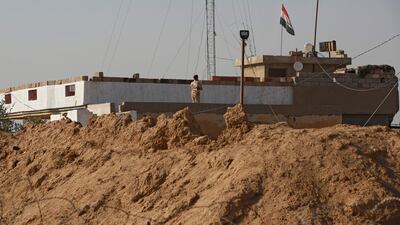
  • A military base in Diyala that was attacked by ISIS. AFP
    A military base in Diyala that was attacked by ISIS. AFP
  • Military vehicles at Al Waleed air base near Al Tanf in Iraq. Reuters
    Military vehicles at Al Waleed air base near Al Tanf in Iraq. Reuters

In the interim period, between December 2011 and the summer of 2014, ISIS attacks surged throughout Iraq.

During the war to defeat the group, small contingents of coalition forces assisted the Baghdad government and Kurdish Peshmerga forces in the semi-autonomous Kurdish region.

US-Iran rivalry

Despite their role being almost entirely limited to training — some coalition special forces were deployed on combat missions with Iraqi government permission — their involvement in the war was strongly opposed by Iran-linked political parties and militias.

The militias were part of a coalition of groups known as the Popular Mobilisation Forces linked to the largest political bloc in Iraq’s parliament, the Co-ordination Framework.

During the war to expel ISIS from Iraqi cities, Iran-backed militias refrained from launching attacks on Coalition forces. But as soon as ISIS attacks plummeted, after the battle of Mosul in 2017, the PMF stepped up attacks.

There followed two years of violence between the US and the militias, escalating until a US military contractor was killed in December 2019.

The US then launched a drone strike on the leader of the PMF, Abu Mahdi Al Muhandis and Iranian Quds Force general Qassem Suleimani, killing them both.

Earlier this month, Mr Al Sudani attended a memorial service for both of the men, alongside the president of Iraq Latif Rashid and the head of Iraq’s judiciary, Faiq Zaidan.

The PMF and allied politicians aligned to Mr Al Sudani, most notably Qais Al Khazali — who founded the US-designated terror group Asaib Ahl Al Haq — continue to insist that US forces leave Iraq. Mr Al Khazali’s Sadiqun party now controls the higher education ministry.

Successive Iraqi governments have resisted their demands, saying the foreign forces provide important support to stop an ISIS resurgence.

Since losing its last urban stronghold of Mosul in 2017, the group has been confined to remote, rugged terrain, launching only sporadic attacks.

Mr Al Sudani said in the interview that he believed Iraq could maintain good ties with both Iran and the US, something multiple Iraqi governments have attempted over the past 10 years.

“I don’t see this as an impossible matter, to see Iraq have a good relationship with Iran and the US,” Mr Al Sudani told the newspaper.


Generation Start-up: Awok company profile

Started: 2013

Founder: Ulugbek Yuldashev

Sector: e-commerce

Size: 600 plus

Stage: still in talks with VCs

Principal Investors: self-financed by founder

Ten tax points to be aware of in 2026

1. Domestic VAT refund amendments: request your refund within five years

If a business does not apply for the refund on time, they lose their credit.

2. E-invoicing in the UAE

Businesses should continue preparing for the implementation of e-invoicing in the UAE, with 2026 a preparation and transition period ahead of phased mandatory adoption. 

3. More tax audits

Tax authorities are increasingly using data already available across multiple filings to identify audit risks. 

4. More beneficial VAT and excise tax penalty regime

Tax disputes are expected to become more frequent and more structured, with clearer administrative objection and appeal processes. The UAE has adopted a new penalty regime for VAT and excise disputes, which now mirrors the penalty regime for corporate tax.

5. Greater emphasis on statutory audit

There is a greater need for the accuracy of financial statements. The International Financial Reporting Standards standards need to be strictly adhered to and, as a result, the quality of the audits will need to increase.

6. Further transfer pricing enforcement

Transfer pricing enforcement, which refers to the practice of establishing prices for internal transactions between related entities, is expected to broaden in scope. The UAE will shortly open the possibility to negotiate advance pricing agreements, or essentially rulings for transfer pricing purposes. 

7. Limited time periods for audits

Recent amendments also introduce a default five-year limitation period for tax audits and assessments, subject to specific statutory exceptions. While the standard audit and assessment period is five years, this may be extended to up to 15 years in cases involving fraud or tax evasion. 

8. Pillar 2 implementation 

Many multinational groups will begin to feel the practical effect of the Domestic Minimum Top-Up Tax (DMTT), the UAE's implementation of the OECD’s global minimum tax under Pillar 2. While the rules apply for financial years starting on or after January 1, 2025, it is 2026 that marks the transition to an operational phase.

9. Reduced compliance obligations for imported goods and services

Businesses that apply the reverse-charge mechanism for VAT purposes in the UAE may benefit from reduced compliance obligations. 

10. Substance and CbC reporting focus

Tax authorities are expected to continue strengthening the enforcement of economic substance and Country-by-Country (CbC) reporting frameworks. In the UAE, these regimes are increasingly being used as risk-assessment tools, providing tax authorities with a comprehensive view of multinational groups’ global footprints and enabling them to assess whether profits are aligned with real economic activity. 

Contributed by Thomas Vanhee and Hend Rashwan, Aurifer

Company%20profile
%3Cp%3E%3Cstrong%3ECompany%20name%3A%20%3C%2Fstrong%3EHakbah%0D%3Cbr%3E%3Cstrong%3EStarted%3A%20%3C%2Fstrong%3E2018%0D%3Cbr%3E%3Cstrong%3EFounder%3A%20%3C%2Fstrong%3ENaif%20AbuSaida%0D%3Cbr%3E%3Cstrong%3EBased%3A%20%3C%2Fstrong%3ESaudi%20Arabia%0D%3Cbr%3E%3Cstrong%3ESector%3A%20%3C%2Fstrong%3EFinTech%0D%3Cbr%3E%3Cstrong%3ECurrent%20number%20of%20staff%3A%20%3C%2Fstrong%3E22%20%0D%3Cbr%3E%3Cstrong%3EInitial%20investment%3A%20%3C%2Fstrong%3E%24200%2C000%0D%3Cbr%3E%3Cstrong%3EInvestment%20stage%3A%20%3C%2Fstrong%3Epre-Series%20A%0D%3Cbr%3E%3Cstrong%3EInvestors%3A%20%3C%2Fstrong%3EGlobal%20Ventures%20and%20Aditum%20Investment%20Management%0D%3Cbr%3E%3Cbr%3E%3C%2Fp%3E%0A
Tips for entertaining with ease

·         Set the table the night before. It’s a small job but it will make you feel more organised once done.

·         As the host, your mood sets the tone. If people arrive to find you red-faced and harried, they’re not going to relax until you do. Take a deep breath and try to exude calm energy.

·         Guests tend to turn up thirsty. Fill a big jug with iced water and lemon or lime slices and encourage people to help themselves.

·         Have some background music on to help create a bit of ambience and fill any initial lulls in conversations.

·         The meal certainly doesn’t need to be ready the moment your guests step through the door, but if there’s a nibble or two that can be passed around it will ward off hunger pangs and buy you a bit more time in the kitchen.

·         You absolutely don’t have to make every element of the brunch from scratch. Take inspiration from our ideas for ready-made extras and by all means pick up a store-bought dessert.


In-demand jobs and monthly salaries
  • Technology expert in robotics and automation: Dh20,000 to Dh40,000 
  • Energy engineer: Dh25,000 to Dh30,000 
  • Production engineer: Dh30,000 to Dh40,000 
  • Data-driven supply chain management professional: Dh30,000 to Dh50,000 
  • HR leader: Dh40,000 to Dh60,000 
  • Engineering leader: Dh30,000 to Dh55,000 
  • Project manager: Dh55,000 to Dh65,000 
  • Senior reservoir engineer: Dh40,000 to Dh55,000 
  • Senior drilling engineer: Dh38,000 to Dh46,000 
  • Senior process engineer: Dh28,000 to Dh38,000 
  • Senior maintenance engineer: Dh22,000 to Dh34,000 
  • Field engineer: Dh6,500 to Dh7,500
  • Field supervisor: Dh9,000 to Dh12,000
  • Field operator: Dh5,000 to Dh7,000
Skoda Superb Specs

Engine: 2-litre TSI petrol

Power: 190hp

Torque: 320Nm

Price: From Dh147,000

Available: Now

THE BIO

Ms Davison came to Dubai from Kerala after her marriage in 1996 when she was 21-years-old

Since 2001, Ms Davison has worked at many affordable schools such as Our Own English High School in Sharjah, and The Apple International School and Amled School in Dubai

Favourite Book: The Alchemist

Favourite quote: Failing to prepare is preparing to fail

Favourite place to Travel to: Vienna

Favourite cuisine: Italian food

Favourite Movie : Scent of a Woman


Real estate tokenisation project

Dubai launched the pilot phase of its real estate tokenisation project last month.

The initiative focuses on converting real estate assets into digital tokens recorded on blockchain technology and helps in streamlining the process of buying, selling and investing, the Dubai Land Department said.

Dubai’s real estate tokenisation market is projected to reach Dh60 billion ($16.33 billion) by 2033, representing 7 per cent of the emirate’s total property transactions, according to the DLD.

The Perfect Couple

Starring: Nicole Kidman, Liev Schreiber, Jack Reynor

Creator: Jenna Lamia

Rating: 3/5

SPECS

Mini John Cooper Works Clubman and Mini John Cooper Works Countryman

Engine: two-litre 4-cylinder turbo

Transmission: nine-speed automatic

Power: 306hp

Torque: 450Nm

Price: JCW Clubman, Dh220,500; JCW Countryman, Dh225,500

Updated: January 15, 2023, 6:01 PM