Outside India's biggest hospital, patients and homeless huddle together during cold snap


Taniya Dutta
  • English
  • Arabic

On a freezing marble pavement outside India’s biggest hospital in the capital New Delhi, Reena Devi optimistically keeps an eye on a nearby government-run shelter home as his ailing son shivers in the bitter cold.

Ms Devi, 30, this week travelled hundreds of kilometres from eastern Bihar state for treatment for her 12-year-old son Roshan Raj ― who suffers from severe arthritis ― at the All India Institute of Medical Sciences.

But as darkness fell, she once more failed to find a space in the handful of makeshift shelters that authorities run to accommodate desperate outpatients and their families in the winter months when temperatures fall to almost 0ºC in the city.

  • Dozens of people including patients seeking treatment at Delhi's hospitals are forced to sleep on the pavement, at bus stands and in subways in unhygienic conditions amid the harsh cold. All photos: Taniya Dutta / The National
    Dozens of people including patients seeking treatment at Delhi's hospitals are forced to sleep on the pavement, at bus stands and in subways in unhygienic conditions amid the harsh cold. All photos: Taniya Dutta / The National
  • Patients at the All India Institute of Medical Sciences are forced to sleep outdoors in temperatures as loow as freezing
    Patients at the All India Institute of Medical Sciences are forced to sleep outdoors in temperatures as loow as freezing
  • Shelters have capacity for about 17,000 people, and beds are allotted on a first-come-first-served basis. This leaves thousands more still on the streets in the cold
    Shelters have capacity for about 17,000 people, and beds are allotted on a first-come-first-served basis. This leaves thousands more still on the streets in the cold
  • Dozens of people including patients seeking treatment at Delhi's hospitals are forced to sleep on the pavement, at bus stands and in subways in unhygienic conditions amid the harsh cold
    Dozens of people including patients seeking treatment at Delhi's hospitals are forced to sleep on the pavement, at bus stands and in subways in unhygienic conditions amid the harsh cold
  • Reena Devi, 30, and her son Roshan Raj, 12, who has arthritis, outside the All India Institute of Medical Sciences
    Reena Devi, 30, and her son Roshan Raj, 12, who has arthritis, outside the All India Institute of Medical Sciences
  • A mother holds her baby among a sea of sleeping people at an underpass in Delhi
    A mother holds her baby among a sea of sleeping people at an underpass in Delhi
  • Pavements, bus stands and subways are packed with people seeking shelter
    Pavements, bus stands and subways are packed with people seeking shelter
  • A thick blanket of morning fog has engulfed the city for weeks, disrupting flights and rail transport
    A thick blanket of morning fog has engulfed the city for weeks, disrupting flights and rail transport
  • A long waiting list and lack of accommodation for hundreds of outpatients means spending nights in the open outside the hospital
    A long waiting list and lack of accommodation for hundreds of outpatients means spending nights in the open outside the hospital
  • Volunteers hand out food on the streets as temperatures drop
    Volunteers hand out food on the streets as temperatures drop
  • Dozens of people including patients seeking treatment at Delhi's hospitals are forced to sleep on the pavement, at bus stands and in subways in unhygienic conditions amid the harsh cold
    Dozens of people including patients seeking treatment at Delhi's hospitals are forced to sleep on the pavement, at bus stands and in subways in unhygienic conditions amid the harsh cold
  • Dozens of people including patients seeking treatment at Delhi's hospitals are forced to sleep on the pavement, at bus stands and in subways in unhygienic conditions amid the harsh cold
    Dozens of people including patients seeking treatment at Delhi's hospitals are forced to sleep on the pavement, at bus stands and in subways in unhygienic conditions amid the harsh cold

“The cold is biting our bones. It is unbearable. My child is already ill and I am worried about his health. The blanket is not enough but I cannot afford more warm clothes,” Ms Devi told The National.

“I could only afford to buy train tickets but have no money to rent a place. We don’t know how long we will have to sleep outside in this harsh weather,” she said.

Ms Devi is one of the thousands of caretakers who bring family members with life-threatening diseases to AIIMS for advanced treatment at nominal costs.

The premier government institute receives close to 10,000 new cases every day and accommodates more than 2,000 inpatients, but a long waiting list and lack of accommodation for hundreds of outpatients means spending nights in the open outside the hospital.

Renting a place or a hotel is an additional financial burden for outpatient families who are mostly engaged in daily wage labour, like Ms Devi’s husband, or do menial jobs and can barely afford food and medicines.

Dozens of people, including patients seeking treatment at the hospital, are forced to sleep on the pavements, bus stands, and pedestrian subways in unhygienic conditions while battling the bitter cold.

Reena Devi, 30, and her son Roshan Raj, 12, who has arthritis, outside the All India Institute of Medical Sciences. Photo: Taniya Dutta / The National

Delhi has been in the grip of a cold wave since the beginning of January and the mercury dipped to the season’s lowest on Thursday, 3.3ºC.

A thick blanket of morning fog has engulfed the city for weeks, disrupting flights and rail transport.

Schools have been shut and doctors are advising people to stay inside and keep warm.

The weather department is predicting that temperatures could drop further this month.

Thousands of homeless trapped outdoors as temperatures plummet

A woman eats while she settles down for the night outside the hospital. Taniya Dutta / The National

But for thousands of desperate patients, their caretakers, like Ms Devi, as well as the city's huge population of homeless, there is no reprieve.

Delhi has an estimated 150,000 homeless and every year, scores of them die because of the cold and related conditions.

The New Delhi government, ruled by the Aam Aadmi Party, in November set up 195 night shelters in the city, but they are almost always packed.

The shelters have capacity for about 17,000 people, and beds are allotted on a first-come-first-served basis, leaving tens of thousands to suffer in the bone-chilling cold.

“I was expecting to get a bed but the caretaker said all of them are occupied. There should be more shelters or beds added so more people can stay in shelters,” Ms Devi told The National.

"Those who have beds won’t leave them easily because it is very cold outside", she said.

For the past week, Anil Kumar, 45, has slept in an underpass outside the government-run Safdarjung Hospital, just across from the AIIMS ― a common spot for outpatients who spend hours looking for a space in reeking subways, bus stands and on pavements ― at times fighting and jostling with others for space.

Dozens of people in New Delhi sleep on pavements, in bus stands and pedestrian subways. Photo: Taniya Dutta / The National

The cold is excruciating, but Mr Kumar says he has spent all his savings on treatment for his wife, who has tuberculosis.

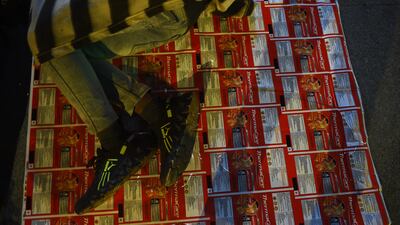
Every night, he asks medical shops for cardboard boxes. He then opens them carefully and lays them out on the stone floor — his makeshift bed.

“I sleep on it. What else can I do? My wife has TB. I cannot leave her alone here and go to a hotel. I don’t have money. I have two small kids to look after,” said Mr Kumar, who came from Bulandshahar in neighbouring Uttar Pradesh.

The crisis repeats year after year in the city where the government claims and promises that sufficient space for the patients and their caretakers is available.

But scenes from busy stretches near the hospitals provide a more accurate picture.

Rows of plastic sheets tied to the hospital boundary walls are used as camps by desperate women and children to protect themselves from the chilly winds.

Many make bonfires out of plastic and paper rubbish to keep themselves warm.

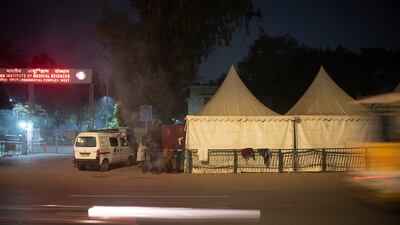
The lucky few sleep in makeshift shelters. Photo: Taniya Dutta / The National

Nitin Singh, 20, a caretaker at one of two shelter homes outside Safdarjung Hospital said that he feels helpless when people come to him.

A bed is allotted for a maximum of two weeks. For patients, they need to show the hospital slips, duration of the treatment, or urgency.

“There are 40 beds in this shelter. One bed can be used by two persons, say a mother and her child. We also welcome homeless people and provide them with blankets, food and water. But I don’t feel the number of beds are enough for the needy,” Mr Singh told The National.

“Throughout the day people come to me, they stand outside and beg me for a bed. I feel helpless. I can’t fit them all inside because there is limited space,” he said.




Company profile

Company name: Dharma

Date started: 2018

Founders: Charaf El Mansouri, Nisma Benani, Leah Howe

Based: Abu Dhabi

Sector: TravelTech

Funding stage: Pre-series A 

Investors: Convivialite Ventures, BY Partners, Shorooq Partners, L& Ventures, Flat6Labs

War and the virus
hall of shame

SUNDERLAND 2002-03

No one has ended a Premier League season quite like Sunderland. They lost each of their final 15 games, taking no points after January. They ended up with 19 in total, sacking managers Peter Reid and Howard Wilkinson and losing 3-1 to Charlton when they scored three own goals in eight minutes.

SUNDERLAND 2005-06

Until Derby came along, Sunderland’s total of 15 points was the Premier League’s record low. They made it until May and their final home game before winning at the Stadium of Light while they lost a joint record 29 of their 38 league games.

HUDDERSFIELD 2018-19

Joined Derby as the only team to be relegated in March. No striker scored until January, while only two players got more assists than goalkeeper Jonas Lossl. The mid-season appointment Jan Siewert was to end his time as Huddersfield manager with a 5.3 per cent win rate.

ASTON VILLA 2015-16

Perhaps the most inexplicably bad season, considering they signed Idrissa Gueye and Adama Traore and still only got 17 points. Villa won their first league game, but none of the next 19. They ended an abominable campaign by taking one point from the last 39 available.

FULHAM 2018-19

Terrible in different ways. Fulham’s total of 26 points is not among the lowest ever but they contrived to get relegated after spending over £100 million (Dh457m) in the transfer market. Much of it went on defenders but they only kept two clean sheets in their first 33 games.

LA LIGA: Sporting Gijon, 13 points in 1997-98.

BUNDESLIGA: Tasmania Berlin, 10 points in 1965-66

Medicus AI

Started: 2016

Founder(s): Dr Baher Al Hakim, Dr Nadine Nehme and Makram Saleh

Based: Vienna, Austria; started in Dubai

Sector: Health Tech

Staff: 119

Funding: €7.7 million (Dh31m)


Western Region Asia Cup T20 Qualifier

Sun Feb 23 – Thu Feb 27, Al Amerat, Oman

The two finalists advance to the Asia qualifier in Malaysia in August


Group A

Bahrain, Maldives, Oman, Qatar

Group B

UAE, Iran, Kuwait, Saudi Arabia


UAE group fixtures

Sunday Feb 23, 9.30am, v Iran

Monday Feb 25, 1pm, v Kuwait

Tuesday Feb 26, 9.30am, v Saudi


UAE squad

Ahmed Raza, Rohan Mustafa, Alishan Sharafu, Ansh Tandon, Vriitya Aravind, Junaid Siddique, Waheed Ahmed, Karthik Meiyappan, Basil Hameed, Mohammed Usman, Mohammed Ayaz, Zahoor Khan, Chirag Suri, Sultan Ahmed

David Haye record

Total fights: 32
Wins: 28
Wins by KO: 26
Losses: 4

MATCH INFO

Champions League quarter-final, first leg

Ajax v Juventus, Wednesday, 11pm (UAE)

Match on BeIN Sports

Safety 'top priority' for rival hyperloop company

The chief operating officer of Hyperloop Transportation Technologies, Andres de Leon, said his company's hyperloop technology is “ready” and safe.

He said the company prioritised safety throughout its development and, last year, Munich Re, one of the world's largest reinsurance companies, announced it was ready to insure their technology.

“Our levitation, propulsion, and vacuum technology have all been developed [...] over several decades and have been deployed and tested at full scale,” he said in a statement to The National.

“Only once the system has been certified and approved will it move people,” he said.

HyperloopTT has begun designing and engineering processes for its Abu Dhabi projects and hopes to break ground soon. 

With no delivery date yet announced, Mr de Leon said timelines had to be considered carefully, as government approval, permits, and regulations could create necessary delays.

Friday’s fixture

6.15pm: Al Wahda v Hatta

6.15pm: Al Dhafra v Ajman

9pm: Al Wasl v Baniyas

9pm: Fujairah v Sharjah

.

Nayanthara: Beyond The Fairy Tale

Starring: Nayanthara, Vignesh Shivan, Radhika Sarathkumar, Nagarjuna Akkineni

Director: Amith Krishnan

Rating: 3.5/5

Honeymoonish
%3Cp%3E%3Cstrong%3EDirector%3A%3C%2Fstrong%3E%20Elie%20El%20Samaan%3C%2Fp%3E%0A%3Cp%3E%3Cstrong%3EStarring%3A%20%3C%2Fstrong%3ENour%20Al%20Ghandour%2C%20Mahmoud%20Boushahri%3C%2Fp%3E%0A%3Cp%3E%3Cstrong%3ERating%3A%3C%2Fstrong%3E%203%2F5%3C%2Fp%3E%0A
What it means to be a conservationist

Who is Enric Sala?

Enric Sala is an expert on marine conservation and is currently the National Geographic Society's Explorer-in-Residence. His love of the sea started with his childhood in Spain, inspired by the example of the legendary diver Jacques Cousteau. He has been a university professor of Oceanography in the US, as well as working at the Spanish National Council for Scientific Research and is a member of the World Economic Forum’s Global Future Council on Biodiversity and the Bio-Economy. He has dedicated his life to protecting life in the oceans. Enric describes himself as a flexitarian who only eats meat occasionally.

What is biodiversity?

According to the United Nations Environment Programme, all life on earth – including in its forests and oceans – forms a “rich tapestry of interconnecting and interdependent forces”. Biodiversity on earth today is the product of four billion years of evolution and consists of many millions of distinct biological species. The term ‘biodiversity’ is relatively new, popularised since the 1980s and coinciding with an understanding of the growing threats to the natural world including habitat loss, pollution and climate change. The loss of biodiversity itself is dangerous because it contributes to clean, consistent water flows, food security, protection from floods and storms and a stable climate. The natural world can be an ally in combating global climate change but to do so it must be protected. Nations are working to achieve this, including setting targets to be reached by 2020 for the protection of the natural state of 17 per cent of the land and 10 per cent of the oceans. However, these are well short of what is needed, according to experts, with half the land needed to be in a natural state to help avert disaster.

Updated: January 06, 2023, 6:25 AM